The Accidental Invention of Popsicles by an 11-Year-Old Boy
How a child's forgotten soda experiment created a billion-dollar frozen treat industry
 Watch on YouTube
 Watch on Rumble
In 1905, an 11-year-old boy named Frank Epperson unintentionally invented one of summer’s most beloved treats when he accidentally left a mixture of powdered soda and water with a stirring stick on his porch overnight during a San Francisco winter freeze. The result was a frozen confection on a handle that would eventually become a multi-billion-dollar industry, a subject of materials science research, and a cultural symbol recognized across dozens of countries. Yet for nearly two decades, it was nothing more than a half-forgotten childhood memory.
What makes this story particularly surprising is not just that a child invented the popsicle, but that he initially did nothing with his discovery for 18 years. Epperson rediscovered his invention as an adult in 1923, when he began selling what he called “Epsicles” at Neptune Beach, an amusement park in Alameda, California. The journey from that cold porch in San Francisco to a global phenomenon is a story filled with legal oddities, industrial science, cultural adaptation, and the strange mechanics of how history decides who deserves credit for an idea.
The Curious Origins of a Frozen Phenomenon
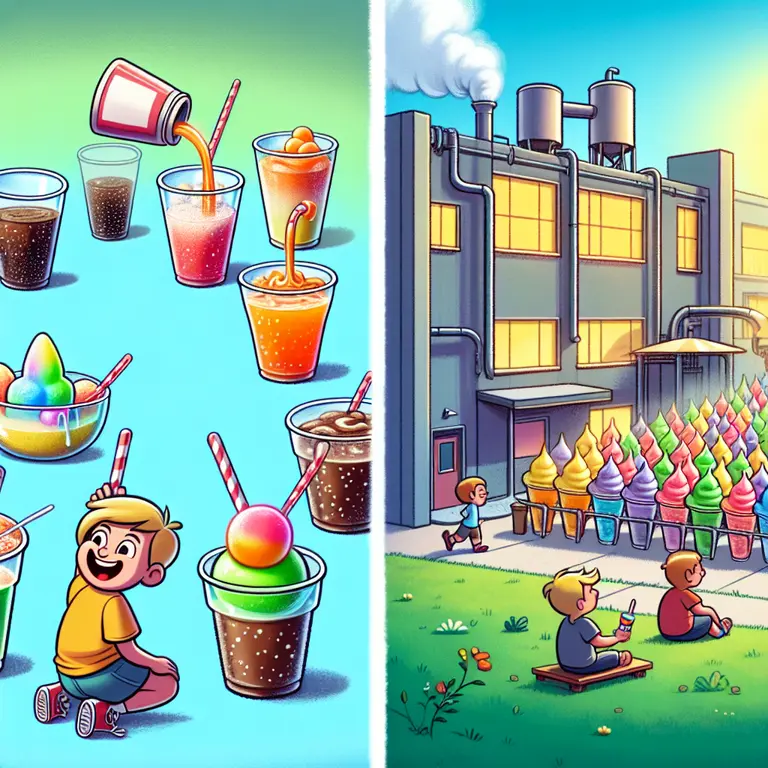
The winter of 1905 in San Francisco was particularly cold, with temperatures dropping below freezing — an unusual occurrence for the typically mild Bay Area climate. Young Frank Epperson had been experimenting with making his own soda by mixing flavored powder with water, a popular pastime for children during this era, when homemade concoctions served as affordable alternatives to commercial beverages. Store-bought sodas existed but were not yet the ubiquitous household staple they would later become, and children across America routinely improvised their own versions using cheaply priced flavored powders sold at general stores.
After mixing his soda on the family porch, Frank became distracted — perhaps called in for dinner or homework — and left his cup of soda water with the wooden stirring stick still in it. The next morning, he discovered that the overnight freeze had transformed his forgotten mixture into something entirely new: a frozen treat conveniently attached to a handle. The discovery was the kind of happy accident that required no particular genius to appreciate. Even an 11-year-old could recognize that a frozen flavored block with a built-in grip was more useful and enjoyable than a frozen block without one.
The accidental invention might have remained just a childhood memory had Epperson not revisited the concept years later. During the intervening decades, he grew up, entered the Bay Area real estate business, and started a family of his own. It was not until 1923, while serving his own children frozen treats inspired by his childhood accident, that he recognized the commercial potential of his creation. His children’s enthusiastic response to what they called “Pop’s sicle” convinced him that others might enjoy the treat just as much. The name stuck, and within a year, Epperson had applied for a patent and begun selling the product at a local amusement park. The transition from a forgotten childhood experiment to a commercial product took less than a year once he committed to the idea, suggesting that the concept was so immediately intuitive that it needed little refinement to be marketable.
The Business Oddities Behind the Popsicle
Epperson’s frozen treat on a stick quickly gained popularity, but the financial history of the popsicle took several bizarre turns that few people are aware of today. Despite patenting his invention in 1924 under the name “frozen ice on a stick,” Epperson ended up selling the rights to the Popsicle to the Joe Lowe Company of New York for an undisclosed sum. The exact circumstances of the sale remain somewhat murky, but historical accounts suggest that Epperson was facing financial difficulties related to his real estate ventures during the volatile mid-1920s, which may have pressured him into accepting less-than-favorable terms. While the invention eventually made millions for its corporate owners, Epperson himself never achieved significant wealth from his creation, a fate shared by many inventors throughout history who lacked the capital or legal resources to fully exploit their own ideas.
In an unexpected legal twist, the Popsicle Corporation and Good Humor — maker of the famous chocolate-coated ice cream bars — became embroiled in a territorial lawsuit in the 1930s over the market for frozen treats on sticks. The settlement produced one of the stranger distinctions in American food history: Popsicle could sell frozen treats only with two sticks, marketed as twin popsicles to be broken in half and shared, while Good Humor maintained exclusive rights to single-stick frozen desserts. This legal constraint, born of corporate rivalry rather than any consumer research or design philosophy, inadvertently created a cultural ritual that millions of Americans associate with childhood. The act of breaking a popsicle in half and sharing it with a friend or sibling became a defining social gesture, embedding the product more deeply into American life than a single-stick version ever could have. The twin-stick design, initially a legal workaround, transformed into a deliberate social feature that the company eventually marketed as a symbol of sharing and generosity.
The Popsicle brand changed hands multiple times throughout the 20th century, eventually being acquired by Good Humor-Breyers, a division of Unilever — ironically reuniting the once-feuding frozen dessert companies under one corporate umbrella. Throughout these corporate machinations, the basic concept remained remarkably unchanged, demonstrating the enduring appeal of Epperson’s accidental discovery. Very few consumer products survive a century of ownership changes, market shifts, and evolving tastes without fundamental redesign, yet the popsicle has required almost no conceptual modification since a child left a cup on a porch in 1905.
The Material Science Connection
What is often overlooked in popular retellings of the popsicle’s origin story is that the product represents an early, entirely accidental example of food-based crystallization engineering. The freezing process creates ice crystals whose size and distribution determine the texture of the finished product in ways that are not immediately obvious to the casual consumer. Modern popsicle manufacturing involves careful control of freezing rates, since faster freezing produces smaller crystals and a smoother, less grainy texture. Sugar concentrations must also be precisely calibrated because they affect freezing point depression, the phenomenon by which dissolved substances lower the freezing point of a liquid. Stabilizer chemistry plays an equally important role, controlling ice crystal growth during the inevitable temperature fluctuations that occur throughout commercial storage and transportation.
The science behind popsicles has evolved dramatically since Epperson’s day. Contemporary manufacturers employ sophisticated equipment that can freeze thousands of popsicles per hour at precisely controlled temperatures, often using blast-freezing tunnels that drop the product to well below zero Celsius within minutes. Food scientists have developed specialized formulations incorporating hydrocolloids such as locust bean gum and carrageenan, ingredients most consumers have never heard of but are essential for preventing the gritty, crystalline texture that develops when a popsicle is subjected to the warming and re-cooling cycles of a typical household freezer.
This accidental discovery by a child presaged sophisticated industrial processes now studied by materials scientists and food engineers at universities and research institutions worldwide. The humble popsicle demonstrates principles of phase transition, colligative properties, and nucleation that are fundamental to understanding materials far beyond frozen treats, extending into pharmaceuticals, metallurgy, and the production of specialty glass. In this sense, Frank Epperson’s forgotten cup of soda water sits at the beginning of a surprisingly long intellectual lineage.
Cultural Impact and Global Variations
The popsicle concept spread globally throughout the 20th century, adapting to local tastes, agricultural traditions, and culinary preferences, producing products almost unrecognizable from the American original. In Mexico, paletas — the local equivalent — often incorporate whole pieces of tropical fruit and sometimes chili powder or tamarind, creating complex flavor profiles that balance sweetness, heat, and acidity in combinations that would seem unusual to someone raised on grape or cherry varieties. Street vendors selling paletas from insulated carts remain a common sight in Mexican cities and towns, representing a living food tradition that has resisted displacement by commercial brands. Japanese ice pops frequently feature flavors like matcha green tea, sweet potato, or azuki red bean, reflecting a broader cultural preference for less-sweet desserts and a willingness to incorporate savory or earthy notes into frozen confections. In India, kulfi-inspired popsicles incorporate cardamom, saffron, and crushed pistachios, drawing on a frozen dessert tradition that predates the American popsicle by several centuries.
Perhaps most surprisingly, Frank Epperson’s claim to have invented the product at age 11 went largely unchallenged during his lifetime, despite frozen treats on sticks appearing in various forms throughout culinary history in other parts of the world. The story demonstrates how product commercialization, rather than the act of invention itself, often determines who receives historical credit for innovations that seem deceptively simple in retrospect. Ideas that appear obvious after the fact rarely receive the recognition they deserve until someone transforms them into a reproducible, marketable product — and even then, the inventor is not always the one who benefits most.
Conclusion: The Enduring Legacy of an Accident
Today, approximately two billion Popsicles are sold yearly in the United States alone, all tracing back to a child’s forgotten experiment on a cold San Francisco night. The popsicle has transcended its humble origins to become a cultural touchstone, appearing in artwork, literature, and everyday idiom, suggesting it has become embedded in the collective imagination as a symbol of summer, childhood, and uncomplicated pleasure.
The story of the popsicle illustrates how innovation often springs from unexpected sources and circumstances. Frank Epperson’s childhood accident has provided refreshment to countless people across generations and continents, and it serves as a reminder that transformative ideas do not always emerge from corporate research laboratories or academic institutions. Sometimes they are discovered by an 11-year-old boy who forgot to bring his cup inside. The popsicle’s journey from accident to global phenomenon also highlights the sometimes arbitrary nature of commercial success. Had Epperson not revisited his childhood discovery, or had he lacked the entrepreneurial instinct to recognize its potential, one of summer’s defining treats might never have entered our cultural consciousness. His story reminds us that the distance between a happy accident and a world-changing innovation often comes down to nothing more than recognition, persistence, and the willingness to take a childhood memory seriously.