
Piezoelectricity: a Quiet Revolution in Physics and Tech
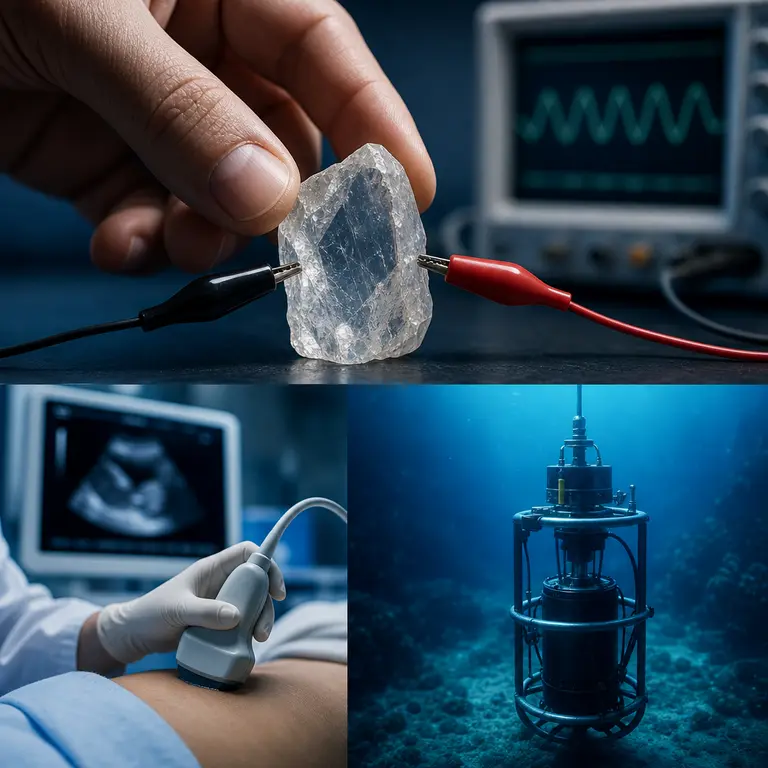
Piezoelectricity, the ability of certain crystals to generate electric charge under mechanical stress, underpins technologies from ultrasound machines to deep-sea sensors — and its origins trace back to a rivalry between two brothers and a stolen Nobel Prize.
 Watch on YouTube
 Watch on Rumble
The Brothers Who Squeezed a Crystal and Changed Physics
In 1880, Pierre and Jacques Curie made an observation so counterintuitive that the French Academy of Sciences initially doubted it. By compressing certain crystals — quartz, tourmaline, Rochelle salt — along specific axes, they generated a measurable electrical voltage. The effect was not chemical, not thermal, not frictional. It was purely mechanical. They named it piezoelectricity, from the Greek piezein, meaning to press or squeeze.
What made the discovery stranger still was its symmetry. The following year, the brothers predicted and then confirmed the converse effect: applying an electric field to the same crystals physically deforms them. Squeeze them, and they generate voltage. Electrify them, and they move. This reversibility would eventually make piezoelectric materials among the most quietly indispensable substances in modern civilization, embedded in technologies ranging from the most delicate surgical instruments to the most mundane household gadgets.
Yet the Curies received little immediate recognition for this specific discovery. Pierre’s later work with Marie on radioactivity consumed his scientific legacy, and the piezoelectric contribution was largely absorbed into the background of physics without a dedicated prize or public celebration. The Nobel committee never awarded the Curies for piezoelectricity. It remains one of the field’s quietly overlooked origins, a foundational insight that changed the world while its authors were remembered for something else entirely.
Why Crystals Do What Liquids Cannot
The mechanism behind piezoelectricity is rooted in crystalline asymmetry, and understanding it requires a brief detour into the geometry of matter at the atomic scale. In a piezoelectric material, the internal arrangement of atoms lacks a center of symmetry — meaning positive and negative charge centers do not perfectly overlap. Under ordinary conditions, these displaced charge centers cancel each other out across the bulk of the material. But when the crystal is mechanically stressed, this asymmetry becomes electrically pronounced. The displaced charge centers shift further out of alignment, creating a net dipole moment across the material, and voltage appears at the crystal’s surfaces.
Not all crystals are piezoelectric, and the distinction lies in their geometry. Of the 32 recognized crystal symmetry classes, 21 are non-centrosymmetric, and 20 of those exhibit piezoelectricity. Quartz, the most abundant mineral in Earth’s continental crust, is the canonical example. Its silicon-oxygen tetrahedral structure deforms predictably under pressure, producing voltages that are extraordinarily stable and reproducible over a wide temperature range. This stability is why quartz oscillators became the heartbeat of every clock, wristwatch, and computer processor since the mid-twentieth century. The quartz crystal in a standard wristwatch vibrates at exactly 32,768 times per second when driven by a small electrical current — a frequency chosen because it is a power of two, making it easy to divide down into a precise one-second pulse using simple digital circuits.
Barium titanate, discovered in the 1940s, introduced a new and more powerful class of piezoelectric material: ferroelectric ceramics, which can be poled — meaning their internal dipole domains can be aligned by applying a strong electric field during manufacture. Once poled, these ceramics retain their alignment and exhibit piezoelectric responses far stronger than those of natural crystals. Lead zirconate titanate, known universally as PZT, was synthesized in the 1950s and became the dominant industrial piezoelectric material; it remains so today. Its combination of high sensitivity, mechanical durability, and ease of manufacture made it the default choice for engineers across dozens of industries. However, growing concern about lead toxicity and increasing regulatory pressure — particularly from the European Union’s restrictions on hazardous substances in electronics — has driven significant research into lead-free alternatives, including sodium potassium niobate and bismuth ferrite compounds.
From Sonar to Surgery: The Hidden Ubiquity of Squeezed Crystals
Piezoelectricity’s first major technological application came not in a laboratory but in wartime. Paul Langevin, a French physicist and former student of Pierre Curie himself, developed an underwater transducer during World War I using quartz sandwiched between steel plates. When driven by an alternating electrical signal, the quartz emitted ultrasonic pulses that propagated through water and bounced off solid objects — including submarine hulls. The returning echo was detected by the same device, converted back into an electrical signal, and interpreted as distance. This was the direct ancestor of sonar, and it permanently altered the nature of naval warfare. The intellectual lineage from a Paris laboratory in 1880 to the detection of enemy submarines in the Atlantic is direct and traceable.
Medical ultrasound imaging, now used in over 300 million procedures annually worldwide, operates on precisely the same principle that Langevin demonstrated. A piezoelectric transducer emits a pulse of high-frequency sound into the body and then listens for the returning echo, converting the mechanical wave back into an electrical signal that can be processed into an image. The same device functions as both speaker and microphone, transmitter and receiver — a dual role made possible by piezoelectricity's inherent reversibility. The resolution of modern ultrasound systems has improved dramatically, but the underlying physics has not changed since Langevin’s wartime experiments.
The range of less visible applications is equally striking. In inkjet printers, a piezoelectric element flexes with microsecond precision to eject individual droplets of ink, each one smaller than a human red blood cell, with enough accuracy to produce photographic-quality images. In atomic force microscopes, piezoelectric actuators position a scanning tip with sub-nanometer accuracy, allowing scientists to image and even manipulate individual atoms on a surface. In automotive airbag systems, piezoelectric sensors detect the sudden deceleration signature of a collision and trigger deployment within milliseconds — far faster than any mechanical system could respond. Even the humble cigarette lighter with a click-type igniter uses a spring-loaded hammer to strike a piezoelectric crystal, generating a spark voltage of roughly 800 volts from a single mechanical impulse, with no battery, no fuel cell, and no moving parts beyond the hammer itself.
Energy Harvesting and the Floors That Power Themselves
One of the most active and conceptually striking frontiers in piezoelectric research involves energy harvesting — the capture of mechanical energy from ambient vibrations and its conversion into usable electricity. The concept sounds almost alchemical at first encounter: floors that generate power when walked upon, bridges that harvest the vibration of passing traffic, clothing embedded with piezoelectric fibers that charge a device from the motion of a person walking to work. Yet each of these ideas has moved beyond speculation into demonstrated reality.
In 2008, East Japan Railway Company installed piezoelectric panels beneath the ticket gates of a busy Tokyo station, generating small amounts of electricity from the foot traffic of tens of thousands of daily commuters. The output was modest — enough to partially power the display screens at the gates — but the demonstration proved the concept at a meaningful scale under real-world conditions. Similar installations followed in a nightclub in Rotterdam, where the vibrations of dancing crowds powered portions of the lighting system, and in public pedestrian areas in London, where embedded floor panels contributed to local power supplies. None of these installations replaced conventional power grids, but they established that piezoelectric energy harvesting is not merely theoretical.
Researchers at the Massachusetts Institute of Technology and other institutions have developed flexible piezoelectric polymers, particularly polyvinylidene fluoride (PVDF), which can be woven into textiles or conformally applied to curved and irregular surfaces. These materials open possibilities that rigid ceramics cannot reach: wearable generators that harvest energy from body movement, implantable biomedical devices powered by the mechanical rhythms of a beating heart or expanding lungs, and structural health monitoring systems embedded in aircraft wings or bridge cables that derive their own operating power from the very vibrations they are tasked with measuring.
The central challenge remains efficiency. Even the best-performing piezoelectric energy harvesters convert only a fraction of available mechanical energy into electricity, typically between 20 and 40 percent under carefully optimized conditions, and often far less in real-world deployments where vibration frequencies are irregular and unpredictable. Impedance matching — tuning the mechanical and electrical properties of the harvester to resonate with the dominant frequency of the ambient vibration source — remains an active engineering problem. Researchers are exploring nonlinear and broadband harvesting architectures that can capture energy across a broader frequency range without requiring precise tuning.
Despite these limitations, the strategic value of even small amounts of self-generated power is growing rapidly. The Internet of Things is projected to encompass tens of billions of low-power sensors embedded in infrastructure, consumer products, industrial machinery, and the human body. Many of these sensors will be located in positions where battery replacement is impractical, dangerous, or prohibitively expensive. A sensor embedded in a concrete bridge pillar, a sensor monitoring pressure inside a sealed industrial pipe, a sensor tracking physiological data from within the human body — in each case, a self-powering device that draws energy from its mechanical environment is not merely convenient but potentially the only viable solution. The crystal squeezed by two brothers in a Paris laboratory in 1880, dismissed at first by the very institution that should have celebrated it, may yet become the foundational power source of a wireless, sensor-saturated civilization that its discoverers could not have imagined.
Conclusion
The story of piezoelectricity is, among other things, a lesson in how foundational discoveries are absorbed into the infrastructure of civilization so completely that they become invisible. Pierre and Jacques Curie identified a genuine phenomenon of nature, traced its underlying logic, confirmed its reversibility, and handed subsequent generations a tool of extraordinary versatility. The tool was used to detect submarines, image unborn children, position atoms, eject ink droplets, trigger airbags, and keep time with atomic precision. Now it is being asked to power sensors that will continuously monitor the physical world without human intervention.
None of this appeared inevitable in 1880. The French Academy of Sciences doubted the initial results. Pierre moved on to other work. Jacques faded from scientific history almost entirely. The phenomenon they discovered was real, reproducible, and waiting for the technologies that would eventually need it. That is often how the most consequential science works: not as a dramatic revelation that immediately reshapes the world, but as a quiet, verified fact that sits in the literature until civilization catches up to it.
Sources & Further Reading
- Curie, Pierre and Jacques Curie. Développement par compression de l'électricité polaire dans les cristaux hémièdres à faces inclinées. Bulletin de la Société Minéralogique de France, 1880.
- Jaffe, Bernard, William R. Cook, and Hans Jaffe. Piezoelectric Ceramics. Academic Press, 1971.
- Anton, Steven R., and Henry A. Sodano. A Review of Power Harvesting Using Piezoelectric Materials. Smart Materials and Structures, IOP Publishing, 2007. https://iopscience.iop.org/article/10.1088/0964-1726/16/3/R01
- East Japan Railway Company. Environmental Report: Piezoelectric Generation System at Shibuya Station. JR East, 2008. https://www.jreast.co.jp/e/environment/