
The Curious Tale of the Codex Gigas: The Devil's Bible
The Codex Gigas, or the Devil's Bible, is one of the most significant extant medieval manuscripts created in the early 13th century.
 Watch on YouTube
 Watch on Rumble
The Codex Gigas: Medieval Ambition, Diabolical Legend, and the World’s Largest Manuscript
Nestled in the collection of the National Library of Sweden in Stockholm is one of the most remarkable artifacts to have survived from the medieval world. Known formally as the Codex Gigas, and colloquially as the Devil’s Bible, this manuscript commands attention not merely for its extraordinary physical scale but for the layers of mystery, scholarship, and legend that have accumulated around it over eight centuries. It sits at the intersection of religious devotion, intellectual ambition, and folklore in a way that few objects in human history can claim. To study the Codex Gigas is to peer into a world where monks were the custodians of all knowledge, where the boundaries between the sacred and the diabolical were contested daily, and where a single human life might be devoted entirely to the production of a single book.
Dimensions and Construction: A Monument in Parchment
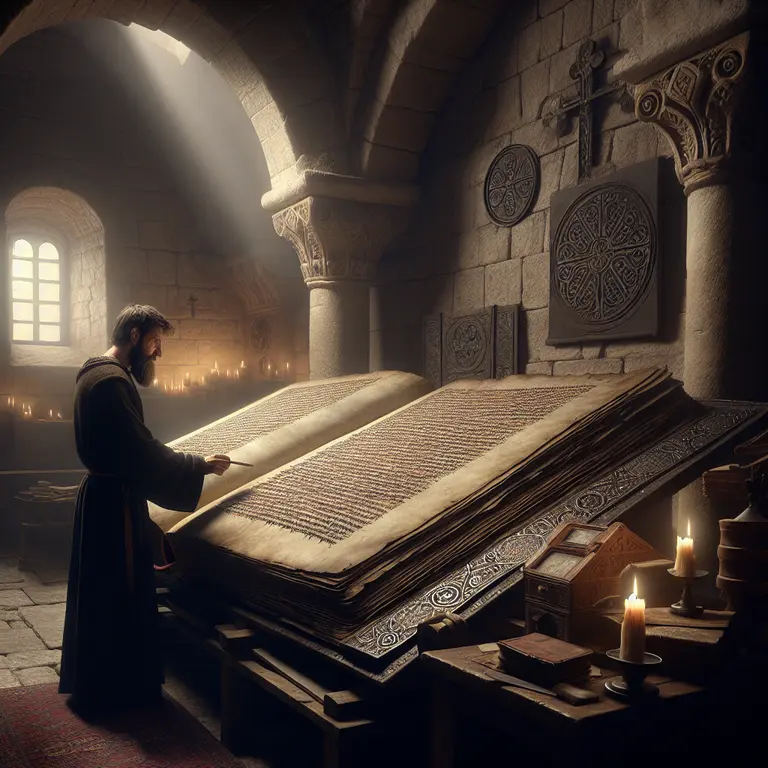
Created in Bohemia, which corresponds to the modern-day Czech Republic and was then part of the Holy Roman Empire, in the early thirteenth century, the Codex Gigas is a physical object that defies easy comprehension. It measures approximately 36 inches tall, 20 inches wide, and nearly nine inches thick. It weighs around 165 pounds, or just under 75 kilograms, making it impossible for a single person to carry without considerable effort. Historical accounts suggest that, during various periods of European conflict, the manuscript required multiple individuals to move it from one location to another.
The construction of the manuscript required the skins of more than 160 animals, most likely donkeys, which were processed into vellum parchment of exceptional quality. The consistency of the handwriting throughout the volume is one of its most-analyzed features. Forensic paleographers who have examined the manuscript closely have concluded that the script was almost certainly produced by a single hand throughout its creation. This consistency extends not only to the letterforms themselves but to the pressure applied, the spacing between lines, and the overall rhythm of the text. That a single scribe could maintain such uniformity across a project spanning decades represents an almost incomprehensible act of disciplined labor. Some researchers estimate that if the scribe worked six hours a day without interruption, the project would still have required more than twenty years to complete, a figure that aligns with historical estimates placing the total production time at roughly a quarter of a century.
The Legend of the Condemned Monk
No account of the Codex Gigas is complete without engaging seriously with the legend that gave it its popular name. According to the story, which circulated in various forms throughout medieval Bohemia and beyond, a monk living at the Benedictine monastery of Podlazice had committed a grievous sin, the exact nature of which varies depending on the version of the tale. His punishment was to be walled up alive, a fate considered among the most horrifying available within the monastic disciplinary tradition. Upon reading this sentence, the monk reportedly struck a bargain with the devil, offering his soul in exchange for supernatural assistance in completing a manuscript of such scope and beauty that it would bring eternal glory to the monastery.
The devil, according to the legend, fulfilled his end of the arrangement by completing the manuscript in a single night. The monk, overwhelmed by guilt upon seeing the finished work and realizing what he had surrendered, then added the now-famous full-page illustration of Satan as a form of penitence, a visual acknowledgment of the bargain he had struck and perhaps a warning to future readers.
What makes this legend particularly interesting from a scholarly perspective is not its supernatural content but what it reveals about medieval attitudes toward extraordinary human achievement. In a culture where individual genius was viewed with deep suspicion and where all remarkable accomplishment was expected to be attributed to God, the legend of satanic assistance functioned as a way of explaining something that seemed to exceed normal human capacity. The very consistency and scale of the manuscript made it difficult for contemporaries to accept as the product of ordinary monastic labor, and so the legend emerged to fill that explanatory gap. The story is not simply superstition but a cultural mechanism for processing the genuinely astonishing.
The Contents: A Medieval Encyclopedia of Knowledge
What the Codex Gigas contains is nearly as remarkable as the circumstances of its creation. It is not simply a Bible, though it does open with a complete Latin Vulgate translation of both the Old and New Testaments. The manuscript goes considerably further than that, functioning as a comprehensive repository of knowledge considered most essential within the educated monastic world of thirteenth-century Bohemia.
Following the biblical text, the manuscript includes two major works by the first-century Jewish historian Flavius Josephus: Antiquities of the Jews and The Jewish War. These texts were considered essential reading for any serious medieval scholar seeking to understand the historical context of the Christian scriptures, and their inclusion reflects the breadth of intellectual ambition behind the project. The Codex Gigas also contains the Etymologiae of Isidore of Seville, a seventh-century encyclopedic work that attempted to catalog all human knowledge across twenty volumes and served throughout the medieval period as something close to a universal reference text.
Beyond these major works, the manuscript includes detailed medical treatises that offer a window into contemporary understanding of health, disease, and the human body within monastic communities. There are also penitential texts, calendars, a list of the monastery’s brothers, and perhaps most surprisingly, practical instructions for performing exorcisms. This last inclusion is a reminder that the medieval manuscript was not purely an academic object but a functional one, intended to serve the practical needs of religious life in ways that modern readers might find unexpected.
The sheer range of material gathered within a single binding reflects a distinctly medieval vision of knowledge as unified and hierarchical rather than divided into separate disciplines. Theology, history, medicine, and ritual practice were understood as parts of a single integrated understanding of the world, and the Codex Gigas embodies that vision more completely than almost any other surviving artifact.
The Devil’s Portrait and Its Lasting Significance
The illustration that earned the manuscript its popular name occupies a full page near the end of the volume and depicts a figure almost universally identified as Satan. The image stretches nearly half the page's height and portrays the figure in green, with clawed hands raised and a red tongue visible. The figure is flanked by two small towers, which some scholars interpret as representing the towers of hell. What makes the illustration so striking is not merely its subject matter but its visual relationship to everything surrounding it. The rest of the manuscript, while richly decorated with ornamental initials and religious imagery, follows conventions familiar from other manuscripts of the period. The devil illustration does not. It is singular, confrontational, and executed with a vividness that suggests genuine artistic investment rather than routine decoration.
The Codex Gigas passed through several hands over the centuries following its creation. It was eventually acquired by the Habsburg Emperor Rudolf II in the late sixteenth century and was taken to Stockholm as war spoils by Swedish forces during the Thirty Years' War in 1648, where it has remained ever since. The National Library of Sweden has made high-resolution digital scans of the entire manuscript available online, allowing researchers and curious readers around the world to examine it in detail without traveling to Stockholm.
Conclusion: A Testament to Human Endurance
The Codex Gigas endures as something more than a historical curiosity. It is a document of human endurance, of the medieval conviction that knowledge was worth preserving at almost any cost, and of the imaginative power of legend to attach itself to objects that seem to exceed ordinary explanation. Whether one approaches it as a religious artifact, a work of art, a historical source, or simply as a monument to one individual’s extraordinary dedication, the manuscript rewards sustained attention. It connects us across eight centuries to a world that was in many ways profoundly different from our own, while simultaneously reminding us that the impulse to gather, organize, and transmit knowledge is among the most persistently human of all endeavors. The monk of Podlazice, whoever he actually was, left behind something that has outlasted every institution and ideology of his time, and that alone is a kind of immortality worth contemplating.