
The Antique Book Printing Mistake That Revolutionized Art
A 16th-century printing error accidentally inspired a unique art form.
The Antique Book Printing Mistake That Revolutionized Art
In the annals of art history, pivotal moments often arise from the most unlikely circumstances. One such serendipitous event occurred in the late 16th century, leading to the birth of marbling, an ethereal art form that mimics the free-flowing patterns found in natural marble. This tale takes us through a surprising journey involving monk scribes, faulty inks, and an accident that forever changed bookmaking and art. What makes this story particularly remarkable is not merely the accident itself, but the chain of cultural transmissions, economic forces, and artistic ambitions that transformed a single mishap into a global craft tradition spanning centuries. The story of marbling is, in many ways, a story about how human beings instinctively recognize beauty even when they stumble into it entirely by chance.
Historical Background
Woodblock printing, which originated in China during the Tang dynasty between 618 and 907 AD, gradually spread to other parts of Asia and eventually into Europe. By the 15th and 16th centuries, European woodblock printing had evolved into a sophisticated but fragile technique that demanded extraordinary precision from its practitioners. Monastic scribes were often responsible for copying texts and producing illuminated manuscripts during this period, working in dedicated rooms called scriptoria where silence, discipline, and methodical care were considered sacred obligations. The manuscripts they produced were not merely functional objects but expressions of devotion, and the quality of materials mattered enormously.
Around 1590, Japanese artisans were independently experimenting with new techniques for decorating papers, primarily for use in books and correspondence. They had developed and refined a method called Suminagashi, which translates roughly as "floating ink," in which colored inks were carefully floated on the surface of water before being transferred onto paper gently placed above the liquid. The technique had roots even further back, with some historians tracing early forms of Suminagashi to the Heian period in Japan, around the 12th century. This method required exceptionally precise control over ink viscosity and paper absorbency, and practitioners spent years mastering the subtle interplay between liquid, pigment, and fiber. What the Japanese had discovered was essentially the physics of surface tension rendered as art, a concept that would eventually find its way westward through trade routes and cultural exchange, though the European tradition appears to have developed largely in parallel rather than through direct transmission.
The Accident That Changed Everything
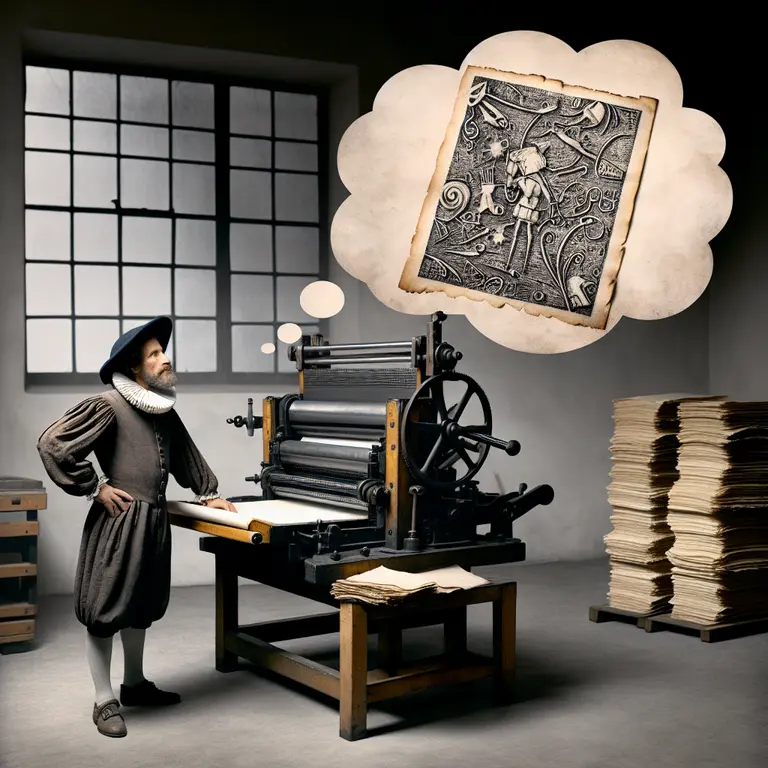
Fast-forward to a German monastic scriptorium around 1595. A scribe named Andreas was working on an illuminated manuscript using traditional woodblock methods when disaster struck in the most mundane possible fashion. While mixing gall inks, an iron-based ink made from oak galls that had been the standard writing fluid of European monks for centuries, he inadvertently used an undiluted acidic solution instead of water to thin out his pigments. The error likely seemed catastrophic at first. Wasted materials, ruined parchment, and lost working hours were serious matters in a scriptorium operating on limited resources.
But the mix-up produced entirely unexpected results. Instead of spreading uniformly across the manuscript pages as conventional ink would, the droplets reacted with one another upon contact with the parchment, creating spontaneous swirling vortices of brilliant color and intricate, vein-like designs that bore a striking resemblance to polished marble slabs. The chemistry behind this was straightforward in hindsight. The acidic solution altered the surface tension dynamics between the ink components, causing them to repel and swirl around each other in patterns governed by fluid dynamics rather than the scribe’s hand. What Andreas had accidentally discovered was a way to make liquid physics visible, to capture a fleeting moment of chemical interaction in permanent pigment on paper.
The visual effect was dramatic enough that Andreas apparently chose to preserve the ruined pages rather than discard them, a decision that speaks to something deeply human in the encounter with unexpected beauty. Word spread through the monastery, and then beyond it, with the speed that interesting novelties tend to travel among craftspeople who are always searching for new techniques to elevate their work.
The Adoption and Evolution of Marbling
Amazed by these unconventional yet stunning visuals, artisans quickly embraced the technique and began experimenting with ways to deliberately reproduce and refine it. Recognizing its potential to enhance the aesthetic appeal of manuscripts and books, craftsmen began developing more controlled methods to achieve the marbled effect, shifting from accidental chemistry to intentional craft. The marbled patterns added visual richness to books and documents, but they also served a surprisingly practical function. The intricate, unique patterns that resulted from the marbling process were virtually impossible to replicate exactly, making marbled endpapers an early form of security feature in important documents and ledgers. Because no two marbled sheets were identical, a forger attempting to replace a page in a marbled book would immediately be exposed.
Craftsmen began experimenting with carrageenan, a gelatinous substance derived from seaweed, as a thickened base on which to float their pigments. This innovation gave practitioners far greater control over the patterns they produced, allowing them to introduce combs, styluses, and other tools to manipulate the floating colors before transferring them to paper. The result was a taxonomy of marbling styles, each with its own name and associated techniques. The French curl, the Spanish wave, the peacock pattern, and the nonpareil were among the dozens of named designs that emerged from this period of rapid experimentation and refinement.
The Spread and Influence of Marbling
The marbling technique spread rapidly throughout Europe, with each region developing its own distinctive style and vocabulary. In France, marbling became known as papier marbré and was associated with the luxury book trade centered in Paris, where wealthy collectors demanded increasingly elaborate and beautiful volumes. In Italy, it was called carta marmorizzata and became closely associated with the Venetian paper trade, which was already among the most sophisticated in Europe. Turkish artisans developed their own parallel tradition called Ebru, which translates as "cloud art," and their style emphasized flowing, organic patterns that differed subtly yet distinctly from the more geometric European approaches.
The process evolved continuously, incorporating new materials and methods. Oil-based colors offered different visual properties than water-soluble pigments. Different surfactants, including ox gall, soap solutions, and various plant extracts, were used to manipulate how inks spread and interacted on the water surface. Each craftsman guarded their specific formulas jealously, and the trade secrets of successful marblers were passed down within families and guilds with the same care applied to recipes for medicines or metallurgical processes. This secrecy, paradoxically, encouraged diversity, because isolated workshops developed their own solutions to the same technical challenges, producing regional variations that now allow art historians to identify the geographic origin of antique marbled papers with considerable precision.
Marbling in Bookbinding
Marbling soon became an integral part of the bookbinding trade, used primarily for endpapers and covers, transforming plain books into objects that announced their owner’s taste and wealth before a single page was opened. The endpaper, that sheet glued to the inside of a book’s cover, was a particularly natural home for marbling because it served no textual function and was therefore free to be purely decorative. Specialized craftsmen emerged who dedicated their entire professional lives to perfecting this art form and were known simply as marblers. Their work graced not only books but also documents, stationery, hat boxes, wallpaper, and decorative panels.
The economic ecosystem that grew around marbling was substantial. Paper merchants, pigment suppliers, seaweed harvesters, bookbinders, and retail stationers all depended in part on the demand for marbled goods. By the 18th century, marbled paper had become a recognizable feature of educated European life, present in the libraries of aristocrats, the offices of merchants, and the studies of scholars. Jane Austen wrote her novels in notebooks with marbled covers. Charles Darwin kept notes in marbled ledgers. The art form had migrated from monasteries to the everyday material culture of literate society.
Legacy and Modern Revival
The legacy of marbling extends powerfully into the modern era, inspiring artists and artisans worldwide who find in it a compelling intersection of control and chance. Contemporary marblers experiment with traditional techniques alongside innovative approaches, using synthetic pigments, acrylic paints, and even digital tools to push the boundaries of what the art form can express. Marbling workshops and studios have appeared globally, from Istanbul to Tokyo to Brooklyn, preserving the craft and introducing it to new generations who encounter it with the same sense of wonder that presumably stopped Andreas in his tracks in that German scriptorium more than four centuries ago.
What sustains marbling’s appeal across such a long span of time is partly its democratic relationship with chance. Unlike most art forms, marbling cannot be fully controlled. The artist makes decisions about color, tool, and movement, but the final pattern is always partly determined by physics, by the invisible forces of surface tension and fluid dynamics that operate below the threshold of human intention. Every sheet is a collaboration between the craftsperson and the material world, which may be why marbled paper continues to feel alive in a way that purely mechanical reproductions do not.
Conclusion
What began as a printing mistake in a German scriptorium in the late 16th century evolved into a revered art form, demonstrating with elegant clarity how accidents can lead to unexpected beauty and lasting innovation. The intricate patterns of marbling, born from a lucky error involving misidentified liquids and ruined parchment, have left an indelible mark on the world of art, bookmaking, and material culture across multiple continents and centuries. This timeless technique continues to captivate and inspire, a testament to the enduring power of creativity and the unforeseen paths it can take when human curiosity meets a happy accident.
The marbling story reminds us that even the most mundane mistakes can spark revolutions, transforming our understanding and appreciation of art and craftsmanship in ways that ripple outward across generations. It also reminds us that innovation rarely belongs to a single moment or a single person. The accident in the scriptorium mattered because it occurred within a world already primed to recognize its significance, a world of skilled craftspeople, active trade networks, and competitive markets for beautiful objects. As we look to the future, the ancient art of marbling stands as a symbol of the boundless potential at the intersection of chance and ingenuity, and of the remarkable things that can happen when someone pauses to look carefully at what they have accidentally made.