
The Neglected Eruption of Mount Toba: a Human Catastrophe
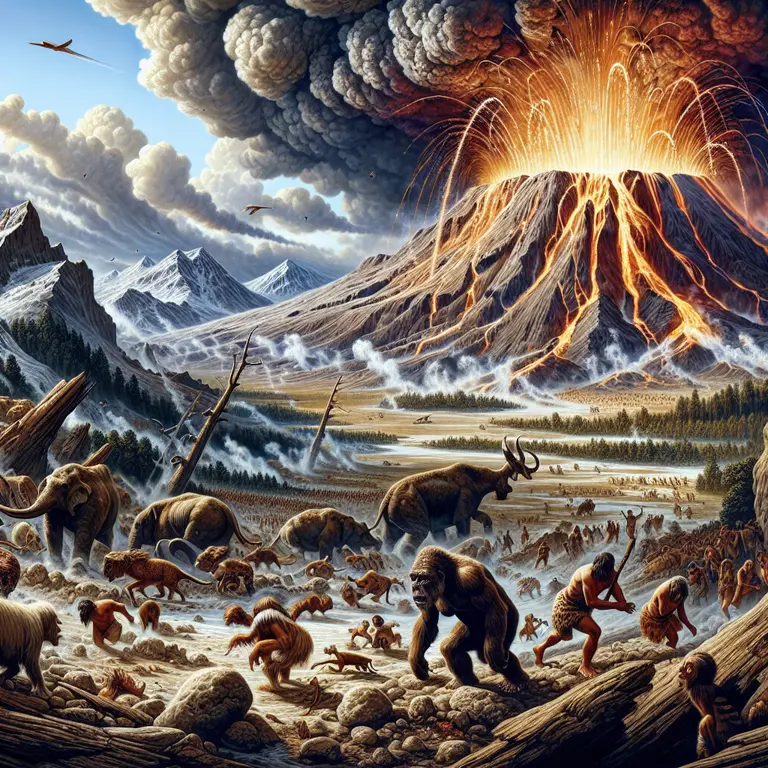
Approximately 74,000 years ago, a super eruption from Mount Toba occurred in present-day Indonesia. Its impact was so profound that it nearly caused the extinction of the human race.
 Watch on YouTube
 Watch on Rumble
Introduction
While volcanic eruptions such as Mount Vesuvius and Krakatoa are widely known and frequently referenced in discussions of natural disasters, the mega-colossal eruption of Mount Toba in Sumatra, Indonesia, remains largely unfamiliar to the general public. This is a remarkable oversight, given that the Toba super-eruption, which occurred approximately 74,000 years ago, stands as one of the most consequential geological events in Earth’s recent history. Its effects were not confined to a single region or civilization. They rippled outward across the entire planet, reshaping climates, collapsing ecosystems, and, according to a compelling body of scientific evidence, pushing the human species to the very edge of extinction. To understand the Toba eruption is to confront a humbling truth: that humanity’s survival has never been guaranteed, and that the thread connecting our ancestors to the present day may have been, at one critical moment, terrifyingly thin.
Overview and Immediate Effects
The Toba super-eruption is classified as one of the largest explosive volcanic events to have occurred on Earth in the last 25 million years. To appreciate its scale, it helps to compare it with eruptions already considered catastrophic by modern standards. The 1980 eruption of Mount St. Helens in Washington State ejected roughly 1 cubic kilometer of material. The Toba eruption expelled an estimated 2,800 cubic kilometers of volcanic material, approximately 2,800 times the volume released by Mount St. Helens, in a geologically instantaneous burst of energy. The force of this explosion would have been incomprehensible to any witness, generating pyroclastic flows that incinerated everything within hundreds of kilometers and sending shockwaves through the atmosphere that circled the globe.
The physical scar left behind by this event is still visible today. The massive caldera formed by the collapse of the volcanic structure eventually filled with water over thousands of years, creating what is now Lake Toba, the world's largest volcanic lake. Stretching approximately 100 kilometers in length and 30 kilometers in width, the lake sits within the Batak Highlands of northern Sumatra and remains a striking geological monument to the violence that created it. Beneath its surface lies a resurgent dome, evidence that the magmatic system responsible for the original eruption has not entirely gone dormant.
The Volcanic Winter
Among the most devastating long-term consequences of the Toba eruption was the global volcanic winter it triggered. When the volcano erupted, it injected enormous quantities of volcanic ash and aerosols, particularly sulfur dioxide, into the stratosphere. Unlike ash particles, which settle out of the atmosphere relatively quickly, sulfur dioxide reacts with water vapor to form sulfate aerosols that can remain suspended in the upper atmosphere for years. These aerosols act as a reflective shield, scattering incoming solar radiation back into space before it can warm the Earth’s surface.
The result was a dramatic and sustained drop in global temperatures. Scientific estimates, drawn from climate modeling and the study of ice cores and deep-sea sediments, suggest that average surface temperatures fell by somewhere between 3 and 5 degrees Celsius in the years immediately following the eruption. In some regions, the cooling may have been even more severe. While those numbers may sound modest in isolation, a drop of even 3 degrees Celsius sustained over several years is enough to fundamentally alter growing seasons, shift precipitation patterns, and trigger the advance of glacial ice in higher latitudes. For ecosystems that had evolved in relative climatic stability, the sudden onset of this volcanic winter was catastrophic.
Forests retreated. Grasslands dried and contracted. Food chains that depended on plant productivity began to collapse from the bottom up. Animal populations that could not migrate fast enough or adapt quickly enough faced starvation and extinction. The volcanic winter did not last forever, but its effects were long-lasting and severe enough to leave lasting marks on the planet's biological record.
Toxic Gases, Ashfall, and Ecosystem Collapse
The devastation wrought by the Toba eruption extended well beyond the temperature effects of its stratospheric aerosols. The physical fallout from the eruption blanketed enormous stretches of land across South Asia, Southeast Asia, and East Africa with layers of volcanic ash. Geological surveys have found Toba ash deposits in cores taken from the Indian Ocean floor and in sediment layers across the Indian subcontinent, sometimes reaching depths of several meters. This ash, known as tephra, would have smothered vegetation, contaminated freshwater sources, and rendered vast stretches of previously habitable land essentially uninhabitable.
Compounding the physical destruction was the chemical toxicity of the gases that the eruption released. Sulfur dioxide, when combined with atmospheric moisture, produces sulfuric acid, which falls back to Earth as acid rain. Hydrochloric acid and hydrofluoric acid were also released in significant quantities. These compounds are lethal to plant life and damaging to animal respiratory systems. The combination of acid precipitation and ash deposition would have stripped nutrients from soils, killed off vegetation that managed to survive the initial ashfall, and poisoned water supplies across a wide geographic range.
The ecological consequences of this combined assault were profound. Habitats that had supported diverse communities of plants and animals were reduced to barren, chemically hostile landscapes. Recovery from such conditions does not happen in years, but in centuries, and for species already stressed by the volcanic winter occurring simultaneously, the window for survival was extremely narrow.
The Bottleneck Effect on Human Populations
Perhaps the most haunting dimension of the Toba eruption is its proposed connection to a dramatic reduction in early human populations, an event researchers refer to as the population bottleneck. The bottleneck hypothesis, first advanced in the 1990s and developed by researchers including Stanley Ambrose of the University of Illinois, suggests that the environmental catastrophe unleashed by the Toba eruption reduced the global population of Homo sapiens to between 3,000 and 10,000 individuals, perhaps fewer. If accurate, this would mean that every human being alive today is descended from a remarkably small group of survivors who managed to endure one of the harshest periods in our species' history.
The evidence for this hypothesis comes primarily from the field of population genetics. Studies of mitochondrial DNA, which is inherited exclusively through the maternal line and mutates at a relatively predictable rate, reveal a striking lack of genetic diversity in modern human populations when compared to other species of similar size and distribution. This reduced diversity suggests that at some point in the relatively recent past, the human population underwent a severe constriction, a moment when the total number of breeding individuals dropped to a level so low that much of the previously existing genetic variation was simply lost. The timing of this inferred bottleneck, based on the rate of mitochondrial mutation, aligns closely with the date of the Toba eruption.
Studies of the Y chromosome, which traces the paternal line, have produced similar findings, pointing to a period of dramatically reduced male lineage diversity at roughly the same time. While correlation does not establish causation, and some researchers have raised legitimate questions about the precision of the genetic dating methods involved, the convergence of geological, climatic, and genetic evidence remains one of the more compelling arguments in paleoanthropology. It is worth noting that archaeological evidence from South Africa suggests that some human communities may have survived the Toba event with relatively little disruption, leading to ongoing debate about whether the bottleneck was as severe or as globally uniform as originally proposed. The discussion continues to evolve as new data emerges.
Conclusion
The eruption of Mount Toba is a stark and sobering reminder of the power that natural forces hold over the trajectory of life on Earth. It was not merely a geological event of impressive scale. It was a planetary crisis that reshaped climates, dismantled ecosystems, and may have reduced humanity to a handful of survivors clinging to existence in isolated refuges. That we are here at all, in our billions, tracing our ancestry back through an unbroken chain to those few thousand individuals, is a testament to the extraordinary resilience of our species.
Despite its extraordinary significance, the Toba eruption remains largely absent from popular understanding of natural history. It deserves a more prominent place in our collective awareness, not only as a geological curiosity but as a lens through which to understand human vulnerability and adaptability. As scientists continue to refine their understanding of this event through advances in genetic analysis, climate modeling, and geological fieldwork, the story of Toba grows richer and more nuanced. It stands as one of the most important chapters in the history of life on this planet, a chapter that came remarkably close to having no sequel at all.