
Exploring the Rich History of the Paisley Caves Complex
Paisley Caves in Oregon revealed 14,300-year-old human DNA from coprolites, challenging theories of early North American migration and predating the Clovis culture.
 Watch on YouTube
 Watch on Rumble
Introduction
Tucked into the arid high desert of Lake County, Oregon, the Paisley Caves are a series of eight naturally formed shelters carved into the rimrock above the now-dry bed of Summer Lake. At first glance, they appear unremarkable — shallow alcoves worn into volcanic tuff by millennia of wind and water. But beneath the dusty sediment floors of these caves lies some of the most consequential archaeological evidence ever uncovered on the North American continent. The discoveries made here have not merely added a footnote to the story of early human migration; they have fundamentally challenged what researchers believed they knew about when and how people first arrived in the Americas. For decades, the dominant narrative held firm: humans entered North America no earlier than 13,000 years ago, following a single corridor of passable land. Paisley Caves quietly dismantled that timeline.
The Landscape and History of the Site
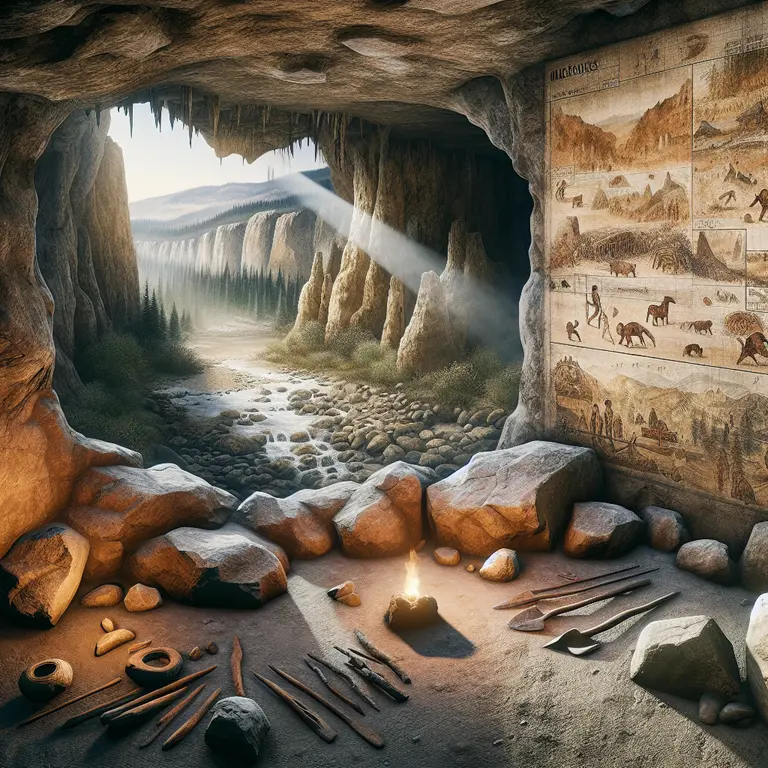
To understand why Paisley Caves matter, it helps to picture the world in which early inhabitants would have encountered them. During the late Pleistocene epoch, the Great Basin region of the American West looked nothing like the parched scrubland visible today. The caves overlooked a vast inland lake teeming with fish, waterfowl, and large game. Marshes and grasslands extended across what is now the barren basin floor. This environment would have been extraordinarily attractive to nomadic hunter-gatherers moving through an unfamiliar continent, offering food, fresh water, and shelter in abundance.
The caves themselves were first formally investigated in the 1930s by archaeologist Luther Cressman, who recovered a range of artifacts and recognized the site’s potential. However, it was not until the early 2000s that the full significance of Paisley Caves began to emerge. Dennis Jenkins of the University of Oregon led a series of intensive excavations beginning in 2002 that would ultimately produce findings capable of reshaping the entire field of American prehistory. Jenkins and his team applied modern analytical techniques to materials that earlier researchers had either overlooked or lacked the tools to properly evaluate. What they found beneath carefully stratified layers of sediment was nothing short of extraordinary.
Coprolites and the DNA Evidence
The most scientifically striking discovery at Paisley Caves came not from stone tools or carved bone, but from fossilized human feces, known in the scientific literature as coprolites. These desiccated remnants, preserved by the extreme aridity of the cave environment, were subjected to DNA analysis in a collaboration between Jenkins and molecular archaeologist Eske Willerslev of the University of Copenhagen. The results published in Science magazine in 2008 sent a clear signal through the archaeological community: the coprolites contained human mitochondrial DNA belonging to haplogroups A2 and B2, lineages associated with Indigenous populations of the Americas. The material dates to approximately 14,300 years before the present.
This single finding placed humans at Paisley Caves more than a thousand years before the Clovis culture, long considered the foundational chapter of North American prehistory. Mitochondrial DNA is particularly useful in this kind of ancient analysis because it is inherited exclusively through the maternal line and degrades more slowly than nuclear DNA, making it recoverable from ancient organic material under the right preservation conditions. The coprolites at Paisley Caves represented ideal circumstances: sealed within dry sediment, undisturbed for millennia, and rich enough in biological material to yield readable genetic sequences.
Beyond their genetic content, the coprolites also contained plant fibers, animal proteins, and other dietary indicators that offered a window into what these early inhabitants were eating. The presence of horse and camel proteins was particularly notable, as both animals were native to North America during the Pleistocene but went extinct roughly 10,000 to 12,000 years ago. This correlation between the dietary evidence and the known extinction timeline further supported the antiquity of the deposits and painted a vivid picture of a hunting culture operating in a dramatically different ecological world.
Artifacts, Tools, and the Material Record
Alongside the organic evidence, Paisley Caves yielded a substantial collection of more conventional archaeological materials. Stone tools, projectile points, and worked bone fragments were recovered from multiple layers of the excavation, each stratum representing a distinct period of occupation. Some of the projectile points recovered from deeper layers resemble Western Stemmed Tradition points, a technological style associated with early Great Basin cultures that appears to be independent of the Clovis tradition. This distinction is significant because it suggests that multiple technological traditions may have coexisted in early North America, complicating any simple linear narrative of cultural development.
The organic materials recovered from the caves were equally informative. Twisted fiber cordage, basketry fragments, and animal bones showing signs of human processing all contributed to a richly detailed portrait of daily life. The presence of fiber cordage is particularly revealing, as its manufacture requires considerable knowledge, patience, and manual skill, suggesting that the people who sheltered here were not simple, opportunistic wanderers but rather communities with developed craft traditions and accumulated knowledge passed down through generations.
The layered stratigraphy of the caves allowed researchers to construct a timeline of repeated human occupation spanning thousands of years. Paisley Caves was not a single-use campsite but a site returned to again and again over vast spans of time, suggesting it held lasting value as a resource-rich stopping point for mobile populations moving through the Great Basin.
Implications for Migration Theories and Ongoing Debates
The findings at Paisley Caves bring us to the center of one of the most contested questions in all of American archaeology: how, when, and by what route did the first people enter the Americas? The traditional model, known as the Clovis First hypothesis, proposed that a single founding population crossed the Bering land bridge from Siberia and moved southward through an ice-free corridor between the Laurentide and Cordilleran ice sheets approximately 13,000 years ago. The Clovis culture, characterized by its distinctive fluted projectile points, was identified at sites across the continent and treated as the baseline for all subsequent human presence.
Paisley Caves, along with a handful of other contested pre-Clovis sites such as Monte Verde in Chile and Meadowcroft Rockshelter in Pennsylvania, forced a serious reconsideration of this model. If humans were present in Oregon 14,300 years ago, they could not have arrived through an ice-free corridor that most geologists believe did not open until around 13,000 years ago. This pushes researchers toward alternative explanations, most prominently the coastal migration hypothesis, which proposes that early populations moved southward along the Pacific coastline by watercraft, island-hopping, and exploiting marine resources as they went.
The Paisley Caves findings have not gone unchallenged. Some researchers raised concerns about possible contamination of the coprolite samples, arguing that ancient human DNA could have been introduced into the sediment through percolating groundwater or contact with modern handlers. Jenkins and his team addressed these concerns methodically, implementing rigorous contamination controls and conducting additional rounds of analysis that consistently returned the same results. A 2012 follow-up study published in Science reinforced the original findings and added further detail to the genetic picture. While some skepticism remains within the field, the weight of accumulated evidence has shifted the broader consensus toward accepting a pre-Clovis human presence at the site.
Conclusion
Paisley Caves occupy a unique position in the landscape of North American archaeology. They are not grand ruins or monumental structures but modest natural shelters whose significance lies entirely in what was left behind by people who could not have imagined that their discarded meals and everyday tools would one day rewrite history. The combination of ancient DNA preserved in organic material, a stratified artifact record, and a well-documented geological context makes this site unusually persuasive in a field where evidence is often fragmentary and contested.
The story told by Paisley Caves is one of human adaptability, persistence, and movement across a continent still being discovered. The people who left their traces here were not the first Americans in any simple mythological sense, but they are among the earliest individuals whose presence can be confirmed through direct biological evidence. As analytical technologies continue to advance and new excavations open additional windows into the deep past, Paisley Caves will remain a foundational reference point for understanding who arrived in North America, when they arrived, and the remarkable journey that brought them there.