
Stellar Winds Sculpt the Spectacular Bubble Nebula Formation
Bubble Nebula, also known as NGC 7635, is a nebula located in the constellation Cassiopeia which gets its shape from the stellar wind of the star at its center.
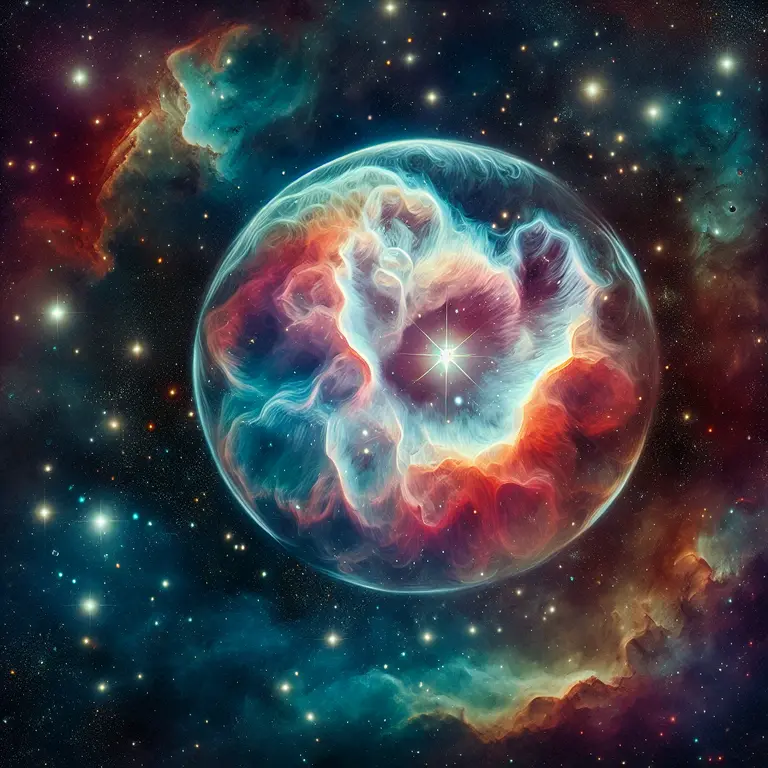
The Bubble Nebula: A Window Into Stellar Evolution
Located approximately 7,100 light-years from Earth in the constellation Cassiopeia, the Bubble Nebula — formally cataloged as NGC 7635 — is one of the more visually striking and scientifically significant objects in the night sky. Its name is immediately self-explanatory to anyone who has seen an image of it: a near-perfect sphere of glowing gas, suspended against a dense backdrop of stars and interstellar material. Yet despite its seemingly simple appearance, the Bubble Nebula is the product of enormously complex physical forces playing out over thousands of years. It offers astronomers a rare and detailed look at how massive stars interact with the space around them, and what fate ultimately awaits them.
What Is a Nebula?
To fully appreciate the Bubble Nebula, it helps to understand what a nebula is and why these objects matter to our understanding of the universe. The word nebula comes from the Latin for cloud or mist, and the term was historically applied to any fuzzy, diffuse object observed in the sky that was not a clearly defined star or planet. Today, astronomers use it specifically to describe clouds of gas and dust found in interstellar space — the vast, seemingly empty regions between stars.
Nebulae are primarily composed of hydrogen and helium, the two most abundant elements in the universe, along with traces of heavier elements and complex molecules. They are found throughout galaxies and often serve as the birthplaces of new stars, as gravitational forces gradually pull concentrations of gas and dust together until nuclear fusion ignites. In this sense, nebulae are not just beautiful objects — they are fundamental to the life cycle of stars and, by extension, to the creation of the chemical elements that make up planets and living organisms.
Nebulae are generally classified into several types depending on how they interact with light. Dark nebulae are dense enough to block the light coming from stars or other nebulae behind them, appearing as shadowy patches against brighter regions of the sky. Emission nebulae glow because the gas within them has been energized by nearby radiation sources, typically hot young stars, causing the gas atoms to emit light at specific wavelengths. Reflection nebulae do not produce their own light but instead scatter the light of nearby stars, often appearing blue for the same reason that Earth’s sky is blue. The Bubble Nebula is primarily an emission nebula, though its formation mechanism makes it something of a special case even within that category.
Characteristics and Appearance of the Bubble Nebula
What makes the Bubble Nebula stand out, even among emission nebulae, is the sheer clarity and symmetry of its structure. Most nebulae appear irregular, shaped by the chaotic interplay of gravity, radiation, and magnetic fields over millions of years. The Bubble Nebula, by contrast, presents a remarkably well-defined spherical shell, roughly seven light-years in diameter, glowing in shades of blue, green, and red depending on the wavelengths of light captured by the instruments observing it.
The colors seen in published images of the Bubble Nebula are not simply what a human eye would see if transported nearby. They represent different types of light emissions from ionized gases — hydrogen, oxygen, and sulfur among them — captured using specialized narrowband filters that isolate specific wavelengths. These long-exposure images, often built from many hours of collected light, reveal structures and gradients invisible to conventional photography. The result is a scientifically informative portrait that is also extraordinarily beautiful.
The nebula sits within a larger region of star formation and interstellar gas, and the bubble itself appears to be slightly off-center relative to the star driving it. This asymmetry is not random. The surrounding molecular cloud is not uniform in density, and the stellar wind that creates the bubble encounters more resistance in some directions than others. Where the gas and dust are denser, the bubble wall is thicker and expands more slowly. This interaction between the expanding shell and the uneven surrounding medium is itself a subject of ongoing research.
The Star at the Center: SAO 20575
The engine behind the Bubble Nebula is a single massive star known as SAO 20575, also designated BD+60 2522. This star is classified as an O-type star, placing it among the hottest, most luminous, and most massive stars known to exist. O-type stars are relatively rare and burn through their nuclear fuel at an extraordinary rate, living for only a few million years compared to the billions of years enjoyed by smaller stars like our Sun.
SAO 20575 is estimated to be roughly 10 to 40 times the mass of the Sun and burns at a surface temperature of around 37,500 Kelvin — more than six times hotter than the Sun’s surface. At this temperature, the star radiates enormous amounts of ultraviolet light, which ionizes the surrounding gas and causes it to glow. But what physically sculpts the bubble shape is not radiation alone. It is the stellar wind, a continuous outflow of charged particles streaming away from the star’s surface at speeds of several million kilometers per hour.
This wind acts like an invisible force constantly pushing outward in all directions from the star. Over time, it sweeps up the surrounding interstellar gas and dust, compressing it into a thin, dense shell. That shell is the bubble we observe. Astronomers estimate that this process has been underway for approximately 10,000 years, based on measurements of the bubble’s current size and its ongoing rate of expansion. In cosmic terms, 10,000 years is an extraordinarily short time — barely a blink — which means we are observing the Bubble Nebula at a relatively early stage in its development.
Formation, Evolution, and the Star’s Eventual Fate
The process by which SAO 20575 has shaped the Bubble Nebula illustrates a broader phenomenon in astrophysics known as stellar feedback. Massive stars do not passively exist within their environments — they actively reshape them, injecting energy, momentum, and newly synthesized elements into the surrounding interstellar medium. This feedback can suppress the formation of new stars in some regions while triggering it in others, compressing gas clouds until they collapse under their own gravity.
The Bubble Nebula is a particularly clean example of this process because the driving star is still active and the bubble is still growing. Astronomers can study it almost like a controlled experiment, measuring the wind velocity, the expansion rate, and the density of the shell to build detailed physical models of how stellar winds interact with molecular clouds. These models have applications far beyond the Bubble Nebula itself, informing our understanding of galaxy formation and the distribution of matter throughout the universe.
The future of the Bubble Nebula is as dramatic as its present. SAO 20575 is consuming its hydrogen fuel at a prodigious rate and will not survive for long by astronomical standards. When the star exhausts its core hydrogen, it will swell into a supergiant, and the stellar wind driving the bubble may intensify or change character. Eventually, the star will undergo a core-collapse supernova — one of the most energetic events in the universe — releasing in seconds more energy than the Sun will emit over its entire lifetime. The shockwave from this explosion will almost certainly disrupt and eventually disperse the bubble, scattering the material outward into the surrounding interstellar medium. The heavy elements forged inside SAO 20575 will join the galactic reservoir from which future stars and planets will one day form.
Conclusion
The Bubble Nebula spans seven light-years of space yet remains completely invisible to the naked eye, detectable only through telescopes equipped with narrowband filters sensitive to the faint glow of ionized gas. This invisibility makes it easy to forget that such structures exist in vast numbers throughout our galaxy, each one a record of stellar activity, a snapshot of physical processes unfolding across timescales far beyond human experience.
By studying NGC 7635, astronomers gain more than an appreciation for a beautiful object. They gain insight into how massive stars live and die, how they shape the space around them, and how the raw material of future stellar generations is prepared and distributed. The Bubble Nebula is, in this sense, not just a feature of the sky — it is a chapter in the ongoing story of how the universe builds and rebuilds itself, one stellar wind at a time.