
Unveiling the Milky Way: The 21-Centimeter Revolution
Before optical telescopes could peer through cosmic dust, a single radio frequency emitted by neutral hydrogen revealed the spiral structure of our own galaxy — a discovery hiding in plain sight at 1420 megahertz.
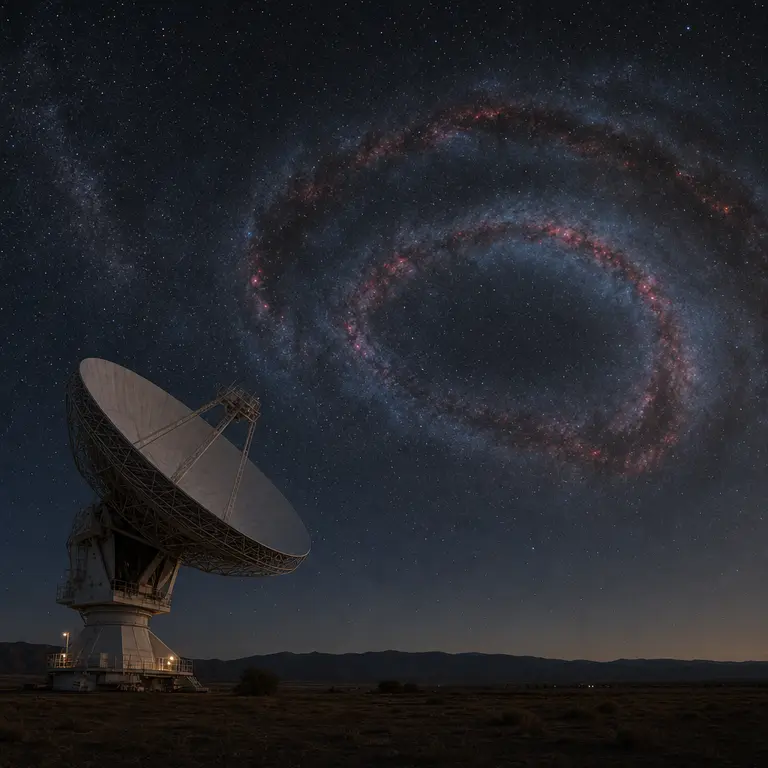
A Galaxy We Could Not See
For most of human history, astronomers faced a peculiar embarrassment: they could map distant galaxies with relative confidence while remaining almost entirely blind to the structure of their own. The Milky Way, seen edge-on from Earth’s position roughly two-thirds of the way out along one of its spiral arms, presents an impenetrable wall of dust and gas to optical telescopes. Visible light simply cannot punch through the dense interstellar medium that fills the galactic plane. As late as the 1940s, the large-scale architecture of our home galaxy — whether it had two spiral arms or four, how tightly they wound, where the central bar began and ended — remained genuinely unknown.
The situation was not merely inconvenient. It was a fundamental epistemological gap at the center of modern astronomy. Scientists could describe the rotation curves of galaxies tens of millions of light-years away, classify their morphologies, and estimate their stellar populations with reasonable precision. Yet the galaxy in which every one of those scientists lived and worked remained, in its broadest outlines, a mystery. The irony was not lost on astronomers of the era, who understood that their position inside the Milky Way was precisely what made it so difficult to study. There is no vantage point from which to step back and look at the whole.
The solution came not from building bigger mirrors, but from listening to a frequency that dust cannot block: the 21-centimeter hydrogen line, broadcasting at precisely 1420.405 megahertz, a signal produced by the most abundant atom in the universe as it flips the spin of its own electron.
The Hyperfine Transition Nobody Expected to Find
In 1944, Dutch astronomer Hendrik van de Hulst, working under Nazi occupation and unable to conduct experimental physics, turned instead to theoretical calculation. He predicted that neutral hydrogen atoms, drifting through interstellar space, would occasionally emit a very specific radio wavelength. The mechanism is extraordinarily subtle: a hydrogen atom consists of a single proton and a single electron, both of which carry a quantum property called spin. When the electron’s spin flips from parallel to antiparallel relative to the proton — a transition so improbable it occurs spontaneously in any given atom only once every 10 to 11 million years — it releases a photon at 21 centimeters wavelength.
What makes this prediction so remarkable in retrospect is the context in which it was made. Van de Hulst was a graduate student in Utrecht, cut off from international scientific literature by wartime censorship, working with minimal resources in an occupied country. He presented his findings at a colloquium in Leiden in April 1944, more than a year before the war in Europe ended. The calculation was elegant and theoretically sound, but verifying it experimentally required radio telescope technology that did not yet exist in a form capable of the task. The prediction sat in the literature for seven years, waiting for instruments to catch up with theory.
The reason this matters is that space contains an almost incomprehensible quantity of hydrogen. Even a transition that rare, multiplied across the roughly 10^57 hydrogen atoms estimated to exist in the Milky Way alone, produces a detectable and constant radio hiss. Van de Hulst’s prediction was confirmed in 1951 independently by Harold Ewen and Edward Purcell at Harvard, and within weeks by Dutch and Australian teams — a remarkable near-simultaneous verification across three continents. Ewen and Purcell used a horn antenna they had built for roughly 400 dollars and mounted it on a Harvard building, detecting the signal after just a few weeks of observation. When they notified the Dutch team, they learned that the group in Leiden had been attempting the same measurement and was within days of success.
The 21-centimeter line passes through dust clouds without scattering or absorption. It was, in effect, a transparent window cut directly through the galaxy’s opaque veil. For the first time, radio telescopes could see not just through the dust, but into and across the full extent of the galactic disk, reaching regions that optical astronomy had never been able to probe.
Tracing the Arms of the Milky Way
Once the signal was confirmed, astronomers realized they possessed something extraordinary: a tool for measuring both the location and the velocity of hydrogen clouds anywhere in the galaxy. Because of the Doppler effect, hydrogen moving toward Earth shifts its emission slightly toward shorter wavelengths, while hydrogen receding shifts toward longer ones. By scanning the sky and measuring these frequency shifts against a known galactic rotation model, researchers could calculate the distance and position of hydrogen concentrations throughout the disk.
This method, known as kinematic distance estimation, was not without its complications. The galactic rotation model itself had to be constructed and refined alongside the mapping effort, and certain lines of sight through the galaxy yielded ambiguous results, with two different distances yielding the same observed velocity. Astronomers developed increasingly sophisticated techniques to resolve these ambiguities, cross-referencing radio data with observations of stellar populations and other galactic tracers. The work was painstaking, collaborative, and spanned decades, but the results coalesced into something unprecedented.
Beginning in the early 1950s, Jan Oort in the Netherlands and Frank Kerr in Australia led systematic surveys of the 21-centimeter emission across the entire sky. The maps that emerged over the following decade were startling. The Milky Way was confirmed as a barred spiral galaxy, with at least four major arm structures — the Perseus Arm, the Sagittarius Arm, the Norma Arm, and the Outer Arm — wrapping around a central bar of stars roughly 27,000 light-years long. Our own solar system sits in a minor spur between the Perseus and Sagittarius arms, sometimes called the Orion Arm or Local Spur, at a distance of approximately 26,000 light-years from the galactic center.
The discovery that the solar system occupies a minor spur rather than a major arm was itself a quietly humbling revelation. Astronomers had long suspected that the Sun was not at the galactic center — that much had been established by Harlow Shapley in the early twentieth century through observations of globular clusters — but the precise nature of our local environment remained unclear. The 21-centimeter maps revealed that we sit in a relatively modest feature of the galaxy’s spiral structure, a secondary tendril of gas and stars branching off from one of the primary arms. This was the first time humanity had a credible, observationally grounded map of the galaxy it inhabits. The shape had been theorized, but the 21-centimeter line made it measurable.
From Galactic Cartography to Cosmic Communication
The 21-centimeter line has since become one of the most consequential frequencies in all of astronomy, and not only for mapping purposes. Because hydrogen is universal and the physics governing its hyperfine transition is identical everywhere in the cosmos, the frequency has been proposed as a natural channel for interstellar communication. Both the Voyager Golden Record and the Arecibo Message encoded the 21-centimeter wavelength as a unit of measurement, on the assumption that any technologically capable civilization would recognize it. The logic is straightforward: the laws of quantum mechanics do not vary across the universe, which means the energy difference that produces the 21-centimeter photon is the same whether the atom in question is in the Orion Arm of the Milky Way or in a galaxy a billion light-years distant.
The Arecibo Message, transmitted in 1974 toward the globular cluster M13, used the 21-centimeter wavelength as a fundamental unit of length in its encoded diagram. The message was designed by Frank Drake and Carl Sagan with the explicit assumption that hydrogen’s hyperfine transition would serve as a shared reference point between civilizations that might otherwise have no common language. This idea, that a quantum mechanical accident of atomic structure could function as a universal Rosetta Stone, reflects something genuinely profound about the nature of physics and its potential role in bridging the gap between minds that have never met.
More recently, the 21-centimeter signal has become central to one of the most ambitious projects in observational cosmology: mapping the large-scale structure of the universe during the Epoch of Reionization, the period roughly 380 million to one billion years after the Big Bang when the first stars began ionizing the neutral hydrogen that filled all of space. Experiments such as the Hydrogen Epoch of Reionization Array in South Africa and the Square Kilometer Array currently under construction in Australia and South Africa aim to detect the faint 21-centimeter emission from that era — redshifted by cosmic expansion to meter-scale wavelengths — and reconstruct a three-dimensional map of the universe’s earliest large-scale structure. If successful, these surveys would represent a kind of archaeological radio tomography of the universe itself, using the same humble electron spin-flip that first revealed the shape of our own galaxy.
The Spin-Flip That Changed Everything
It is worth pausing to appreciate the full arc of what a single atomic transition has made possible. A hydrogen atom, the simplest structure in the periodic table, occasionally undergoes a rearrangement so minor that it releases less energy than almost any other process in physics. The photon it produces has a wavelength longer than a human hand. And yet this almost imperceptible quantum event, repeated across the vast hydrogen reservoirs of the interstellar medium, gave humanity its first true map of the Milky Way, provided a proposed universal language for contact with other civilizations, and now serves as the primary observational tool for probing the universe’s earliest epochs.
There is something philosophically striking about this chain of consequences. The 21-centimeter line was not discovered through observation but through pure theoretical reasoning, carried out in wartime by a scientist who had no access to the equipment needed to test his own prediction. The confirmation came years later, almost simultaneously, from researchers on opposite sides of the world who had independently arrived at the same target. The applications that followed — galactic mapping, interstellar messaging, cosmological tomography — were not foreseeable from the original calculation. They emerged gradually, as scientists recognized that a tool designed for one purpose could illuminate something far larger.
Van de Hulst lived until 2000, long enough to see the 21-centimeter line become a cornerstone of modern astrophysics. The window he identified through calculation alone, during one of the darkest periods in European history, turned out to open not merely onto the structure of the Milky Way but onto the structure of the observable universe itself. That a single electron, flipping its spin once every ten million years, could carry so much of the cosmos’s history within its quiet emission is perhaps the most unexpected fact in the long and surprising story of how human beings learned to read the sky.
Sources & Further Reading
- Ewen, H.I. and Purcell, E.M. Observation of a Line in the Galactic Radio Spectrum. Nature, 1951. https://www.nature.com/articles/168356a0
- van de Hulst, H.C. Radio Waves from Space: Origin of Radiowaves. Nederlands Tijdschrift voor Natuurkunde, 1945.
- Oort, J.H., Kerr, F.J., and Westerhout, G. The Galactic System as a Spiral Nebula. Monthly Notices of the Royal Astronomical Society, 1958.
- Loeb, Abraham and Furlanetto, Steven R. The First Galaxies in the Universe. Princeton University Press, 2013.