
The Star That Rings Like a Bell: Stellar Seismology
Asteroseismology — the science of listening to vibrations inside distant stars — is quietly rewriting our understanding of stellar interiors, ages, and the fate of planets orbiting them.
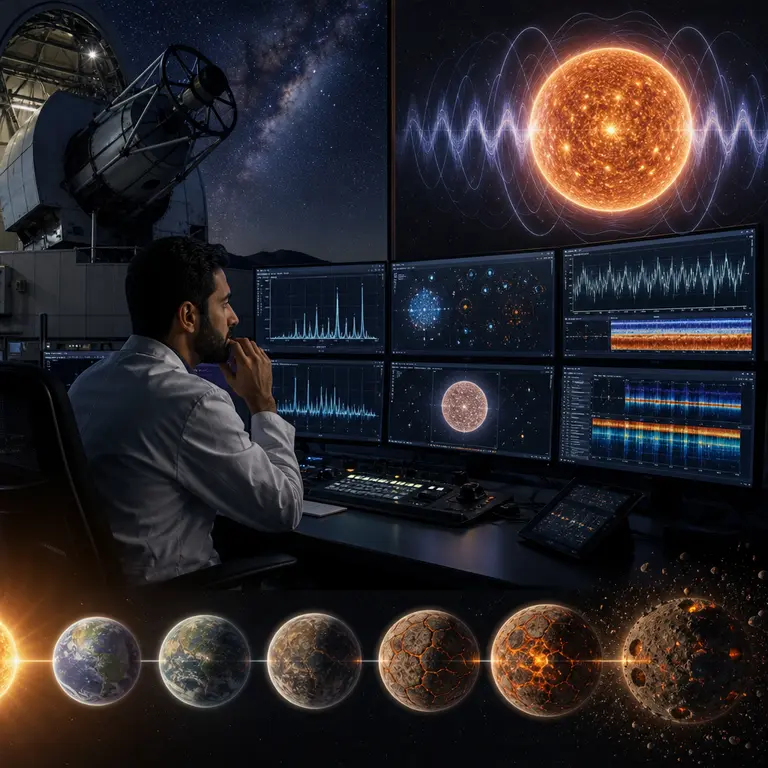
The Universe Has a Heartbeat
In 1962, physicist Robert Leighton and colleagues at Caltech noticed something strange in observations of the Sun's surface: it was oscillating rhythmically, pulsing in and out with a period of roughly five minutes. At the time, no one knew quite what to make of it. The oscillations seemed too regular to be noise and too subtle to be easily explained by any known physical process. Decades later, that puzzling discovery became the seed of an entirely new science called asteroseismology, the study of starquakes and the acoustic waves that propagate through stellar interiors. Today, space telescopes are turning the entire sky into a concert hall, and what they are hearing is quietly rewriting the textbooks of stellar physics, planetary science, and cosmology alike.
The principle behind asteroseismology is disarmingly simple, even if the mathematics underlying it is anything but. Stars are not static balls of plasma sitting inertly in space. They are resonating chambers, more akin to musical instruments than to the unchanging points of light we perceive from Earth. Sound waves generated by convective turbulence in a star's outer layers travel inward, bounce off density boundaries deep within the stellar interior, and return to the surface, creating standing wave patterns that cause the stellar surface to expand and contract by tiny but measurable amounts. Sometimes the displacement is just a few kilometers on a star hundreds of thousands of kilometers wide, a fractional change so small it strains comprehension. Yet each oscillation mode carries a fingerprint of the interior structure through which it passed, much like seismic waves traveling through Earth reveal the composition of its mantle and core. The analogy to terrestrial seismology is not merely poetic. The mathematical frameworks share deep structural similarities, and early asteroseismologists drew heavily on techniques developed by geophysicists studying earthquakes.
What the Music Reveals
The oscillation frequencies of a star encode an extraordinary amount of information about its physical state. By analyzing the spacing between different frequency modes, astronomers can determine a star's mean density with remarkable accuracy using a value known as the large frequency separation. A second parameter, called the small frequency separation, is exquisitely sensitive to the chemical composition of the stellar core, which changes systematically as hydrogen burns into helium over millions and billions of years. The helium abundance in the core serves as an internal clock. Because asteroseismology can measure it indirectly through its effect on oscillation frequencies, the technique has become the most precise stellar age-dating tool available to astronomers. Under favorable conditions, it can pin down a star's age to within a few hundred million years, far better than any competing method.
This precision carries profound consequences for exoplanet science. When the Kepler space telescope operated between 2009 and 2018, it was designed primarily to detect the slight dimming of starlight caused by planets passing in front of their host stars. But its ultra-stable photometry, capable of detecting brightness changes smaller than one part in ten thousand, was also ideal for detecting the even tinier variations caused by stellar oscillations. Researchers found that applying asteroseismic analysis to Kepler host stars could dramatically sharpen estimates of planetary radii and orbital distances. The reason is straightforward: a planet's physical size is calculated as a fraction of its host star's size, so if the star's radius is uncertain, the planet's radius is equally uncertain. Asteroseismology removed that ambiguity with a precision that transit photometry alone could never achieve.
In one landmark 2015 study published in the Astrophysical Journal, a team led by Victor Silva Aguirre used asteroseismic ages to show that the Kepler-444 system, home to five small rocky planets, formed 11.2 billion years ago. That makes it one of the oldest planetary systems known, having coalesced when the universe itself was less than three billion years old, and the Milky Way was still a young, chemically primitive galaxy. The finding raised tantalizing questions about whether Earth-sized planets and the conditions for life could have arisen far earlier in cosmic history than previously assumed.
Hearing the Deep Interior
The most dramatic recent advances in asteroseismology have come from probing not just the outer convective zones of stars, but their deep radiative interiors and cores. There are two fundamental classes of stellar oscillation. Pressure modes, or p-modes, are driven by pressure as the restoring force and propagate primarily through a star's outer layers, where sound speeds are relatively low. Gravity modes, or g-modes, are oscillations in which buoyancy acts as the restoring force. These waves propagate in the stable, radiative regions of stellar interiors, penetrating all the way to the stellar core, and are therefore extraordinarily sensitive to conditions there, including rotation rates, chemical gradients, and the degree of convective overshoot at the boundary between the energy-generating core and the surrounding layers. For decades, g-modes were theoretically predicted but almost impossible to detect from the outside because their surface amplitudes are vanishingly small, often below the detection threshold of even sensitive instruments.
The ESA/NASA Solar and Heliospheric Observatory, known as SOHO, spent years searching specifically for solar g-modes. In 2017, a team led by Eric Fossat at the Université Côte d'Azur announced a tentative detection using 16.5 years of accumulated SOHO data. Their analysis suggested that the Sun's core rotates roughly four times faster than its surface, a result that, if confirmed, would have significant implications for theoretical models of how angular momentum is transported within stars over their lifetimes. The claim remains contested within the community, partly because the signal is so close to the noise floor that its statistical significance is difficult to establish definitively. But the attempt itself illustrates how far the field has pushed into territory once considered permanently inaccessible.
For other stars, the ESA PLATO mission, currently scheduled for launch in 2026, is specifically designed with asteroseismology as one of its primary science goals. It will observe up to one million stars with the photometric precision needed to detect g-modes in Sun-like stars, potentially revealing core rotation rates and internal mixing processes across a wide range of stellar types, masses, and ages. The dataset PLATO generates will likely keep theorists occupied for a generation.
When Stars Die, the Music Changes
Asteroseismology has also transformed the study of stellar evolution at its most extreme phases. Red giant stars, the bloated and luminous late-stage descendants of Sun-like stars, were found to oscillate with particularly large amplitudes, making them ideal targets for seismic analysis even with relatively modest photometric precision. In 2011, Paul Beck and colleagues used Kepler data to detect what are called mixed modes in red giants, oscillations that behave like pressure modes near the stellar surface but transition to gravity-mode behavior as they propagate into the deep interior. This hybrid character means they simultaneously sample both the outer layers and the core, giving astronomers a rare window into the internal architecture of an evolved star.
The discovery allowed astronomers to do something previously thought impossible: distinguish between red giants that are burning hydrogen in a shell around an inert helium core, and those that have already ignited helium fusion in their cores. These two evolutionary stages look nearly identical when viewed from the outside in terms of luminosity, temperature, and surface composition. Yet they represent completely different phases of a star's life, separated by a dramatic, rapid transition. Being able to sort red giants into these two categories using photometric data alone was widely regarded as one of the most significant methodological achievements in stellar astrophysics in decades.
More recently, asteroseismology has been applied to white dwarfs, the dense, slowly cooling remnants left behind after Sun-like stars exhaust their nuclear fuel. White dwarf pulsations, studied in a subfield sometimes called ZZ Ceti research after a prototypical pulsating white dwarf, reveal crystallization fronts forming inside the cooling stellar remnant. As a white dwarf cools over billions of years, its interior gradually solidifies from the center outward, a process physically analogous to a rocky planet freezing from the inside out. This crystallization releases latent heat that temporarily slows the cooling process, and the changing interior structure leaves detectable traces in the oscillation spectrum. Observations with the Transiting Exoplanet Survey Satellite, or TESS, have dramatically expanded the catalog of pulsating white dwarfs since 2018, offering new windows into the final evolutionary states of stars like our own Sun and providing observational tests for theories of dense-matter physics that cannot be replicated in any terrestrial laboratory.
The Future Is Loud
The PLATO mission represents just one part of a broader infrastructure being constructed to listen to the cosmos more carefully. Ground-based networks like the Stellar Observations Network Group (SONG) have deployed telescopes on multiple continents to provide continuous, uninterrupted coverage of bright, oscillating stars, avoiding the observational gaps introduced by Earth's rotation. A single telescope on the ground can only observe a star for a fraction of each day, but a globally distributed network can maintain coverage around the clock, which is essential for resolving the closely spaced oscillation frequencies that carry the most physical information.
Meanwhile, theoretical models of stellar interiors are being refined by applying machine learning algorithms trained on the growing body of asteroseismic data. These tools are allowing researchers to extract ever more subtle signals from noisy datasets and to identify patterns in large stellar populations that would be invisible to traditional analysis methods. The combination of better instruments, more sophisticated theory, and computational tools capable of processing millions of stellar light curves is accelerating the field at a pace that would have seemed implausible to Leighton and his colleagues in 1962.
There is something philosophically striking about the entire enterprise. The interiors of stars are physically inaccessible in the most absolute sense imaginable. No probe will ever descend into a stellar core, no sample will ever be retrieved, no direct measurement will ever be made of conditions at the heart of a nuclear-burning star. Yet by listening carefully to the faint, rhythmic trembling of starlight, astronomers are constructing detailed maps of places that will never be visited and measuring properties of matter under conditions that cannot be reproduced on Earth. The universe, it turns out, has been broadcasting its internal structure all along in the form of oscillations that ripple outward through millions of kilometers of plasma and emerge as barely perceptible fluctuations in the light reaching our telescopes. We simply needed instruments precise enough, and imaginations bold enough, to hear it.
Sources & Further Reading
- Chaplin, W.J. and Miglio, A. Asteroseismology of Solar-Type and Red-Giant Stars. Annual Review of Astronomy and Astrophysics, 2013. https://doi.org/10.1146/annurev-astro-082812-140938
- Silva Aguirre, V. et al. Ages and Fundamental Properties of Kepler Exoplanet Host Stars from Asteroseismology. Monthly Notices of the Royal Astronomical Society, 2015. https://doi.org/10.1093/mnras/stv214
- Beck, P.G. et al. Fast core rotation in red-giant stars as revealed by gravity-dominated mixed modes. Nature, 2012. https://doi.org/10.1038/nature10612
- Fossat, E. et al. Asymptotic g modes: Evidence for a rapid rotation of the solar core. Astronomy and Astrophysics, 2017. https://doi.org/10.1051/0004-6361/201628595