
The Untold Story of Courageous Radium Dial Painters
In the early 20th century, so-called 'Radium Girls' contracted radiation poisoning from painting watch dials with self-luminous paint, resulting in significant implications for worker's rights.
Introduction
In the early 1920s, a group of female factory workers in Orange, New Jersey, became unwitting pioneers in the fight for labor rights and workplace safety. These women, later known as the “Radium Girls,” were employed by the U.S. Radium Corporation to paint watch dials with a luminous paint made from a mixture of radium and zinc sulfide. At the time, the glow of radium was seen as a marvel of modern science, and the dangers of radioactivity were not widely understood by the general public or even by most medical professionals. The work appeared harmless and even glamorous, with the women sometimes playfully painting their nails and teeth with the luminescent substance to show off its eerie glow after their shifts. But beneath the spectacle lay a slow and invisible catastrophe. The tragic consequences these women faced would ultimately change the course of industrial safety forever, reshaping how governments, corporations, and courts understood the relationship between employers and the people who worked for them.
The Work of the Radium Girls
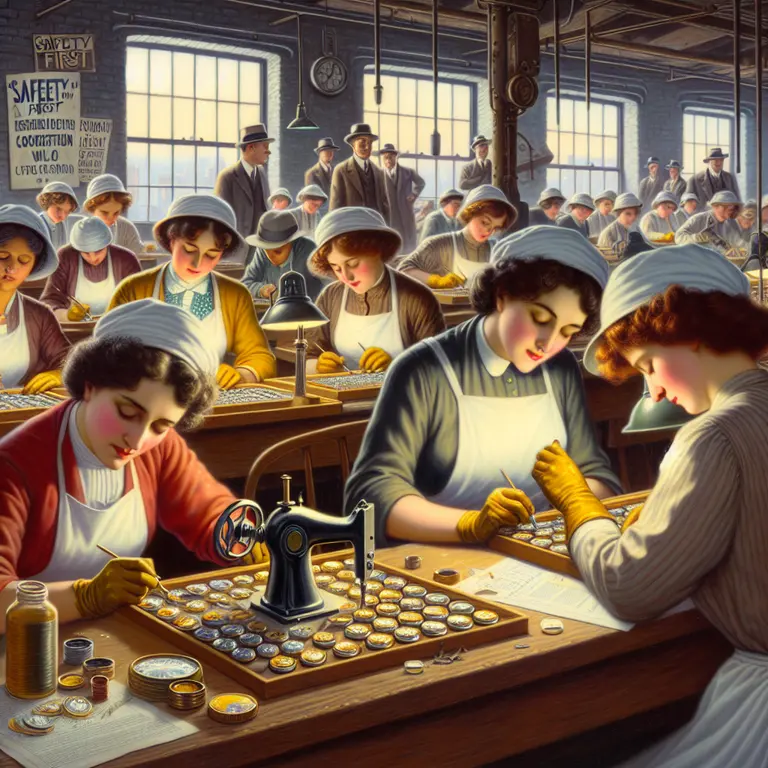
The job of painting watch dials was meticulous and demanding, requiring a steady hand and careful attention to fine detail. The watches were produced for both civilian consumers and military use, with demand for luminous dials surging during and after World War One, when soldiers needed to read their timepieces in the dark. To achieve the necessary precision for painting such small numerals and markings, the women were instructed by their supervisors to keep their brushes pointed by moistening the bristles with their lips, a process known as lip-pointing or tipping. This technique caused the workers to ingest tiny amounts of radium each time they licked their brushes, which they did dozens or even hundreds of times throughout a single workday.
Unaware of any risk, the women continued this routine daily, believing that radium was safe and possibly even beneficial to their health. This belief was not entirely without cultural context. During the early twentieth century, radium was widely promoted as a health-giving substance. Radium-infused tonics, creams, and spa treatments were marketed to wealthy consumers as energizing and rejuvenating. The element had been discovered only in 1898 by Marie and Pierre Curie, and its properties were still being studied. In this atmosphere of scientific excitement and commercial enthusiasm, the idea that radium could be harmful seemed almost counterintuitive. For the dial painters, the luminous quality of the paint seemed to lend their skin a faint, otherworldly glow, which many found charming rather than alarming. Some workers reportedly joked about glowing in the dark on their walks home at night, unaware that what they were experiencing was the visible evidence of a substance accumulating lethally inside their bodies.
The Onset of Tragedy
Over time, the Radium Girls began to experience alarming and deeply troubling health problems. Many suffered from severe anemia, spontaneous bone fractures, and a condition that would come to be known as radium jaw, in which the jawbone would gradually deteriorate and collapse into necrosis. Teeth fell out. Jawbones crumbled. In some cases, surgeons described the bone tissue as so thoroughly contaminated that it glowed faintly in darkened operating rooms. The radioactive radium had been accumulating in the women’s bones, behaving chemically like calcium and therefore being absorbed directly into skeletal tissue, where it irradiated the surrounding cells from within over months and years.
Some women developed cancers of the bone, jaw, and skull. Others experienced debilitating chronic pain, disfigurement, and progressive physical deterioration that left them bedridden and unable to work. Deaths began to occur among women who had been in their twenties and thirties, women who had taken the job believing it was a respectable and well-paying form of employment. Despite these unmistakable symptoms, the dangers of radium exposure were initially denied by the U.S. Radium Corporation. Company officials claimed the illnesses were unrelated to the work, and some even suggested that the women’s conditions were the result of syphilis, a morally loaded accusation that was almost certainly intended to discredit them and deflect legal responsibility. Several physicians who examined the workers were reportedly pressured to suppress or misrepresent their findings, a pattern of corporate interference in medical inquiry that would become a recurring feature of occupational health scandals throughout the twentieth century.
The Legal Battle and Its Broader Significance
As the death toll among the workers mounted and the physical evidence of their suffering became impossible to ignore, the connection between radium exposure and their illnesses grew undeniable. In 1925, a group of former dial painters began pursuing legal action against the U.S. Radium Corporation, marking one of the earliest cases in American legal history in which an employer was held directly responsible for the health consequences suffered by its workers. The women, already gravely ill and in some cases facing terminal diagnoses, pursued justice against a corporation with far greater resources and legal firepower than they possessed.
The legal proceedings were long and difficult. The corporation attempted to run out the clock, knowing that many of the plaintiffs were dying and hoping that their cases would be rendered moot before a verdict could be reached. The statute of limitations was used as a weapon, with the company arguing that too much time had passed since the initial exposure for the women to claim damages. The women and their attorneys fought back by arguing that the injury was ongoing and that the women had not known the cause of their suffering until well after the exposure had occurred. This argument, which eventually succeeded, helped establish an important legal principle regarding workers' right to seek redress even when harm from occupational exposure takes years to manifest.
The eventual settlement in 1928, reached just before some of the plaintiffs died, drew enormous national attention. Journalists covered the case extensively, and the public was both horrified and galvanized. The Radium Girls became symbols of corporate negligence and working-class resilience. Their willingness to appear in court, visibly ill and sometimes barely able to walk, made an impression that no legal argument alone could have achieved. The case spurred significant reforms in workplace safety standards and helped establish the principle that employers have a legal and ethical duty to protect their workers from known hazards, even when those hazards are not yet fully understood by mainstream science.
The Lasting Legacy of the Radium Girls
The legacy of the Radium Girls extends far beyond the courtroom settlements they achieved. Their struggle contributed directly to a broader cultural and legislative shift in how the United States approached occupational health and safety. The case helped lay the groundwork for the eventual establishment of federal regulatory frameworks governing hazardous materials in the workplace. While the Atomic Energy Act of 1946 and the later Occupational Safety and Health Act of 1970 were shaped by many forces, the foundational arguments that workers deserve protection from industrial hazards were tested and strengthened in cases like those brought by the dial painters.
The scientific knowledge generated by studying the Radium Girls also proved to be of lasting importance. Researchers who examined the women’s bodies, both during their lives and after their deaths, developed crucial early insights into how radioactive materials behave inside the human body. This research directly informed the safety protocols developed for workers on the Manhattan Project during World War Two, potentially saving many lives among the scientists and laborers involved in building the atomic bomb. In a deeply ironic sense, the suffering of the Radium Girls helped protect the next generation of workers who handled radioactive materials under far more dangerous conditions.
Conclusion
The story of the Radium Girls is a powerful and sobering reminder of the dangers workers faced before modern safety regulations were established, and of how hard ordinary people had to fight to make those regulations a reality. Their tragic experiences exposed the risks of radium exposure at a time when the scientific and corporate establishment preferred to look away. Their legal battles established precedents that continue to shape occupational health law. And their courage in confronting a powerful corporation while suffering from terminal illness remains one of the most remarkable examples of collective determination in American labor history. The safety measures that workers now take for granted when handling hazardous materials, the right to know what substances they are being exposed to, the right to seek compensation when an employer’s negligence causes harm, these protections exist in no small part because a group of young women in New Jersey refused to be silenced. Their names deserve to be remembered not merely as victims, but as architects of a safer and more just world of work.