
Greek Fire: The Byzantine Empire's Unsolved Legendary Weapon
Byzantine Greek Fire was a terrifying naval weapon whose precise formula has been lost for nearly a millennium, yet modern chemists and historians are still piecing together its secrets.
Introduction
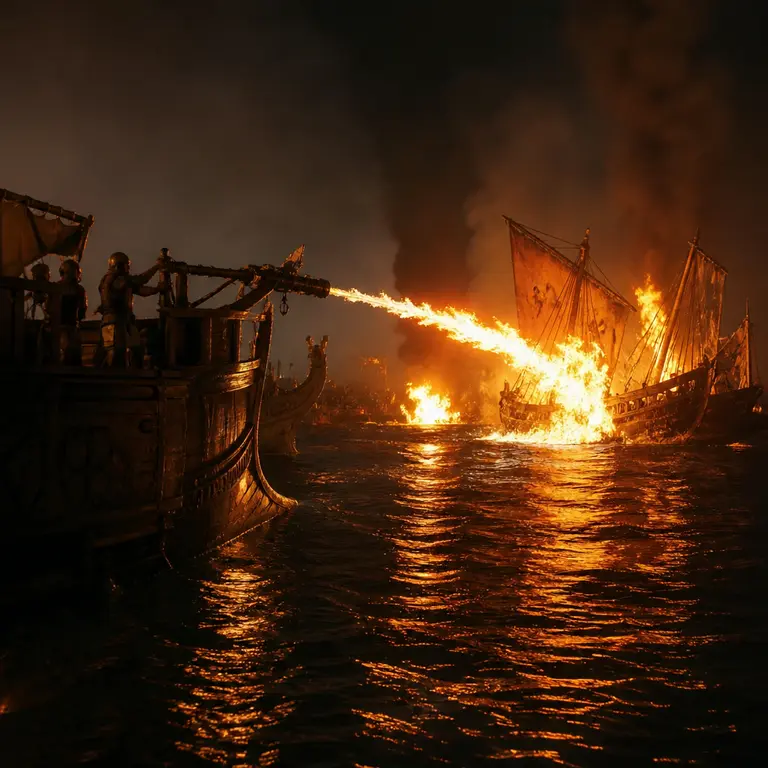
In the summer of 678 CE, a Muslim Arab fleet from the Umayyad Caliphate assembled in the Sea of Marmara with the intention of capturing Constantinople, the jewel of the Byzantine Empire. What the fleet encountered instead was something that defied all military experience: a substance projected from bronze tubes mounted on Byzantine warships that burst into flames on contact with water and could not be extinguished by it. The Arab fleet was devastated. The same weapon repelled a second major Arab assault in 717 to 718 CE. Over the following centuries, Greek Fire, as it came to be called by crusaders and chroniclers, became the single most closely guarded military secret in the medieval world, and perhaps in all of recorded history.
The Byzantines called it “liquid fire” or “sea fire,” rendered in Greek as hygron pyr. Its psychological impact was as devastating as its physical destruction. Sailors who survived encounters with it described flames that clung to wood, skin, and rigging alike, burning even as men plunged into the sea. The Byzantine historian Theophanes the Confessor, writing in the early ninth century, credited its invention to a Syrian architect and chemist named Kallinikos of Heliopolis, who reportedly fled from Arab-controlled Syria to Constantinople around 668 CE. Whether Kallinikos was a single individual or a convenient historical shorthand for a team of Byzantine engineers remains a matter of scholarly debate, but the weapon’s development is reliably dated to the reign of Emperor Constantine IV. What followed was four centuries of naval dominance built on a formula that no enemy ever fully cracked, and that no surviving document has ever fully revealed.
What Was Actually in It
The formula for Greek Fire was never written down in any surviving document, or if it was, that document has not been found. The Byzantine imperial court treated the recipe as a state secret of the highest order. Emperor Constantine VII Porphyrogennetos, writing in the mid-tenth century in his administrative manual De Administrando Imperio, explicitly warned his son never to share the composition of Greek Fire with foreign powers, stating that it had been revealed to Constantine the Great by an angel and that God would punish any emperor who betrayed it. This theological framing was almost certainly a political device to discourage defection among those who knew the formula. By wrapping the secret in divine sanction, the imperial court transformed a chemistry problem into a spiritual obligation, making betrayal not merely treasonous but sacrilegious.
Modern chemists and historians have proposed several candidate compositions based on the weapon’s described behavior. It floated on water, burned intensely, could be projected as a stream or hurled in clay grenades, and was reportedly extinguishable only by sand, strong vinegar, or old urine. The most widely accepted hypothesis, advanced by scholars including John Haldon and Brian Croke, centers on crude petroleum or naphtha, available from natural seeps in the Black Sea and Caucasus regions, combined with quicklime, which reacts exothermically with water, along with pine resin and possibly sulfur. The quicklime component would explain why water intensified rather than suppressed the flames, a counterintuitive property that would have seemed supernatural to anyone encountering it for the first time. Some researchers have also proposed the inclusion of calcium phosphide, which ignites spontaneously upon contact with moisture, though evidence of its deliberate use in this era remains sparse.
The delivery mechanism was equally sophisticated. Byzantine warships were fitted with siphons, bronze tubes connected to pressurized reservoirs, that could project a stream of burning liquid onto enemy vessels. A hand-pumped bellows system likely maintained the pressure. Smaller, handheld versions and ceramic grenades filled with the substance were also deployed in land battles. The engineering required to heat, pressurize, and project a flammable liquid without destroying the ship carrying it represents a remarkable feat of applied chemistry and mechanical design for the seventh century. The fact that Byzantine crews operated these systems routinely, in combat conditions, without catastrophic accidents suggests a level of procedural discipline and technical training that modern accounts rarely acknowledge.
The Geopolitical Weight of a Secret
For roughly four centuries, Greek Fire served as a strategic equalizer, allowing the Byzantine Empire to punch far above its weight in naval confrontations. It was decisive not only against Arab fleets but also against Rus attacks on Constantinople in 941 CE, when Prince Igor of Kyiv led a massive fleet that Byzantine ships reportedly destroyed with the weapon. The chronicler Liutprand of Cremona, an Italian bishop who visited Constantinople in the tenth century, described the Greek Fire siphons in wide-eyed terms, noting that the flames seemed to leap from the mouths of bronze lion heads mounted at the ships’ prows. This was a theatrical flourish that combined psychological warfare with lethal chemistry, illustrating how the Byzantines understood that the fear a weapon generates can be as militarily valuable as the damage it inflicts.
The Byzantines went to extraordinary lengths to prevent the formula from reaching their enemies. When a Bulgarian tsar offered a large sum of gold to a Byzantine official for the secret in the tenth century, the emperor had the official’s hand cut off. There are accounts, possibly apocryphal, of Byzantine chemists who worked with the substance being kept in isolation and sworn to secrecy on pain of death. The institutional apparatus surrounding Greek Fire resembles, in structure if not in scale, the compartmentalized security arrangements used around nuclear weapons programs in the twentieth century. Knowledge was distributed on a strict need-to-know basis, and those who possessed it were bound by overlapping layers of legal, religious, and physical coercion.
Despite these precautions, imitation versions appeared among Arab, Chinese, and later Western European forces. Arabic military texts from the Abbasid period describe incendiary compounds similar to Greek Fire, and Chinese military manuals from the Song dynasty reference petroleum-based fire weapons. But none of these appears to have replicated the original's full behavior, particularly its water-intensifying combustion, suggesting that the precise combination of ingredients and delivery method was never successfully reverse-engineered during the weapon’s period of use. The copies were dangerous, but they were not the same thing.
The last reliable historical reference to Greek Fire in Byzantine military deployment appears in the twelfth century. After the catastrophic sack of Constantinople by the Fourth Crusade in 1204 CE, the institutional knowledge that sustained the weapon’s production- the workshops, the supply chains, the trained engineers- was shattered along with much else. When the Byzantines recaptured their capital in 1261 under Michael VIII Palaiologos, the empire was a shadow of its former self, and Greek Fire appears to have fallen entirely out of use. The formula, never committed to a surviving document, died with the people who carried it.
Modern Science Closes In
The question of Greek Fire’s composition has attracted serious scientific attention in recent decades, moving beyond antiquarian curiosity into the realm of experimental archaeology and materials science. In 2022, researchers at the University of Patras in Greece published an analysis suggesting that a naphtha-quicklime-resin mixture, when tested under conditions approximating those of Byzantine naval equipment, exhibited combustion behavior consistent with historical descriptions, including the counterintuitive intensification of burning when water was applied. The study used reconstructed ceramic grenades and tested ignition thresholds, burn duration, and water interaction, providing the most empirically grounded assessment of the weapon’s plausible chemistry to date. While the researchers stopped short of claiming a definitive reconstruction, their results narrowed the field of plausible candidates considerably.
Separately, a newly digitized collection of Byzantine military manuscripts held at the Biblioteca Medicea Laurenziana in Florence, part of a broader digitization project completed in 2023, has given scholars access to high-resolution images of texts including the Tactica of Emperor Leo VI. This document contains some of the most detailed surviving descriptions of Greek Fire’s tactical deployment. While the manuscripts do not reveal the formula, they provide granular operational details on siphon placement, crew training, and the conditions under which the weapon was most effective, including wind direction, sea state, and the preferred engagement range. Paleographers and military historians are now cross-referencing these texts with Arabic sources, including the military encyclopedias of the Abbasid period, which contain accounts of Greek Fire from the enemy’s perspective and occasionally describe its effects in ways that complement or complicate the Byzantine record.
The interest is not purely historical. Defense researchers and materials scientists studying incendiary compounds have cited Greek Fire as an early example of a chemically engineered weapon optimized for a specific operational environment, in this case maritime combat in confined waters. The principles underlying its design, particularly the use of hydrophobic accelerants and exothermic reactions triggered by environmental contact, have analogs in modern incendiary technology. Understanding the Byzantine achievement in its own terms illuminates how pre-industrial societies could develop sophisticated applied chemistry under conditions of intense secrecy and institutional pressure, and suggests that the gap between ancient and modern technical capability is often smaller than popular history assumes.
A Secret That Still Holds
What makes Greek Fire genuinely remarkable is not just its effectiveness but its epistemic fate: a weapon that shaped the political survival of a civilization for four centuries, and whose exact nature remains unresolved more than 1,300 years after its first recorded use. Most ancient technologies- the construction of the Pyramids, Roman concrete, Damascus steel- have yielded at least partial answers to modern materials analysis. Researchers have examined physical remains, tested surviving samples, and reverse-engineered production processes from archaeological evidence. Greek Fire has not yielded in the same way, because there is no surviving artifact to analyze. No sealed container of the substance, no residue on a recovered siphon, and no archaeological deposit has been definitively identified. The secret was kept so well that it outlasted the empire that kept it, an extraordinary historical achievement in itself.
For historians of science and technology, this is both a frustration and a fascination. It demonstrates that pre-modern societies were fully capable of industrial-scale secrecy around strategic technologies, a reminder that the concept of classified research is far older than the modern nation-state. The Byzantine management of Greek Fire anticipates, in organizational logic if not in bureaucratic form, the compartmentalization strategies used around radar technology in the Second World War and nuclear weapons development during the Cold War. The impulse to guard a decisive technological advantage through institutional secrecy is not a product of modernity; it is a recurring feature of organized human competition.
Greek Fire also raises an uncomfortable possibility for historians: that other ancient or medieval technologies, dismissed as mythological or exaggerated in historical sources, may have been equally real and equally lost. The ancient world produced accounts of weapons, materials, and processes that modern scholarship has sometimes too quickly categorized as legend. The case of Greek Fire suggests that where a society had strong enough motivation to maintain secrecy, and sufficient institutional capacity to enforce it, genuine technical knowledge could disappear without leaving a recoverable trace. The absence of evidence, in such cases, is not evidence of absence.
What survives is the outline of a story: a refugee chemist arrives in a beleaguered city, delivers a weapon that saves an empire, and that empire guards the secret so fiercely that it dies with the last person who understood it. More than thirteen centuries later, the most powerful analytical tools in the history of science have brought us close to an answer, but not quite there. Greek Fire remains, in the most literal sense, an unsolved problem, and a testament to the possibility that human ingenuity, applied to secrecy, can defeat even the curiosity of the future.
Sources & Further Reading
- Haldon, John and Byrne, Maurice. A Possible Solution to the Problem of Greek Fire. Byzantinische Zeitschrift, 1977.
- Rolland, Nicolas. Greek Fire: The Byzantine Empire's Secret Weapon. Encyclopaedia Iranica, 2012. https://iranicaonline.org
- Parthun, Uwe. The Tactica of Leo VI: New Digitized Folios and Military Chemistry. Byzantine Studies Review, 2023.
- Davidson, H.R. Ellis. The Secret Weapon of Byzantium. Byzantinische Zeitschrift, 1973.