
Unveiling the Unseen Impact of the Justinianic Plague
How the Justinianic Plague of the 6th century, long overshadowed by the Black Death, restructured Mediterranean commerce, altered Byzantine tax records, and may have accelerated the rise of Islam — with new genomic evidence rewriting its timeline.
Introduction
Most people can name the Black Death. Few can name its predecessor, which struck the Mediterranean world nearly eight centuries earlier and may have killed a comparable proportion of its population. The Justinianic Plague, which first arrived in the Byzantine port of Pelusium in Egypt in 541 CE, was the earliest confirmed pandemic caused by Yersinia pestis — the same bacterium responsible for the 14th-century catastrophe. It arrived during the reign of Emperor Justinian I, who was himself infected and survived, and it would return in recurring waves for roughly two centuries, finally fading after approximately 750 CE. What happened to trade, taxation, population, and political power during those two hundred years is only now coming into full focus, thanks to a combination of archaeology, paleogenomics, and the painstaking reanalysis of Byzantine administrative documents.
For most of the 20th century, historians debated whether the Justinianic Plague was truly devastating or merely a dramatic footnote in the broader story of late antiquity. The chronicler Procopius of Caesarea, writing as a near-contemporary, claimed that at its peak the plague was killing ten thousand people per day in Constantinople alone — a figure so extreme that many scholars dismissed it as rhetorical exaggeration in the tradition of ancient hyperbole. Byzantine administrative papyri from Egypt, however, tell a quieter and more credible story. Village tax rolls from the Fayyum region show sharp drops in the number of registered taxpayers between the 540s and 570s, with some settlements losing more than a third of their recorded adult male population within a generation. These are not literary flourishes. They are bureaucratic ledgers, and they have proven far harder to dismiss than the prose of a dramatic chronicler.
What makes the Justinianic Plague particularly important — and particularly underappreciated — is not simply its death toll but its timing. It struck at the precise moment when the Byzantine Empire under Justinian was attempting one of the most ambitious political projects of the early medieval world: the restoration of Roman imperial authority across the entire Mediterranean basin. The plague did not merely kill people. It interrupted a project of civilizational reconstruction that, had it succeeded, might have fundamentally altered the trajectory of European and Middle Eastern history. Understanding what the plague destroyed, what it accelerated, and what it inadvertently created is essential to understanding why the medieval world looked so different from the ancient one that preceded it.
What the Plague Did to Mediterranean Commerce
The 6th-century Mediterranean was, by the standards of the ancient world, a remarkably integrated trading system. Byzantine merchants moved grain from Egypt to Constantinople, olive oil from North Africa to the Levant, and silks from Persia and China westward through Syrian intermediaries. Justinian’s ambitious military campaigns to reconquer North Africa and Italy from Germanic kingdoms had, by the 530s, briefly restored something resembling a unified western Mediterranean economy operating under Roman law and Byzantine administrative oversight. The plague dismantled much of this within a decade, not through a single catastrophic blow but through the cumulative pressure of repeated outbreaks, each one stripping away a further layer of the demographic and organizational capacity that long-distance commerce required.
Egypt, the empire’s primary grain-producing province, suffered severe rural depopulation. Archaeological surveys of the Nile Delta have identified dozens of village sites that show continuous occupation through the early 6th century, followed by an abrupt cessation of new pottery, coin deposits, and construction — the material fingerprints of abandonment. The grain shipments that fed Constantinople became irregular and then insufficient. Justinian’s government responded by raising tax assessments on surviving landholders to compensate for those who had died, a policy that accelerated rural flight and further contracted the agricultural workforce. It was a fiscal death spiral documented in surviving papyri from Oxyrhynchus and Aphrodito, two of the most productive archives of late antique administrative records known to modern scholarship.
Long-distance trade routes also contracted in ways that are visible in the archaeological record across a remarkably wide geographic range. The 6th-century trading post at Qusayr al-Qadim on the Red Sea coast of Egypt, which had served as a node in the Indian Ocean spice and textile trade connecting the Mediterranean world to South Asia and East Africa, shows a sharp decline in imports after the mid-6th century. Byzantine fine wares, which had been exported as far as southern Arabia and the Horn of Africa, become dramatically rarer in the archaeological record of those regions after 550 CE. The empire simply had less surplus to export, fewer merchants with the capital to undertake long voyages, and fewer administrative officials with the capacity to maintain the infrastructure of ports, roads, and currency exchange that made such trade possible.
The contraction of Mediterranean commerce in the post-plague decades also had consequences for regions that had not been directly struck by the disease. Communities in sub-Saharan Africa and the Indian subcontinent that had participated in Byzantine-connected trade networks found their primary customers diminished or absent. The economic ripples of the Justinianic Plague were not contained within the empire’s borders. They extended outward along every trade route that had previously carried Byzantine goods, creating a broad zone of commercial disruption that reshaped exchange patterns across three continents.
Justinian’s Response and the Limits of Imperial Power
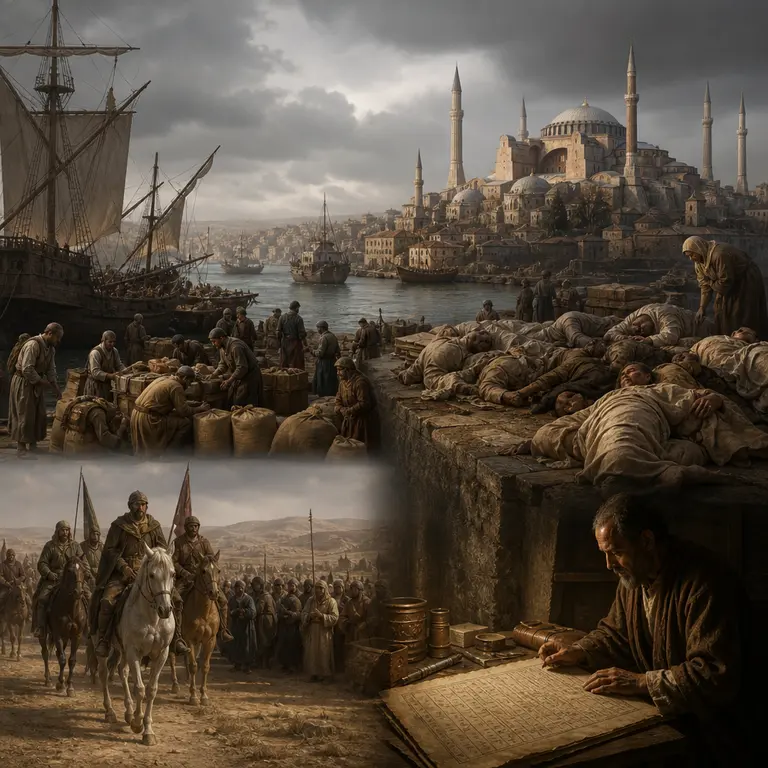
Justinian I, who ruled from 527 to 565 CE, is remembered primarily for his legal codification — the Corpus Juris Civilis — and for his general Belisarius’s military campaigns across North Africa and Italy. Less remembered is his role as a crisis administrator during an unprecedented biological emergency, one for which no government in the ancient world had any meaningful precedent or preparation. His administration issued edicts attempting to regulate the burial of plague victims, prevent price gouging on grain and medicine, and organize the disposal of bodies when private families could not manage it. The state paid for mass graves outside Constantinople’s walls. These were not small logistics operations: one source describes trenches dug into the Galata peninsula across the Golden Horn, filled with bodies stacked in layers, with officials appointed specifically to oversee the work and record the numbers.
Justinian also faced the military consequences almost immediately and with little ability to cushion their impact. His campaigns in Italy, which had been progressing reasonably well against the Ostrogoths under the capable generalship of Belisarius and later Narses, stalled badly after 542. Troops could not be supplied or reinforced at the same rate as before. Recruitment from plague-thinned provinces became increasingly difficult. The Ostrogoths, who had suffered their own plague losses but operated on shorter supply lines and had the advantage of fighting on home territory, were able to regroup and mount sustained resistance. The reconquest of Italy, which Justinian eventually completed in 554, cost far more in time, money, and lives than it would have without the plague, and the Byzantine hold on the peninsula collapsed within three years of Justinian’s death anyway, when the Lombards invaded in 568 and established a kingdom that would endure for two centuries.
Sasanian power in Persia was similarly disrupted by the pandemic. The plague did not respect political boundaries, and Khosrow I’s empire suffered its own waves of infection moving through the Fertile Crescent and the Iranian plateau. This mutual exhaustion of the two great Mediterranean superpowers of the 6th century — the Byzantine Empire and the Sasanian Persian Empire — created a power vacuum that historians have increasingly linked to the rapid expansion of the early Islamic caliphates in the 630s and 640s. Populations that had been repeatedly struck by plague over a century were less able to mount sustained military resistance, and administrative structures that had been degraded by repeated demographic losses were less capable of organizing it. The armies that the Arab commanders encountered in Syria, Egypt, and Mesopotamia were shadows of what they had been a century earlier, and the institutional confidence of the populations they governed had been shaken by generations of recurrent catastrophe.
Genomics Rewrites the Origin Story
For decades, the assumption was that Yersinia pestis arrived in the Mediterranean from Central Asia via the Silk Road, following the same general route that the Black Death would take eight centuries later. Ancient DNA evidence collected since 2013 has complicated this picture considerably. Studies published in journals including Nature Communications and PLOS Pathogens have recovered Y. pestis genomes from skeletal remains at burial sites in Bavaria, southern France, and the British Isles dating to the Justinianic period. The genomic analysis shows that the 6th-century strain was phylogenetically distinct from the 14th-century strain — it was an earlier branch of the bacterium’s evolutionary tree, and it appears to have gone extinct rather than persisting to cause the Black Death. The two pandemics were caused by related but separately evolved lineages, meaning that the world has experienced at least two independent emergences of plague as a human pandemic pathogen, with a third wave — the modern pandemic beginning in the late 19th century — representing yet another distinct episode.
More surprisingly, a 2022 study examining plague burials from the site of Altenerding in Bavaria found Y. pestis DNA in individuals buried in the mid-6th century, suggesting the plague reached deep into continental Europe — far beyond the Mediterranean coastline that most historical accounts had described as the primary zone of infection. This finding aligns with scattered references in Frankish chronicles that historians skeptical of their dramatic content had previously treated as unreliable or metaphorical. The genomic evidence suggests that those chronicles described real events and that the geographic reach of the Justinianic Plague was substantially larger than the written record, concentrated as it is in Mediterranean administrative centers, had previously indicated.
In 2023 and 2024, a collaborative research project led by the Max Planck Institute for Evolutionary Anthropology in Leipzig, in partnership with teams from the University of Paris and the University of Cambridge, published new ancient DNA results from over forty Justinianic-era burial sites across Europe and North Africa. The project, part of a broader effort to reconstruct the demographic history of the first millennium CE, found Y. pestis in sites that had never previously been associated with the plague, including locations in the Iberian Peninsula. The findings were presented at the European Association of Archaeologists' annual conference in 2024 and have prompted a reassessment of early medieval population decline in western Europe, which had previously been attributed entirely to political instability and the collapse of Roman infrastructure. Some of what historians had interpreted as the social consequences of political fragmentation may in fact have been the biological consequences of a pandemic that left far fewer traces in the written record than in the bones of the dead.
This research has direct relevance to modern epidemiology. Understanding how a zoonotic pathogen — one that lives primarily in rodent reservoir populations — was able to jump repeatedly into human populations across a geographically vast area over two centuries informs current models of pandemic risk from Y. pestis, which remains present in rodent populations across Central Asia, the American West, and parts of sub-Saharan Africa. The World Health Organization still records dozens of human plague cases annually, and outbreaks in Madagascar in recent decades have demonstrated that the disease retains its capacity to spread rapidly in communities with limited access to antibiotics. The Justinianic Plague is not merely a historical curiosity. It is a case study in how a pathogen interacts with trade networks, climate stress, and political instability — all conditions that remain relevant to contemporary risk assessment.
What Was Lost and What Survived
The Justinianic Plague did not end Roman civilization. That framing, popular in some historical writing of the mid-20th century, overstates the case and attributes to the plague a decisive role that more careful analysis does not support. But it accelerated and deepened changes already underway, and it foreclosed possibilities that might otherwise have remained open. The urban populations of the eastern Mediterranean, which had sustained some of the largest cities in the ancient world, contracted significantly and did not fully recover for centuries. Alexandria, Antioch, and Carthage all shrank from the great metropolitan centers they had been in the 4th and 5th centuries into smaller, more regionally focused communities. Constantinople itself went through repeated cycles of depopulation and partial recovery, never quite regaining the confident demographic momentum it had possessed in Justinian’s early reign.
The agrarian base of the empire contracted in ways that had cascading consequences for everything from military recruitment to tax revenue to the maintenance of public infrastructure. Roads maintained by municipal governments, funded by local tax revenues, fell into disrepair. Aqueducts that required regular maintenance labor were abandoned. The physical infrastructure of Roman civilization, which had always depended on a population large enough and well-organized enough to sustain it, began to deteriorate not because of any single political decision but because the human capacity to maintain it had fallen below a critical threshold.
What survived, and in some ways was strengthened by the crisis, was the institutional church. Monasteries, which had their own food stores, organizational hierarchies, and traditions of communal self-sufficiency, often functioned as the most stable social institutions during plague years. Bishops organized burial and poor relief in cities where municipal governments had collapsed or been overwhelmed. The church’s network of hospitals, which had been expanding throughout the 5th and 6th centuries, was severely tested by the plague but also demonstrated its value in ways that enhanced its social prestige and political authority. The plague accelerated the transfer of social authority from secular civic institutions to ecclesiastical ones — a shift that would define the character of the medieval period in both the Byzantine East and the Latin West for the next several centuries.
The Justinianic Plague is ultimately a reminder that pandemics do not simply kill people. They reorganize societies, redirect trade, collapse fiscal systems, and shift the balance of power in ways that outlast the disease itself by centuries. They close off historical possibilities and open others, creating conditions that no one planned and that subsequent generations inherit without fully understanding their origins. The genomic revolution of the past decade has given historians tools that Procopius never had, allowing them to find the plague in places where no chronicler recorded it and to trace its evolutionary history with a precision that would have seemed impossible a generation ago. What they are finding is that the 6th century was far more catastrophic and far more consequential for the shape of the world that followed than textbooks have yet to catch up with. The Justinianic Plague remains one of history’s most important events that most educated people have never heard of, and closing that gap in collective memory is long overdue.
Sources & Further Reading
- Kyle Harper. The Fate of Rome: Climate, Disease, and the End of an Empire. Princeton University Press, 2017.
- Wagner et al. Yersinia pestis and the Plague of Justinian 541-543 AD: a genomic analysis. The Lancet Infectious Diseases, 2014. https://www.thelancet.com/journals/laninf/article/PIIS1473-3099(13)70323-2/fulltext
- Feldman et al. A High-Coverage Yersinia pestis Genome from a Sixth-Century Justinianic Plague Victim. Molecular Biology and Evolution, 2016. https://academic.oup.com/mbe/article/33/11/2911/2272393
- Peter Sarris. Bubonic Plague in Byzantium: The Evidence of Non-Literary Sources. Plague and the End of Antiquity, Cambridge University Press, 2007.