
Mystery of Greek Fire: Byzantine Empire's Secret Weapon
Byzantine Greek fire was one of antiquity's most devastating and secretive weapons, yet its precise chemical composition remains unresolved more than a millennium after its last recorded use.
Introduction
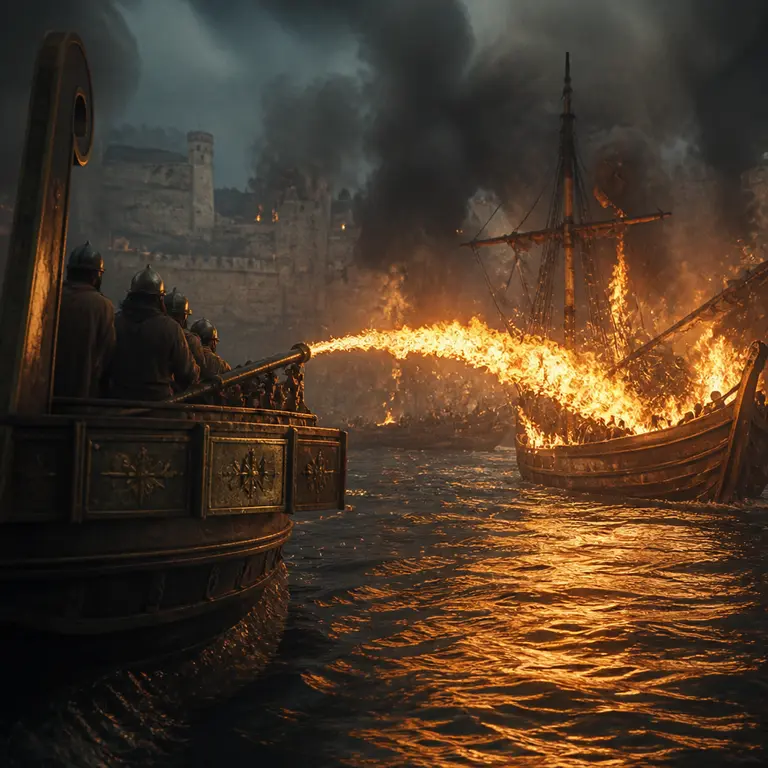
Sometime around 672 CE, the Byzantine Empire deployed a weapon that would reshape naval warfare in the Mediterranean for the next four centuries. Arab fleets besieging Constantinople encountered something they had never seen before: a substance that ignited on contact with water, clung to wood and flesh alike, and could not be extinguished by conventional means. Byzantine sailors launched this material through bronze siphons mounted on the prows of their warships, called dromons, directing streams of liquid fire at enemy vessels. The Arab fleet, according to the chronicler Theophanes the Confessor, was effectively destroyed. The weapon would later be called Greek fire, though the Byzantines themselves referred to it as liquid fire or sea fire.
What made Greek fire so extraordinary was not merely its destructive power but its apparent defiance of basic physics. Water, the universal suppressor of ordinary flame, seemed to accelerate it. Witnesses described burning material floating on the sea’s surface, consuming ships and men who jumped overboard to escape. Sand and vinegar were reportedly among the few agents capable of smothering it. For enemies of Byzantium, it appeared almost supernatural — a divine weapon bestowed upon the empire by God. For historians and chemists, it has remained one of the most tantalizing unsolved problems in the history of technology. No other weapon of the ancient or medieval world has generated so much scholarly debate while yielding so few definitive answers. It is a mystery that sits at the intersection of chemistry, military history, political intrigue, and the sociology of secrecy.
The Man Behind the Formula
Byzantine sources credit the invention to a Syrian engineer named Kallinikos, or Callinicus, of Heliopolis — a city in the region now corresponding to Baalbek in modern Lebanon. Kallinikos is described as a refugee who fled the Arab conquest of Syria and brought his formula to Constantinople, where it was reportedly adopted by Emperor Constantine IV. The date most often cited for its first military use is 678 CE, during the first Arab siege of Constantinople, though some scholars place the initial development slightly earlier, suggesting that Kallinikos may have been refining the compound for some years before it was deployed in battle.
Kallinikos is a frustratingly obscure figure. No writings attributed to him survive. No portrait, no detailed biography, no list of other inventions. He appears in the historical record almost exclusively in connection with this single devastating creation, then vanishes entirely. His national or ethnic identity is debated — some sources describe him as Greek, others as Syrian or Jewish. What is not disputed is that his contribution to Byzantine military survival was enormous. The Arab sieges of Constantinople in the 670s and again in 717 to 718 CE were both repelled in part through the deployment of Greek fire, and the preservation of the Byzantine state for another seven centuries shaped the political and cultural trajectory of the entire eastern Mediterranean world.
It is worth pausing on the strangeness of this biographical gap. Kallinikos gave one of the most powerful empires of the medieval world its most decisive military advantage, and yet he left almost no trace in the historical record beyond a handful of references. This is not entirely surprising given the Byzantine secrecy surrounding the weapon, but it does raise questions. It is possible that later Byzantine authorities deliberately suppressed detailed accounts of his identity or methods to prevent the formula from being reconstructed from biographical context. It is also possible that Kallinikos was not a single individual but rather a composite figure representing a team of engineers or a tradition of incendiary experimentation that was later attributed to one man for the sake of narrative simplicity. History is full of such compressions.
The Chemistry of Destruction
The exact composition of Greek fire is unknown, and that is not a rhetorical hedge — it is a genuine historical fact. The Byzantines guarded the formula with extraordinary secrecy. Emperor Constantine VII Porphyrogennetos, writing in the mid-10th century, explicitly instructed his son that the secret of Greek fire must never be shared with foreign powers, emphasizing that it had been revealed to the first Christian emperor by an angel and that any emperor who attempted to share it would be cursed. This was not mere rhetoric; Byzantine sources record that the formula was compartmentalized, with different craftsmen knowing only portions of the production process. The system resembles what modern intelligence agencies would call compartmentalization — a structural approach to secrecy in which no single person holds enough information to reconstruct the whole.
Modern researchers have proposed numerous candidate formulations. The most widely accepted hypothesis involves crude petroleum or naphtha as a base — the Byzantine Empire had access to natural petroleum seeps in the Crimea and around the Black Sea. In response, various researchers have proposed additions, including quicklime, which reacts exothermically with water and could explain the weapon’s apparent ability to ignite on contact with seawater; pine resin or pitch, which would increase adhesion and burning duration; and sulfur, which was widely associated with incendiary warfare in the ancient world. Some researchers have proposed calcium phosphide, which spontaneously ignites in air, as an ingredient, though evidence for Byzantine access to this compound is thin and the proposal remains controversial among specialists.
The chemist and historian John Haldon, along with his colleagues, conducted experimental reconstructions in the 1990s using petroleum-based mixtures delivered through heated bronze siphons. Their results demonstrated that a pressurized naphtha mixture could be projected as a stream of burning liquid with realistic range and adhesion, lending support to the petroleum-based hypothesis. However, no reconstruction has definitively replicated all properties described by historical witnesses, particularly the ignition-on-water behavior, which remains the most chemically puzzling characteristic. One possibility is that witnesses exaggerated or misunderstood what they saw — that what appeared to be ignition caused by water was actually a compound that burned so intensely and adhered so tenaciously that dousing with water simply failed to extinguish it, creating the impression that the water itself was feeding the flame. Perception under combat conditions is notoriously unreliable, and medieval chroniclers were not chemists.
Strategic and Psychological Impact
Greek fire’s importance extended well beyond the immediate destruction it caused. Its psychological effect on enemy forces was profound and long-lasting. Arab military commanders who had swept across Persia and North Africa with remarkable speed found themselves unable to overcome a weapon they could neither understand nor counter. The failed siege of 717 to 718 CE, in which a massive combined Arab land and sea force was repulsed with the help of Greek fire, is considered by many historians to be one of the pivotal military engagements of the early medieval period, comparable in consequence to the Battle of Tours in 732 CE for halting Arab expansion into Europe. Had Constantinople fallen a generation earlier than it eventually did, the political map of the medieval world might look unrecognizable to modern eyes.
The Byzantines used the weapon selectively, deploying it primarily in naval engagements where its properties were most effective. They also transferred a version of it — possibly a modified or deliberately degraded formula — to allied powers on occasion, though they were careful about what they shared. When the Bulgarian ruler Simeon I threatened Constantinople in the early 10th century, the Byzantines reportedly sent Greek fire to their Rus allies to use against Bulgarian forces, suggesting the weapon could be packaged in some portable form, perhaps as incendiary grenades or sealed ceramic pots. This portability, if accurately described, implies a more sophisticated delivery technology than the shipboard siphon system alone.
Later medieval incendiary weapons, including various forms of wildfire used by Western European armies, were likely inspired by or loosely derived from Greek fire, though they were almost certainly different in composition. The Crusaders encountered Byzantine fire weapons during their complicated interactions with Constantinople and carried descriptions of incendiary warfare back to Western Europe. By the 13th century, various incendiary mixtures were in use across the Mediterranean world, but none appear to have replicated the specific properties of the original Byzantine compound. The word traveled further than the formula.
The Disappearance of the Formula
Greek fire appears in Byzantine records through the 12th century. Its last clearly documented military use is often placed around 1118 CE, during the reign of Emperor Alexios I Komnenos, who reportedly deployed it against Norman forces. After this point, references to the weapon become sparse and ambiguous. By the time Constantinople finally fell to the Ottoman Turks in 1453, there is no credible evidence that Greek fire in its original form was still available to the defenders. Whether the formula was lost through the disruption of the Byzantine state, the deaths of the craftsmen who held it, deliberate suppression, or gradual obsolescence as gunpowder weapons became available, is unknown.
The disappearance of the formula is itself a remarkable historical event. It represents one of the few cases in recorded history where a major military technology was genuinely lost rather than superseded or preserved in archives. Gunpowder did not replace Greek fire so much as render it less strategically unique, and by the time gunpowder artillery became dominant, the specific knowledge of how to produce the Byzantine compound had apparently ceased to be transmitted. This is a sobering reminder that knowledge is not inherently self-preserving. Without deliberate, redundant, and accessible documentation, even the most consequential technical knowledge can simply cease to exist. The compartmentalization that protected the formula during the empire’s strength became the mechanism of its extinction during the empire’s decline.
Present-Day Research and Renewed Interest
In 2023 and 2024, renewed scholarly attention focused on Byzantine military technology as part of a broader reassessment of medieval engineering capabilities. A research initiative at the University of Athens, in collaboration with chemists at the National Hellenic Research Foundation, has been applying modern analytical chemistry to residue samples from Byzantine-era shipwrecks in the Aegean, hoping to identify chemical signatures consistent with incendiary materials. While no definitive results attributable to Greek fire had been published as of early 2025, the project represents the most systematic materials-science approach to the question yet undertaken. Even a negative result — the absence of expected compounds — would help narrow the field of plausible formulations.
Separately, the digitization of Byzantine manuscript collections, including holdings at the Vatican Apostolic Library and the Biblioteca Nazionale Marciana in Venice, has made previously inaccessible military treatises available to researchers worldwide. Among these are several versions of the Tactica, a Byzantine military manual, and fragments of texts that discuss incendiary warfare in technical terms. Digital humanities scholars are now applying computational text analysis to these documents to identify patterns in terminology that might shed light on ingredients or production methods that earlier readers missed. The application of machine learning to historical linguistics is still in its early stages, but the possibility of surfacing overlooked technical detail from manuscripts that have been read for centuries without yielding their secrets is genuinely exciting.
The question of Greek fire also intersects with contemporary interest in non-Newtonian fluid dynamics and advanced incendiary materials in defense research, fields that have occasionally cited the Byzantine weapon as a historical precedent for adhesive combustible compounds. Whether that lineage is direct or merely inspirational, the weapon that a Syrian refugee engineer brought to Constantinople in the seventh century continues to generate serious scientific inquiry more than thirteen centuries after its first recorded use. That a substance whose formula has been lost for nearly a millennium can still animate modern laboratories and computational linguists alike is perhaps the most fitting testament to its power. Greek fire, it seems, has not entirely gone out.
Sources & Further Reading
- Haldon, John, and Maurice Byrne. A Possible Solution to the Problem of Greek Fire. Byzantinische Zeitschrift, 1977.
- Rollins, Mark. Greek Fire, Poison Arrows and Scorpion Bombs: Biological and Chemical Warfare in the Ancient World. Overlook Duckworth, 2008.
- Theophanes the Confessor. Chronographia. Translated by Cyril Mango and Roger Scott, Clarendon Press, 1997.
- Davidson, Hilda Ellis. The Secret Weapon of Byzantium. Byzantinische Zeitschrift, 1973.