
The Pineapple That Sparked a Ceramic Craze in Staffordshire
Learn how the exotic pineapple influenced an unexpected ceramic boom in 18th-century England.
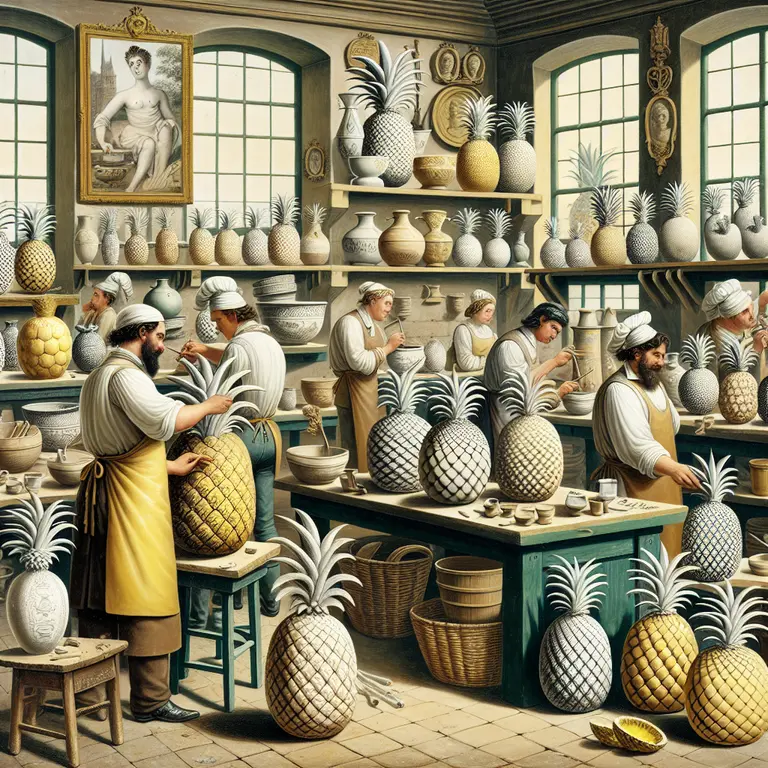
The Pineapple and the Potter: How a Tropical Fruit Transformed English Ceramics
The history of ceramics is filled with curious and transformative moments, but perhaps none so uniquely unpredictable as the influence of the pineapple in 18th-century England. This tropical fruit, rarely seen by the average British citizen of the time, had come to symbolize wealth, hospitality, and social ambition in ways that seem almost absurd by modern standards. Yet its cultural weight was very real, and its advent in high society directly spurred a significant trend within ceramic production that rippled throughout Staffordshire’s pottery industry and beyond. What began as an aristocratic obsession with an exotic fruit ultimately reshaped manufacturing techniques, economic structures, and the decorative arts across an entire continent.
Historical Context: The Pineapple Arrives in Europe
Pineapples have been shrouded in mystery and luxury since they first arrived in Europe from South America in the late 15th century, carried back by Christopher Columbus and his crew following their 1493 voyage to the Caribbean island of Guadeloupe. For European observers who had never encountered anything like it, the fruit was a botanical marvel, its armored exterior and crown of spiky leaves suggesting something between a pinecone and a royal scepter. Word of its extraordinary sweetness spread rapidly through the courts and intellectual circles of the continent, where it became an object of intense curiosity.
The intrigue surrounding these fruits reached a particular peak in England when King Charles II was depicted receiving a pineapple as a gift in John Rose’s painting around 1675. The image was loaded with symbolic meaning. A king accepting a pineapple was not merely accepting a piece of fruit; he was accepting a token of the world’s rarest and most coveted produce. Given the extraordinary difficulty of importing or cultivating pineapples in the British climate, one fruit could cost the equivalent of tens of thousands of pounds by today’s standards. Wealthy landowners began constructing elaborate heated glasshouses called pineries specifically to grow them, and some hosts rented pineapples by the evening to display at dinner parties, returning the fruit untouched the following morning. The pineapple was, in every practical sense, too valuable to eat.
Symbolism and Social Impact: Ceramics as Cultural Currency
As pineapples began to solidify their status as the ultimate emblem of luxury and social standing, English potters recognized an extraordinary commercial opportunity. The fruit itself was inaccessible to the vast majority of the population, but a ceramic replica was not. Producing imitation pineapples in earthenware and, later, in more refined ceramic processes provided an accessible means for ordinary citizens and the aspiring middle classes to participate in this symbol of affluence. Displaying a pineapple-shaped teapot or serving dish on one’s table communicated taste, awareness of fashion, and a degree of sophistication, even if the real fruit remained far out of reach.
Staffordshire potteries emerged as the pioneers of this trend during the early decades of the 18th century. The region had long been a center of ceramic production due to its abundant clay deposits and coal supplies for firing kilns, but the pineapple craze gave local craftsmen a specific and lucrative design challenge to pursue. Pineapple ware, as it came to be known, appeared in the form of teapots, creamware jugs, sugar bowls, and decorative centerpieces. The fruit's textured, segmented skin and distinctive leafy crown demanded a level of sculptural detail that pushed potters to develop new modeling and glazing techniques. In this way, a social obsession became an engine of genuine craft innovation.
Technological Advancements: Craft Responding to Demand
Before the pineapple craze took hold, Staffordshire pottery was largely functional and relatively unadorned. The region produced serviceable domestic wares, but the ambition to replicate the intricate geometry of pineapple skin required potters to rethink their methods at almost every stage of production. The growing interest in exotic and luxury items among the British elite created sustained market pressure that rewarded experimentation and penalized stagnation.
Improvements in kiln technology during this period enabled more precise temperature control, which in turn led to more consistent results when firing complex three-dimensional forms. The irregular, raised texture of pineapple skin required molds and hand-finishing techniques that had not previously been necessary for simpler wares. Potters developed new approaches to surface relief work, pressing clay into detailed molds and then refining the results by hand before applying glazes that could capture the fruit’s distinctive yellow-green coloring. Local clay sources in Staffordshire proved particularly well suited to this kind of detailed work, offering a plasticity that supported the fine surface patterning the designs required. The combination of improved materials, better firing conditions, and growing technical ambition produced a generation of craftsmen who were significantly more skilled than their predecessors, and whose capabilities extended well beyond pineapple ware into the broader decorative arts.
Key Figures: Josiah Wedgwood and the Industrialization of Taste
No figure looms larger over this period of Staffordshire ceramic history than Josiah Wedgwood. Born in 1730 into a family of potters in Burslem, Wedgwood demonstrated from an early age a capacity for both artistic refinement and commercial strategy that set him apart from his contemporaries. He understood that the market for ceramics was not merely a market for useful objects but for social identity, and he positioned his products accordingly.
Wedgwood leveraged the pineapple craze and the broader appetite for exotic decorative objects to advance earthenware crafting techniques in ways that would have lasting consequences for the industry. His development of creamware, a refined, lightweight, cream-colored earthenware, gave him a versatile medium that could be shaped into elaborate forms and decorated with precision. His cauliflower ware and pineapple ware, produced during the 1750s and 1760s, demonstrated a mastery of naturalistic modeling that attracted aristocratic and royal attention. When Queen Charlotte ordered a set of his creamware in 1765, Wedgwood renamed it Queensware and used the royal endorsement as a marketing tool of remarkable effectiveness.
What distinguished Wedgwood from other potters of his era was his understanding that craftsmanship alone was insufficient. He invested in strategic marketing campaigns that portrayed his ceramics as objects worthy of royal banquets and aristocratic collections. He opened showrooms in London, cultivated relationships with influential patrons, and used printed catalogs to reach customers across Britain and Europe. The result was what contemporaries might fairly have called a ceramic fever, a widespread enthusiasm for fine pottery that transformed Wedgwood’s name into a byword for quality and elevated the entire Staffordshire industry in the process.
Economic Impact: A Regional Industry Transformed
The increased demand for ceramic pineapples and the broader decorative wares they inspired considerably transformed local and regional economies. Staffordshire’s pottery towns, including Burslem, Hanley, and Stoke, experienced significant growth in employment and commercial activity during the latter half of the 18th century. Pottery businesses that had previously served local markets found themselves supplying domestic retailers and international traders, with Wedgwood’s wares reaching customers in continental Europe and the American colonies.
The sector's profitability attracted investment in infrastructure, including the construction of canals that enabled the fragile finished goods to be transported more safely than road haulage allowed. The Trent and Mersey Canal, completed in 1777 and championed in part by Wedgwood himself, connected the Staffordshire potteries to the ports at Hull and Liverpool, opening international markets on a scale that had not previously been possible. The economic ripple effects extended to suppliers of raw materials, transporters, and the broader communities that depended on the pottery trade for their livelihoods. What had begun as a fashionable obsession with a tropical fruit had, through a chain of cultural and commercial responses, contributed to the physical reshaping of the English Midlands.
Lasting Legacy: What the Pineapple Taught Us About Innovation
The era marked by the pineapple’s extraordinary cultural influence offers more than an entertaining footnote in the history of British decorative arts. It demonstrates with unusual clarity how cultural symbols can function as catalysts for technological innovation and economic transformation. The potters of Staffordshire did not set out to revolutionize their industry; they set out to meet a demand that society had created around an object of desire. In doing so, they developed skills, techniques, and commercial structures that outlasted the fashion that inspired them for centuries.
The pineapple remains a symbol of hospitality to this day, visible in architectural details, hotel logos, and decorative objects across the English-speaking world, a persistence that speaks to the depth of the cultural impression it made during its 18th-century peak. Wedgwood, as a brand, has survived into the 21st century and continues to produce ceramics that carry the legacy of the innovations pioneered during this period. The story of the pineapple and the potter is ultimately a story about how human beings respond to beauty, status, and desire, and how those responses, channeled through craft and commerce, can leave marks on the material world that endure long after the original impulse is forgotten.