
Tracing the Surprising Beginnings of Today's Treadmills
Originally designed for punishment, treadmills now are fitness tools.
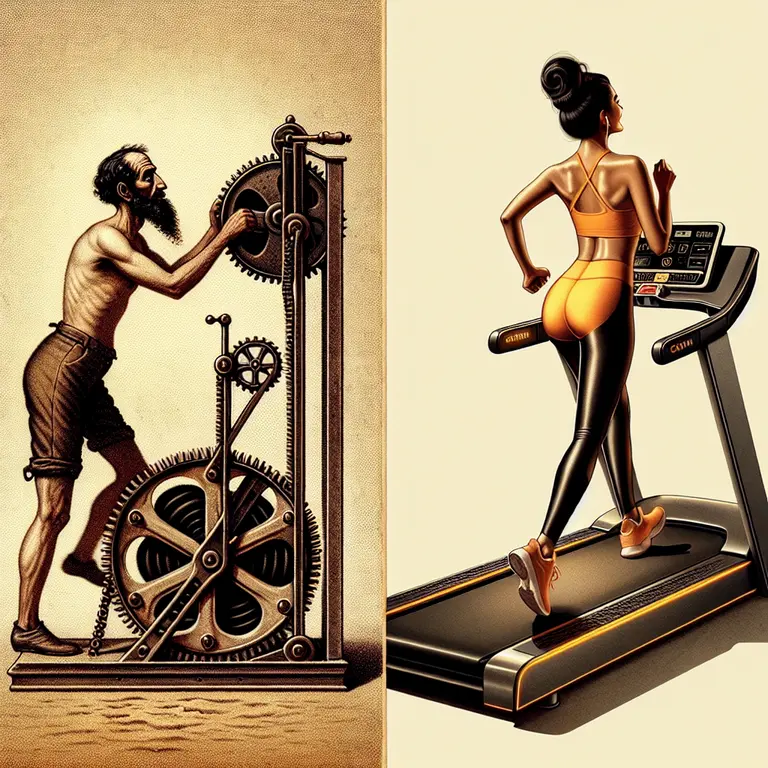
The modern treadmill occupies a curious place in contemporary culture. It sits in gleaming rows inside fitness centers, appears in home gyms, and has become almost synonymous with the pursuit of health, endurance, and physical well-being. Millions of people step onto its moving belt each day with goals centered on longevity, weight management, or athletic training. Yet almost none of them are aware that the machine beneath their feet was not born from any vision of human flourishing. It was born from punishment. The treadmill’s journey from a Victorian instrument of penal suffering to a symbol of modern wellness is one of the more remarkable and underappreciated transformations in the history of everyday objects.
Historical Background: A Machine Born of Discipline
The story begins in 1818 with Sir William Cubitt, a civil engineer working in England who would later become famous for overseeing construction projects of considerable prestige, including portions of the rebuilding of London. At the time, however, Cubitt was preoccupied with a more immediate social problem: what to do with the growing population of idle prisoners filling British jails. The prevailing philosophy of the era held that idleness was morally corrupting and that hard, repetitive labor was the most effective path to reforming a criminal character. Cubitt’s solution was the tread-wheel, a large paddle-like device that prisoners were made to climb continuously, as though ascending an endless staircase that never brought them any closer to the top.
These early machines bore almost no physical resemblance to the sleek, electronically controlled devices we recognize today. They were enormous wooden-and-iron structures, sometimes stretching across entire prison yards, with spokes or steps arranged around a central rotating cylinder. Groups of prisoners would work the wheel simultaneously, each one climbing in place while the cylinder's rotation was harnessed to perform useful mechanical tasks. The design was deliberately simple, deliberately exhausting, and deliberately without end. There was no goal to reach, no distance to cover, and no finish line to cross. That absence of purpose was entirely intentional.
Functionality and Use in Prisons: Labor as Punishment
The mechanics of the prison treadmill were straightforward but physically demanding in ways that modern users of exercise equipment would find almost unimaginable. Prisoners gripped a horizontal bar for balance while stepping continuously on the revolving spokes or paddles. The wheel turned under their collective weight and effort, and that rotational energy was transferred through a system of gears and axles to power grinding mills, water pumps, or ventilation systems within the prison itself. In this way, the treadmill served a dual purpose that appealed greatly to prison administrators and reformers of the time. It was simultaneously a source of punishment and of productive output, a combination that seemed to satisfy both the punitive and utilitarian instincts of early 19th-century penal philosophy.
By 1842, institutions such as the Liverpool Borough Gaol had integrated treadmills into their daily operations, using prisoner labor to grind corn for local consumption. The concept spread rapidly across Britain and then into Europe and North America, where it was embraced as a more respectable alternative to older forms of corporal punishment like flogging. There was something about the treadmill that felt both modern and morally serious. It did not draw blood. It did not disfigure. It simply wore a person down through relentless, purposeless repetition, hour after hour, day after day. Prisoners could be made to walk the equivalent of thousands of feet of vertical climbing in a single shift, often in silence, often without rest, and often without any acknowledgment that the labor they performed was connected to any meaningful outcome for themselves.
The psychological dimensions of this punishment were arguably as significant as the physical ones. The monotony was engineered. The futility was structural. A prisoner climbing a treadmill was not building something, not learning something, and not moving anywhere. That combination of exhaustion and meaninglessness was precisely what made the treadmill so effective as a tool of institutional control, and also what would eventually make it impossible to defend.
Decline and Transformation: The Humanitarian Turning Point
By the latter half of the 19th century, the cultural and moral climate in Britain and elsewhere was beginning to shift in ways that would prove fatal to the prison treadmill. Reformers, journalists, and medical professionals began raising serious concerns about the physical toll the machines were taking on prisoners, many of whom were malnourished, elderly, or already weakened by illness. Reports emerged of prisoners collapsing from exhaustion, suffering joint damage, and developing serious cardiovascular complications as a direct result of their time on the wheel. The argument that such treatment reformed character began to lose its persuasive force in the face of mounting evidence that it primarily destroyed bodies.
The literary world also played a role in shifting public opinion. Oscar Wilde, who served two years of hard labor at Reading Gaol beginning in 1895, wrote extensively about the dehumanizing effects of prison treadmill work in his famous letter De Profundis and in The Ballad of Reading Gaol. His accounts brought the reality of penal labor to a wide and sympathetic audience, helping to erode the comfortable distance that middle-class society had maintained from the mechanics of punishment. By the time the Prisons Act of 1898 was passed in Britain, the treadmill was effectively on its way out. It was formally abolished in British prisons in 1902, ending nearly a century of institutionalized use.
The disappearance of the treadmill from prisons did not, however, mean the disappearance of the underlying mechanical concept. The idea of a revolving surface that simulated walking or running in place remained available to anyone with the imagination to repurpose it.
The Treadmill’s Evolution into Fitness Equipment: Reinvention and Redemption
The reinvention of the treadmill as a tool for health rather than punishment did not happen overnight. For several decades after its disappearance from penal institutions, the basic concept lay largely dormant. It was not until the mid-20th century that engineers and physicians began to see real potential in a device capable of simulating the cardiovascular demands of walking and running in a controlled indoor environment. The first motorized treadmill designed specifically for medical and fitness purposes is generally credited to Robert Bruce and Wayne Quinton, who developed a device in the early 1950s for use in cardiac stress testing. Their machine allowed physicians to monitor how a patient’s heart responded to increasing levels of physical exertion, providing diagnostic information that was previously impossible to gather without sending patients out to run in unpredictable outdoor conditions.
From this clinical origin, the treadmill made its way into athletic training programs, rehabilitation centers, and eventually into the consumer fitness market. By the 1970s and 1980s, the jogging boom sweeping across the United States and other Western nations had created enormous demand for indoor running options, and manufacturers responded with increasingly sophisticated home and commercial treadmill designs. Speed controls, incline adjustments, heart rate monitors, and eventually digital displays with pre-programmed workout routines transformed the machine into something almost unrecognizable from its prison ancestor.
Today’s treadmills are engineered with a level of precision and user-centered design that would have seemed extraordinary to William Cubitt. They cushion the impact of each footfall to protect joints, simulate the resistance of outdoor terrain through variable incline settings, connect to smartphones and streaming services, and provide real-time biometric feedback to help users optimize their training. The machine that was once designed to break the human spirit through exhaustion and monotony is now designed to elevate it.
Conclusion: The Long Arc of an Unlikely Object
The history of the treadmill is, in miniature, a history of how societies change their minds about the relationship between physical effort and human dignity. What was once conceived as a mechanism of suffering has been thoroughly reclaimed as a mechanism of care. The transformation required the passage of nearly a century, the advocacy of reformers and writers, the ingenuity of medical engineers, and the cultural shift toward preventive health that defined the latter half of the 20th century. None of the people who climb onto a treadmill today to improve their cardiovascular fitness or train for a marathon is likely thinking about Reading Gaol or the grinding mills of Liverpool. But the object beneath their feet carries that history quietly, a reminder that even the most ordinary tools of modern life often have origins far stranger and darker than we imagine.