
The Double Helix Discovery: Triumph and Ethical Controversy
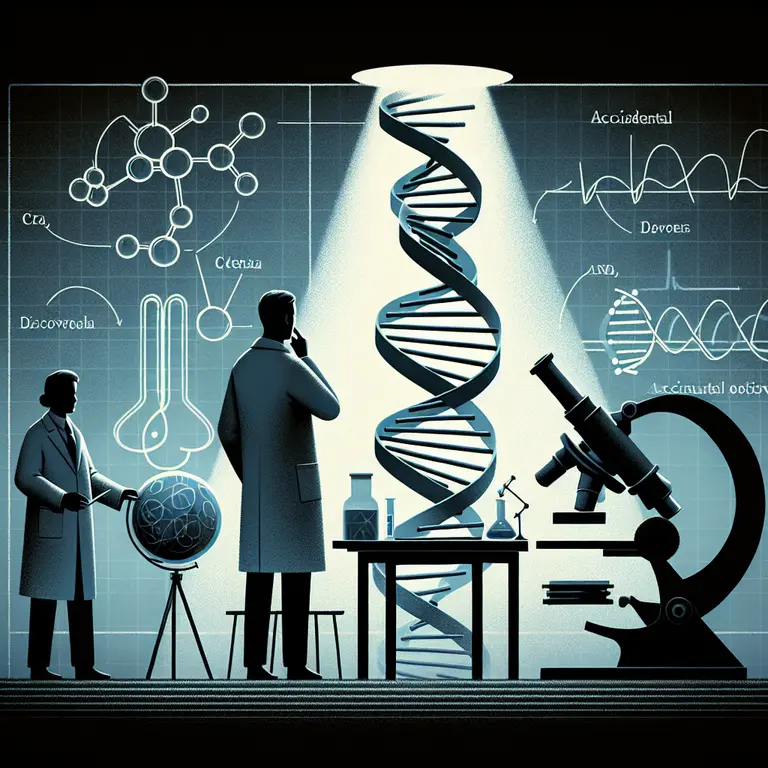
The discovery of DNA's double helix structure by James Watson and Francis Crick in 1953 was significantly influenced by an accidental observation.
 Watch on YouTube
 Watch on Rumble
The Hidden Hand Behind the Double Helix: Rosalind Franklin and the Discovery That Changed Biology
The discovery of DNA’s double helix structure is one of the most celebrated achievements in modern science, often attributed to the intellectual prowess and innovative thinking of James Watson and Francis Crick. Their work in the early 1950s led to a profound understanding of the molecular blueprint that underpins all living organisms. However, this narrative is incomplete without acknowledging the significant, albeit controversial, role played by an unexpected event involving crucial X-ray diffraction images and the contributions of other scientists, most notably Rosalind Franklin. To understand the full story is to confront not only a landmark moment in scientific history, but also a cautionary tale about credit, gender, and the ethics of collaboration.
The Race to Uncover DNA’s Structure
During the early 1950s, the scientific community was fervently engaged in the race to determine the structure of deoxyribonucleic acid, or DNA. This molecule was recognized as the carrier of genetic information, but its precise three-dimensional structure remained elusive. Several prominent research groups were involved in this pursuit, working across different institutions, using different methodologies, and with varying levels of access to emerging data.
Among the central figures was Rosalind Franklin, a skilled and dedicated physical chemist at King’s College London. Franklin was an expert in X-ray crystallography, a technique that allows scientists to study molecular structures by observing the diffraction patterns produced when X-rays pass through a crystalline substance. The patterns captured on photographic film could then be interpreted mathematically to infer the arrangement of atoms within a molecule. It was painstaking, technically demanding work that required both experimental precision and analytical sophistication.
Franklin’s approach was characterized by exceptional rigor. She meticulously prepared DNA fibers, carefully controlled their hydration levels, and captured X-ray diffraction images that were far superior in quality to those produced by her contemporaries. She recognized early on that DNA existed in two distinct forms, which she labeled A and B, each requiring different experimental conditions to produce clear images. Her careful attention to this distinction allowed her to generate data of unusual clarity and reliability.
Among her most significant contributions was the creation of an X-ray photograph known as Photograph 51, taken in May 1952. This image revealed a strikingly clear pattern that strongly suggested a helical structure for DNA. The characteristic X-shaped diffraction pattern, along with the spacing of the bands it contained, pointed toward a molecule with a repeating helical geometry. It was, in the words of those who later examined it, one of the most beautiful X-ray photographs ever taken.
An Ethical Breach: The Unintended Revelation
While Franklin’s work was advancing methodically, James Watson and Francis Crick, based at the Cavendish Laboratory in Cambridge, were also attempting to decipher DNA’s structure. Unlike Franklin, who gathered empirical evidence systematically before drawing conclusions, Watson and Crick relied primarily on model-building, constructing physical representations of possible molecular architectures and testing them against available chemical and physical data. Their approach was more speculative and iterative, and their progress had been repeatedly stalled by errors in their assumptions.
A critical turning point came in January 1953, when Maurice Wilkins, a colleague of Franklin at King’s College, showed Watson Photograph 51 without Franklin’s knowledge or consent. Wilkins and Franklin had a famously difficult professional relationship, complicated in part by an initial misunderstanding about their respective roles in the laboratory. Wilkins apparently regarded the photograph as shared departmental data rather than Franklin’s personal intellectual property, a distinction that remains contested to this day.
The effect on Watson was immediate and electric. The clear spiral pattern in the photograph immediately confirmed for him that DNA must have a double helix structure, an idea he and Crick had considered but could not substantiate. Around the same time, Watson and Crick also gained access to a detailed report summarizing Franklin’s X-ray data and unit cell measurements, prepared for the Medical Research Council. This report, shared through institutional channels without Franklin’s awareness, contained quantitative information that proved essential to finalizing the correct model.
This moment raises profound ethical questions that have never been fully resolved. The sharing of Franklin’s unpublished data without her permission represents, at a minimum, a serious breach of professional conduct. Franklin was working toward her own conclusions and had not authorized anyone to share her findings with competing researchers. The fact that her data proved decisive in Watson and Crick’s breakthrough makes the omission of proper credit all the more significant. Many historians of science now regard this episode as one of the clearest examples of how systemic biases in mid-twentieth century science disadvantaged women researchers, often rendering their contributions invisible even when those contributions were foundational.
Constructing the Double Helix Model
With the insights gained from Photograph 51 and Franklin’s crystallographic measurements, Watson and Crick rapidly advanced their model-building efforts. They incorporated the helical structure suggested by the photograph into their theoretical framework, and they drew on Erwin Chargaff’s earlier observation that in DNA, the amount of adenine always equals the amount of thymine, and the amount of guanine always equals the amount of cytosine. This chemical rule, known as Chargaff’s rules, provided the key to understanding how the two strands of the helix were paired.
On February 28, 1953, Watson and Crick finalized their model. It depicted DNA as two intertwined strands running in opposite directions, forming a helical structure held together by complementary pairs of nucleotide bases: adenine with thymine, and guanine with cytosine. The sugar-phosphate backbone of each strand formed the outer rails of the structure, while the paired bases formed the rungs of what has since become one of the most recognizable images in all of science.
Their model elegantly explained how DNA could replicate itself. Because each strand contained the complementary information needed to reconstruct the other, the double helix provided a natural mechanism for copying genetic information during cell division. This insight provided the conceptual foundation for modern molecular biology and paved the way for genetic sequencing, recombinant DNA technology, and the mapping of the human genome.
Publication and the Recognition of Contributions
The culmination of this work was the publication of three closely related papers in the April 25, 1953, issue of Nature. Watson and Crick’s paper presented their double helix model and briefly acknowledged the contribution of experimental data from other researchers. A second paper by Wilkins and his colleagues and a third by Franklin and her collaborator, Raymond Gosling, appeared in the same issue, presenting X-ray evidence supporting the proposed structure. The arrangement of the papers was later criticized for implying that Franklin’s work was merely confirmatory rather than foundational.
Franklin’s paper, which provided detailed and independently obtained X-ray diffraction evidence consistent with the double helix, was published alongside the others. Yet despite this simultaneous publication, her role in the discovery was largely overshadowed by the narrative surrounding Watson and Crick’s model. In Watson’s later memoir, The Double Helix, published in 1968, Franklin was portrayed in a manner many readers found dismissive and condescending, reinforcing the perception of her as a peripheral rather than a central figure. This portrayal prompted strong rebuttals from colleagues who had known and worked with her.
Legacy and the Ongoing Ethical Debate
Rosalind Franklin died in April 1958, at the age of thirty-seven, from ovarian cancer. The cause of her illness may have been linked to her extensive exposure to X-ray radiation during her research career, though this connection was not established with certainty. In 1962, Watson, Crick, and Wilkins were awarded the Nobel Prize in Physiology or Medicine for the discovery of the double helix. The Nobel Committee does not award prizes posthumously, and so Franklin’s name was absent from the ceremony entirely.
The circumstances surrounding the use of Photograph 51 have generated sustained ethical debate within the scientific community. Questions about consent, attribution, and the structural inequalities that shaped mid-century scientific institutions have only grown more prominent as the history of the discovery has been examined more closely. Franklin’s story has become a touchstone in discussions about how scientific credit is allocated and whose contributions are remembered.
Today, Rosalind Franklin is widely recognized as a central and indispensable figure in the discovery of DNA’s structure. Her meticulous work laid the empirical groundwork for one of the most significant scientific breakthroughs of the twentieth century. Institutions, research vessels, and scientific prizes now bear her name. The European Space Agency named a Mars rover in her honor. These acts of recognition, however belated, reflect a broader reckoning with the history of science and a growing commitment to acknowledging the full complexity of how discovery actually happens, not as the achievement of solitary geniuses, but as the result of many minds, not all of whom receive the credit they deserve.
Sources & Further Reading
- Klug, A. (2004). Rosalind Franklin and the Discovery of the Structure of DNA. Nature.
- Maddox, B. (2012). Rosalind Franklin: The Dark Lady of DNA. HarperCollins Publishers.
- Watson, J. D. (1968). The Double Helix: A Personal Account of the Discovery of the Structure of DNA. Atheneum.
- Olby, R. (1974). The Path to the Double Helix: The Discovery of DNA. University of Washington Press.