
Unexpected Tool: Potatoes Used to Remove Broken Light Bulbs
A common kitchen staple, the humble potato has an unusual use outside cooking, specifically for safely removing broken light bulbs from their sockets.
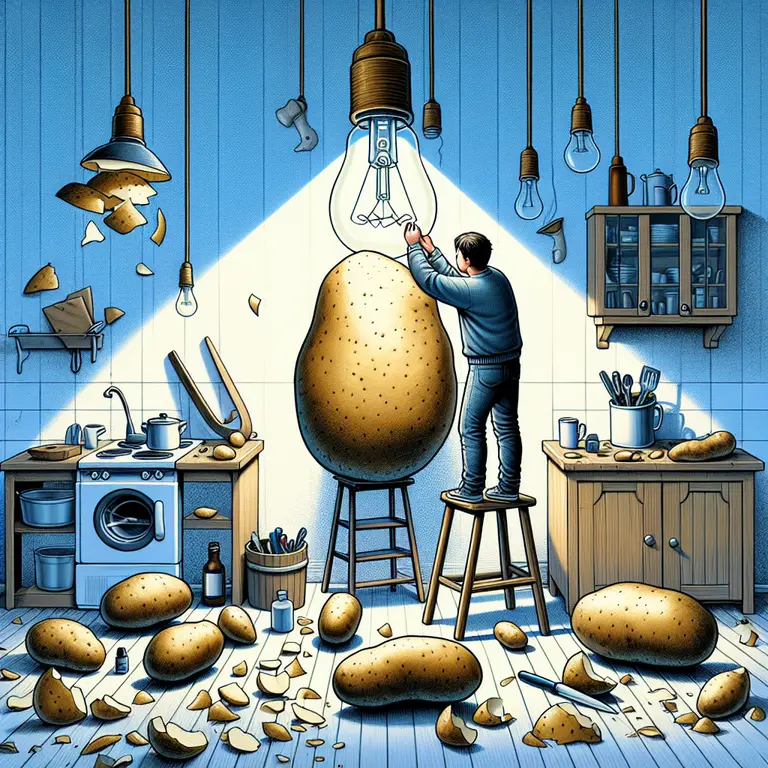
The Humble Potato: A Surprising Hero in Home Repair
There is a lesser-known but highly effective trick involving a potato in the realm of household hacks and DIY solutions. Most people are aware of the myriad uses potatoes have in culinary contexts, from making fries to mashing them into creamy sides. Yet few realize that a potato can be a practical tool for homeowners and handymen alike. This unique use involves safely extracting broken light bulbs that are still screwed into sockets — a problem far more common than most people expect and far more dangerous than it might initially appear. The potato method sits at the intersection of improvisation, basic physics, and centuries-old problem-solving tradition, and understanding it fully reveals something genuinely fascinating about how everyday objects can serve extraordinary purposes.
Why Broken Bulbs Are More Dangerous Than They Look
When a light bulb breaks while still partially screwed into its socket, the situation presents a surprisingly complex set of hazards. The most obvious danger is the jagged glass remaining around the metal base, which can cause deep lacerations if handled carelessly. However, the less visible danger is electrical. Even when a light switch is off, the socket itself may still carry live current, depending on the fixture's wiring configuration. This means that any conductive object introduced into the socket — including human fingers — risks completing a circuit and delivering a potentially serious shock.
Standard household tools like pliers are often the first thing people reach for in this situation, but metal pliers are conductive and can cause exactly the kind of electrical contact you are trying to avoid. Rubber-handled pliers offer more protection, but they can still slip on smooth or jagged glass surfaces, making extraction more difficult and potentially pushing broken shards deeper into the socket. This is precisely the gap that the potato method fills so elegantly. It requires no specialized knowledge, no expensive equipment, and no trip to a hardware store. It simply requires something that almost every kitchen in the world already contains.
The Science Behind Why a Potato Works
The effectiveness of this method is not merely anecdotal. It is grounded in a combination of materials science and basic physics, which makes the potato surprisingly well-suited to the task. Potatoes are composed of roughly 80 percent water by weight, and this high moisture content plays a critical role in creating friction between the cut surface of the potato and the irregular glass edges of the broken bulb. When you press a freshly cut potato against the remnants of the bulb, the moist, starchy flesh conforms slightly to the contours of the broken glass, filling in tiny gaps and creating a grip that a dry or rigid material simply could not achieve.
The starch itself also contributes to this adhesion. Potato starch is a complex carbohydrate that is somewhat tacky when raw, which increases the surface tension between the potato and the glass. This is not unlike how a wet rubber suction cup adheres to a smooth surface more effectively than to a dry one. The result is a grip strong enough to transfer rotational force from your hand through the potato and into the bulb's metal base, allowing you to unscrew it without ever making direct contact with the glass or the socket.
Additionally, potatoes are natural electrical insulators. Unlike metals, which freely allow electrons to pass through them, the organic cellular structure of a potato does not conduct electricity in any meaningful way under normal household voltages. This means that even if the socket still carries residual current, pressing a potato into the socket significantly reduces the risk of electric shock compared to using a bare hand or a metal tool. It is worth noting that this insulating property is a supplement to, not a replacement for, turning off the circuit breaker before attempting the repair.
A Step-by-Step Guide to the Potato Method
Employing this technique correctly requires only a few minutes and a small amount of preparation. The first and most important step is to cut power to the affected light fixture entirely. Do not rely on the wall switch alone. Go to your circuit breaker box and switch off the breaker for the room or fixture. If you are unsure which breaker is correct, use a non-contact voltage tester near the socket to confirm there is no live current before proceeding.
Once the power is turned off, take one medium-sized raw potato and cut it cleanly in half crosswise, exposing a flat, fresh surface. The potato should be firm and raw, not soft or beginning to sprout, as a firm potato will provide the best grip. Take one half and press the cut side firmly and directly onto the broken bulb base still lodged in the socket. Apply steady downward pressure to allow the potato flesh to conform around the glass edges. You should feel the potato settle into a grip after a moment.
With a firm hold established, begin turning the potato counterclockwise using slow, deliberate movements. Do not rush or apply excessive force. The goal is to transfer torque gradually and evenly, just as you would when unscrewing an intact bulb. In most cases, the base will begin to rotate within the first turn or two. Once it is free, carefully pull the potato straight out of the socket, bringing the bulb base with it. Dispose of both the potato and the glass fragments carefully, wrapping them in newspaper or placing them in a sealed bag before discarding.
The Broader Tradition of Improvised Problem-Solving
The potato light bulb trick is not an isolated curiosity. It belongs to a long and genuinely admirable tradition of improvised household solutions that emerged from necessity rather than invention. Before the proliferation of specialized tools and the easy availability of hardware stores, people solved problems with whatever materials were at hand. This kind of thinking was not a sign of poverty or ignorance — it was a form of applied intelligence that required a deep understanding of the physical properties of everyday objects.
This tradition appears across cultures and throughout history. Sailors used raw eggs to temporarily seal leaks in wooden hulls. Farmers used strips of rawhide as makeshift hinges and fasteners. Cooks discovered that a wooden spoon placed across a boiling pot prevents it from boiling over, a trick that works because the spoon disrupts the surface tension of the foam. Each of these solutions arose not from a manual or a tutorial but from careful observation of how materials behave under specific conditions.
The potato bulb method fits neatly into this lineage. It likely emerged in households where calling an electrician was either unaffordable or impractical, and where the person faced with a broken bulb had to think creatively about what was available. The fact that it works as reliably as it does is a testament to the kind of intuitive material science that ordinary people have always practiced without naming it as such.
Conclusion
The potato is one of the most versatile and underappreciated objects in the average home. Its culinary applications are well documented and celebrated, but its utility extends well beyond the kitchen. The broken light bulb trick is a perfect example of how understanding the basic physical and chemical properties of an everyday material can turn a potentially dangerous household problem into a simple, manageable task. The high moisture content creates friction, the starchy flesh provides grip, and the organic composition offers a measure of electrical insulation — all without costing anything beyond the price of a single potato.
More broadly, the existence of this technique is a reminder that not every problem requires a specialized solution. Sometimes the most effective answer is already sitting in your kitchen, waiting to be repurposed. In a world increasingly oriented toward buying new tools and calling professionals, there is something quietly powerful about solving a problem with nothing more than a vegetable, a little patience, and an understanding of how things work.