
In Uzbekistan, It's Illegal to Say 'Rabbit' in Public
In a lesser-known quirk of local law, the word 'rabbit' is banned from public discourse in Uzbekistan due to cultural superstitions.
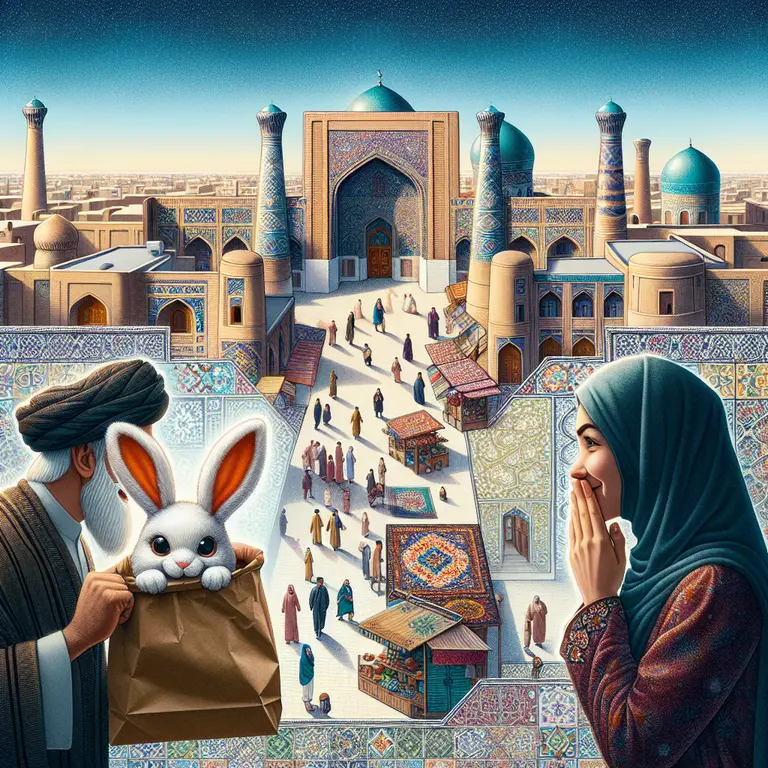
 Watch on YouTube
 Watch on Rumble
Introduction
The Republic of Uzbekistan, a landlocked country nestled in the heart of Central Asia, is renowned for its rich and layered cultural heritage. Its ancient cities of Samarkand, Bukhara, and Khiva have drawn travelers and scholars for millennia, each offering a window into civilizations that once shaped the known world. Silk Road commerce, Persian poetry, Timurid architecture, and nomadic traditions have all left their mark on the Uzbek national character. Yet among the country’s many cultural distinctions, one stands out as particularly arresting to outside observers: a deeply embedded prohibition against publicly uttering the word “rabbit.”
To a foreign visitor, this might sound like an elaborate joke or an urban legend born of cultural misunderstanding. But the aversion runs deeper than a passing social quirk. It is woven into the fabric of Uzbek folklore, reinforced through generations of oral tradition, and, by some accounts, formalized through legal and social mechanisms designed to protect public order and cultural sensibility. Understanding why this single word carries such weight requires a journey into the historical roots of Uzbek superstition, the mechanics of folklore transmission, and the surprising ways in which ancient belief systems continue to govern modern life.
Historical Context
To appreciate the prohibition, one must first understand the historical environment in which Uzbek cultural identity was forged. For centuries, the region now known as Uzbekistan served as a crossroads between East and West, absorbing influences from Persian, Mongol, Turkic, and later Russian civilizations. Throughout these turbulent periods of conquest and exchange, local tribal communities maintained cohesion through shared mythologies and behavioral codes that were passed down orally rather than through written law.
In this context, animals occupied significant symbolic roles. Certain creatures were revered as protective spirits, while others were associated with chaos, misfortune, or spiritual contamination. The rabbit fell firmly into the latter category. Unlike in European or East Asian traditions, where rabbits frequently symbolize fertility, cleverness, or good fortune, the rabbit in Uzbek tribal folklore was consistently framed as a creature of ill omen. Some historians trace this to the animal’s unpredictable, erratic movement patterns, which nomadic peoples interpreted as a sign of spiritual unease or impending disaster. Others point to the rabbit’s association with sudden disappearance, its tendency to vanish into the earth, which was symbolically linked to death and the underworld in early Central Asian cosmologies.
These associations were not incidental. They were systematically reinforced through storytelling traditions that served a practical social function: regulating behavior, managing collective anxiety, and maintaining group solidarity during periods of external threat. The prohibition on naming the rabbit was, in this sense, not merely superstition but a form of cultural technology.
Folklore and Superstition
Traditional Uzbek folklore is extraordinarily rich, encompassing epic poetry, moral fables, cosmological myths, and cautionary tales that have been preserved with remarkable fidelity across generations. Within this body of storytelling, the rabbit appears repeatedly as a figure of misfortune, a creature whose very presence signals that something has gone wrong or is about to.
In many of these tales, the appearance of a rabbit before a journey, a harvest, or a military campaign is treated as a warning sign that should prompt the traveler or commander to pause and reconsider. Some stories describe entire villages falling into hardship after a rabbit was spotted at the threshold of a communal building. Others frame the rabbit as a disguised spirit of misfortune, capable of bringing drought, disease, or conflict simply by being acknowledged. The act of speaking its name aloud was believed to summon its essence, making verbal mention of the creature just as dangerous as a physical encounter.
This belief in the power of spoken language to invoke supernatural forces is not unique to Uzbek culture. Across the world, from ancient Egyptian priestly traditions to the taboo names of Norse gods, societies have understood that words carry weight beyond their literal meaning. In Uzbek tradition, this principle was applied with particular intensity to the rabbit, making its name one of the most carefully avoided utterances in the cultural vocabulary. The prohibition became self-reinforcing over time: the more people avoided the word, the more charged and dangerous it seemed, which in turn strengthened the motivation to avoid it further.
Modern Implications and Social Practices
What makes Uzbekistan’s relationship with this prohibition especially fascinating is the degree to which it has persisted into the modern era. Superstitions in many parts of the world have softened under the pressures of urbanization, mass education, and global media exposure. In Uzbekistan, however, the cultural weight of this belief has proven remarkably durable, adapting to contemporary social contexts rather than fading away.
In public settings, including markets, official ceremonies, community gatherings, and formal events, speakers routinely avoid direct reference to the animal. When the subject cannot be avoided entirely, a well-established system of euphemisms takes over. Phrases such as “the long-eared one,” “the swift-footed creature,” or simply “that animal” serve as socially acceptable substitutes that communicate the necessary meaning without invoking the dangerous name. This linguistic creativity is itself a testament to the vitality of the underlying belief. Communities do not develop elaborate workaround systems for prohibitions they consider trivial.
Children are typically introduced to the prohibition at an early age, often through the same folkloric stories that originally established the rabbit’s ill reputation. The lesson is framed not as blind superstition but as cultural wisdom, a sign of respect for the experiences and warnings of ancestors. In this way, the prohibition functions as a vehicle for transmitting broader values: reverence for tradition, sensitivity to communal well-being, and an awareness that individual speech acts carry social consequences.
Legal Aspects and Cultural Enforcement
Perhaps the most striking dimension of this prohibition is the claim that it carries not only social but also legal weight. While the precise legislative mechanisms are difficult to verify in standard legal databases, accounts from cultural researchers and travelers suggest that Uzbek authorities have, at various points, treated public violations of this norm as matters of civil order rather than mere personal eccentricity.
This is less surprising when viewed through the lens of Uzbekistan’s broader legal culture, which has historically placed significant emphasis on preserving social harmony and respecting traditional values. Laws and regulations in the country have frequently been used to protect cultural practices from disruption, and the enforcement of behavioral norms that might seem informal in other contexts has been treated as a legitimate function of public administration. In this framework, a prohibition rooted in centuries of folklore is not categorically different from other forms of cultural protection. It is simply applied to an unusually specific subject.
The legal dimension also reinforces the social one. When a norm is backed by the possibility of official sanction, its observance becomes more consistent and its transmission more reliable. The prohibition on uttering the rabbit’s name thus exists at the intersection of law and culture, each reinforcing the other in a way that has kept the tradition alive far longer than pure social pressure alone could have.
Conclusion
Uzbekistan’s prohibition on publicly uttering the word “rabbit” is far more than an amusing cultural footnote. It is a window into the extraordinary persistence of ancient belief systems, the social functions of folklore, and the complex relationship between language, power, and community identity. In a world that often assumes modernization will inevitably dissolve traditional superstitions, Uzbekistan offers a compelling counterexample: a society that has found ways to carry its oldest anxieties forward into the present, adapting their expression without abandoning their essence.
The story of the unspoken animal reminds us that culture is never simply decorative. It is structural, shaping the way people communicate, the words they choose to avoid, and the invisible boundaries they navigate every day. For the Uzbek people, a creature that elsewhere inspires children’s stories and holiday imagery remains something altogether more serious: a name best left unspoken, a presence best left unacknowledged, and a reminder that the past is never entirely silent.