
Bubble Wrap Was Actually Intended to Be 3D Wallpaper
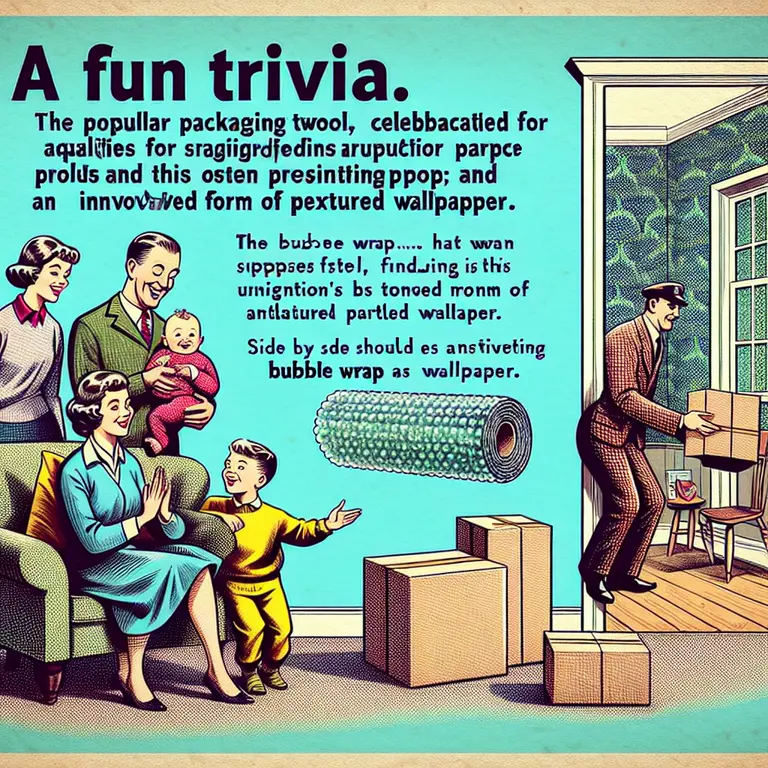
The ubiquitous packaging material, Bubble Wrap, which is well known for protecting mail-order products (and for being fun to pop), was originally invented to serve as a trendy new type of textured wallpaper.
 Watch on YouTube
 Watch on Rumble
Bubble wrap is one of those inventions so deeply embedded in daily life that most people never stop to question where it came from or why it exists. The satisfyingly poppy material, familiar to anyone who has ever moved apartments or torn open a cardboard delivery box, is now widely used for its excellent shock-absorption properties. Ingeniously simple in design, it consists of plastic sheets with regular arrays of air-filled bubbles that compress on impact, distributing force away from whatever fragile object they surround. This concept was one of those “why didn’t I think of that” ideas that marketers dream about, a product so obvious in hindsight that its success seems almost inevitable. However, the initial vision for bubble wrap had nothing to do with packaging, shipping, or protecting anything. Its origin story is a compelling case study in accidental innovation, lateral thinking, and the commercial instincts required to turn a failed experiment into a global industry standard.
Origins and Initial Vision
In 1957, Swiss inventor Alfred Fielding and his partner Marc Chavannes were working in a garage in Hawthorne, New Jersey, experimenting with what they hoped would become a revolutionary new product in home interior design. Their goal was to create a textured wallpaper with a three-dimensional quality that would appeal to modernist tastes and stand apart from the flat, printed designs that dominated the market at the time. To achieve this, they sealed two shower curtains together, creating multiple small pockets of air between them. The resulting material had an unusual, tactile surface that was visually striking and unlike anything currently available in home decor.
The product certainly grabbed attention due to its unique texture, and the inventors were initially enthusiastic about its commercial prospects. However, despite their optimism, the textured wallpaper concept failed to gain traction with consumers or retailers. The idea of covering walls in plastic sheeting filled with air bubbles was, it turned out, a difficult sell. Interior designers were not clamoring for it, and the general public showed little interest in decorating their homes with what essentially amounted to a sealed layer of trapped air. The product that Fielding and Chavannes had invested significant time and creative energy into developing was, by most conventional measures, a failure.
Reimagining the Product
As inventors often do when their first idea does not take off, Fielding and Chavannes began thinking more broadly about other potential applications for their unusual creation. This phase of their work required a shift in perspective, moving away from the question of what they had intended to make and toward the more open-ended question of what their material was actually good at. Through a process of trial, observation, and creative problem-solving, they began to recognize properties in their invention that had nothing to do with aesthetics and everything to do with physics.
The air-filled bubbles, it turned out, were remarkably good at absorbing impact. When pressure was applied to the material, the bubbles compressed and distributed the force across a wider area, cushioning whatever object was placed against it. The material was also lightweight, flexible, and easy to produce in large quantities. These were not qualities that mattered much for wallpaper, but they were enormously valuable in a different context entirely. The shipping and packaging industry in the late 1950s was growing rapidly alongside the expansion of consumer goods manufacturing, and the need for reliable, cost-effective protective materials was acute. Fielding and Chavannes realized they had accidentally engineered a near-perfect solution to a problem they had not originally set out to solve.
Their first major commercial target was IBM, which they successfully convinced to use bubble wrap as protective packaging for a new computer model being shipped across the country. This early adoption by a major technology company was a significant validation of the product’s practical value and helped establish its credibility in the industrial packaging market. The IBM deal demonstrated that bubble wrap could perform reliably under real-world shipping conditions, protecting sensitive and expensive equipment from the jolts, drops, and vibrations of long-distance transport.
Commercial Success and the Rise of Sealed Air Corporation
Fielding and Chavannes founded Sealed Air Corporation in 1960 to manufacture and market their product at scale. The company’s name reflected the core principle behind bubble wrap: sealing air within a flexible plastic membrane to create a protective barrier. From the beginning, Sealed Air positioned bubble wrap not merely as a packaging accessory but as a superior alternative to the materials then commonly used to protect goods in transit.
Before bubble wrap, shippers relied heavily on materials like shredded paper, sawdust, straw, and crumpled newspaper to cushion fragile items. These alternatives had significant drawbacks. They were heavy, adding to shipping costs. They were messy, creating cleanup problems for recipients. They were inconsistent in their protective qualities, offering variable levels of cushioning depending on how they were packed. Bubble wrap addressed all of these issues simultaneously. It was lightweight enough to add minimal cost to shipping weight, clean enough to handle without any residue, and consistent in its protective performance because its structure was uniform and engineered rather than random.
Sealed Air Corporation grew steadily through the 1960s and beyond, expanding its product line and refining its manufacturing processes. The company eventually went public and became a major player in the global packaging industry, with operations spanning dozens of countries. Today, Sealed Air generates billions of dollars in annual revenue and produces a wide range of protective packaging solutions, though bubble wrap remains its most iconic and recognizable product. The journey from a two-man garage operation to a multinational corporation is itself a remarkable story of entrepreneurial persistence.
Impact on the Packaging Industry and Cultural Legacy
Bubble wrap’s success story demonstrates how innovative breakthroughs can sometimes emerge from unusual initial intentions followed by a willingness to radically reconsider what a product is for. Its impact on the packaging industry has been profound, offering a lightweight yet effective solution for protecting goods during transit at a time when global commerce was expanding and demand for reliable shipping materials was growing rapidly. It helped make possible the kind of large-scale, long-distance shipping of fragile consumer goods that modern retail and e-commerce now depend upon entirely.
Beyond its industrial significance, bubble wrap has also acquired a surprisingly rich cultural presence. The act of popping bubbles has been widely studied for stress relief and sensory satisfaction, and researchers have noted that the repetitive, tactile nature of the activity produces measurable reductions in tension. The material has inspired art installations, competitive popping events, and even a dedicated awareness day celebrated annually on the last Monday of January. In 2015, Sealed Air introduced a new version of bubble wrap with unpopable bubbles, designed to be more efficient for shipping, and the announcement was met with widespread public disappointment, suggesting just how deeply the poppable version had embedded itself in everyday emotional life.
Conclusion
The ubiquity of bubble wrap today is a testament to the resilient inventiveness of its creators, Alfred Fielding and Marc Chavannes, and to the broader truth that some of the most successful innovations begin as something else entirely. Their ability to recognize the hidden potential in a failed wallpaper experiment and then pursue that potential with commercial determination transformed a novelty into a necessity. What began as an attempt to bring textured plastic surfaces into the living room ended up protecting billions of shipments worldwide, cushioning everything from wine glasses to spacecraft components. It is a reminder that the distance between a failed idea and a transformative one is sometimes just a matter of asking a different question about the same object.