
The Unforgettable 1970 Oregon Whale Explosion Incident
In 1970, a dead whale in Oregon was disposed of using dynamite, leading to an unexpected and shocking chain of events that became legendary.
 Watch on YouTube
 Watch on Rumble
Introduction
Few stories in the vast annals of peculiar events capture the imagination quite like the infamous whale explosion in Florence, Oregon, in November 1970. This quiet coastal town, better known for its scenic sand dunes and fishing culture than for headline-grabbing spectacles, became the unlikely stage for an unusual and chaotic episode that blended human ingenuity, miscalculation, and unintended comedy in equal measure. At the heart of this bizarre tale was a massive sperm whale carcass, a ticking biological time bomb that would spark one of the most unusual disposal methods in recorded history. What began as a straightforward public works problem quickly escalated into a media event, a public safety incident, and eventually, an enduring piece of American folklore that continues to be told and retold more than half a century later.
The Arrival of the Whale
On November 9, 1970, the serene beaches of Florence were disrupted by the arrival of an uninvited guest: the enormous, decaying body of a sperm whale. The colossal creature, measuring nearly 45 feet in length and weighing an estimated eight tons, had washed ashore under circumstances that were never fully explained. Marine strandings of this scale were not entirely unheard of along the Pacific Northwest coastline, but the sheer size of this particular animal made it an immediate and pressing problem unlike anything local authorities had previously encountered.
Beyond the foul and overwhelming stench emanating from the decomposing carcass, the body posed a genuine public health hazard. Rotting whale tissue creates a breeding ground for harmful bacteria, and the smell alone was enough to render the surrounding beach area practically uninhabitable. There was also the very real concern that the carcass would attract large scavengers, including bears and feral dogs, potentially endangering beachgoers and nearby residents. The whale had not chosen a remote or inaccessible stretch of coastline for its final resting place, but rather a well-trafficked area that could not simply be cordoned off and forgotten.
Local authorities, unfamiliar with such a challenge on this scale, quickly realized the urgency of the situation. Simply leaving the whale to decompose naturally was not a viable option. The natural decomposition of a whale carcass of this size could take weeks, or even months, during which time the stench would be unbearable, and the health risks would only compound. The question loomed large and unanswered: how exactly does one dispose of an eight-ton whale?
A Dilemma for Disposal
Traditional disposal methods were carefully weighed, and each was found lacking in some critical way. Burying the carcass presented enormous logistical challenges. The sheer weight and volume of the animal would require excavating a hole of considerable depth and breadth, and there was no guarantee that the burial would be deep enough to contain the smell or prevent scavengers from digging it up. Cutting the carcass into smaller, more manageable pieces was another option that was considered and quickly dismissed. The labor involved would be not only exhausting but also deeply unpleasant and potentially hazardous to workers, who would be exposed to dangerous levels of decomposition gases and bacteria.
Faced with a seemingly insurmountable problem, officials turned to an unlikely source for a solution: the Oregon Highway Division, the state agency responsible for managing infrastructure, road construction, and engineering projects across the region. These were practical men accustomed to solving large-scale physical problems, and they approached the whale with the same methodical mindset they might apply to a stubborn boulder blocking a mountain road.
After some deliberation, the engineers proposed a bold and decidedly unconventional plan: use dynamite to obliterate the carcass entirely. The underlying logic, while admittedly creative, was not entirely without merit. The idea was to blast the whale into sufficiently small pieces that they could either be carried out to sea by the tides or scavenged by seagulls, crabs, and other coastal wildlife. In theory, nature would handle the cleanup once the heavy lifting had been done by the explosives.
While unconventional, the plan was approved by the relevant authorities. The team calculated that half a ton of dynamite, roughly 1,000 pounds, would be sufficient to achieve the desired results. In retrospect, this figure was arrived at with a confidence that was not entirely supported by any prior experience with whale disposal by explosion, largely because no such experience existed. Confident in their approach nonetheless, they set a date for the explosive operation and began preparing the site.
The Day of Detonation
Word of the plan spread quickly through the local community and beyond, sparking immediate public curiosity and significant media attention. By the morning of November 12, 1970, an excited and sizable crowd had gathered on the beach to witness what promised to be a dramatic and, in its own strange way, historic spectacle. Reporters and television crews arrived from across the state, eager to document what they expected would be a practical and visually impressive solution to a uniquely strange problem. Families, children, and even out-of-town visitors who had heard about the event made the trip to Florence, treating the occasion with something approaching festive anticipation.
Safety perimeters were established, though, in hindsight, they proved woefully inadequate. The explosives were carefully placed under and around the carcass in a configuration designed to maximize the blast’s effectiveness and distribute the force as evenly as possible through the body of the whale. Engineers, spectators, and reporters alike braced for the moment of detonation, cameras and film crews at the ready.
At precisely noon, the countdown began. The crowd fell into an expectant hush. Then the dynamite was detonated, and the spectacle unfolded, though not remotely as anyone had planned.
An Unexpected Outcome
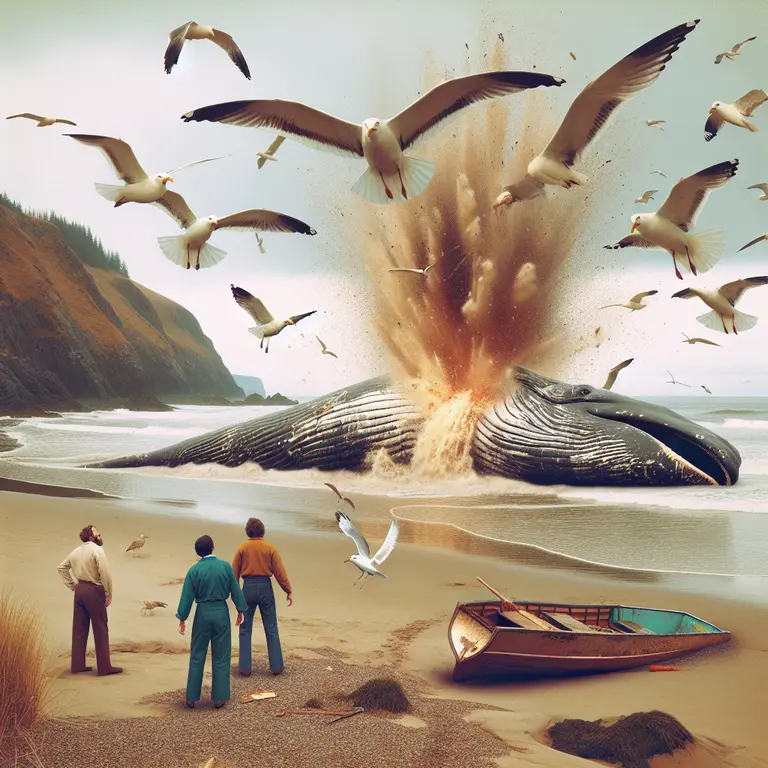
The explosion was far more powerful and chaotic than anyone had anticipated or prepared for. A thunderous boom echoed across the beach and out over the Pacific, sending vast chunks of whale blubber hurtling skyward with tremendous force. For a brief, exhilarating moment, the crowd cheered, marveling at the dramatic, undeniably impressive sight. But their enthusiasm turned rapidly to panic as it became apparent that the debris was not scattering harmlessly into the ocean or dissolving into seagull-friendly morsels. Instead, it was raining down unpredictably, and in some cases dangerously, across a wide radius of the beach.
Large, sticky, and extraordinarily pungent pieces of whale flesh descended on the crowd from above. People scattered in every direction, trying to avoid the falling debris, while reporters desperately shielded their cameras and equipment from the onslaught. One particularly enormous chunk of blubber came crashing down on a parked car belonging to a local businessman who had come to witness the event. The vehicle was essentially destroyed, its roof caved in under the weight of the impact. The owner, a man named Lud Felber, reportedly stood in stunned silence surveying the damage, having never imagined that a trip to the beach would result in a whale-related insurance claim.
Rather than being scattered into manageable, nature-friendly fragments, much of the whale remained largely intact closer to the detonation site. The explosion had done little more than rearrange the mess while simultaneously distributing it across a much larger area. The beach, already unpleasant before the detonation, was now covered in a wide radius of reeking biological material. The solution had, in the most literal sense imaginable, blown up in everyone’s faces.
Lessons Learned and Modern Approaches
The Florence whale explosion became an instant legend, immortalized in local lore and, decades later, in media coverage that spread its fame far beyond Oregon's borders. Humorist Dave Barry wrote about the incident in a widely circulated 1990 column, introducing the story to an entirely new generation of readers who found it both hilarious and instructive. Footage of the explosion, captured by a local television crew, eventually made its way onto the early internet and became one of the more memorable viral videos of the pre-social media era.
While many found humor in the absurdity of the event, it also served as a stark and practical reminder of the importance of careful planning, rigorous risk assessment, and the value of consulting genuine experts before committing to irreversible actions. The engineers of the Oregon Highway Division were talented and experienced professionals, but their expertise lay in roads and bridges, not in the physics of organic matter under explosive force. The incident underscored a broader principle that applies well beyond whale disposal: the confidence with which a plan is executed is no substitute for the quality of the plan itself.
Today, beached whales are handled through far more methodical and scientifically informed approaches. Depending on the location and size of the animal, carcasses may be buried deeply on the beach, towed far out to sea and allowed to sink to the ocean floor, where they become what marine biologists call whale falls, providing rich ecosystems for deep-sea organisms, or in some cases, carefully transported to research facilities. None of these methods produces the same spectacle as a half-ton of dynamite, but they are considerably more effective and significantly less likely to destroy nearby vehicles.
A Legacy of Laughter and Reflection
Decades later, the Florence whale explosion continues to fascinate and amuse in roughly equal measure. The event has been referenced in books, documentary films, comedy sketches, and countless online discussions, becoming a quirky but enduring chapter in Oregon’s cultural history. A historical marker near the site acknowledges the event, drawing curious tourists who make the pilgrimage specifically to stand on the beach where one of history’s more improbable decisions was made and immediately regretted.
For the residents of Florence, the story occupies a peculiar place of civic pride. It is a reminder that even the most well-intentioned problem-solving can go spectacularly wrong, and that there is a certain dignity in being able to laugh at one’s own history. The whale explosion did not represent a failure of character or intelligence on the part of the people involved. It represented something more universal: the very human tendency to confront an unprecedented problem with available tools and abundant confidence, and to learn, sometimes the hard way, that the world does not always cooperate with our plans.
The story endures not because it is simply funny, though it undeniably is, but because it captures something true about the relationship between human ambition and natural reality. The whale arrived on that beach, indifferent to the inconvenience it caused. The people of Florence responded with creativity, decisiveness, and a quantity of dynamite that, in retrospect, was probably not the right answer. The result was chaos, laughter, one ruined automobile, and a story that has outlasted everyone who witnessed it.