
The Mpemba Effect: Hot Water Freezes Faster Than Cold Water
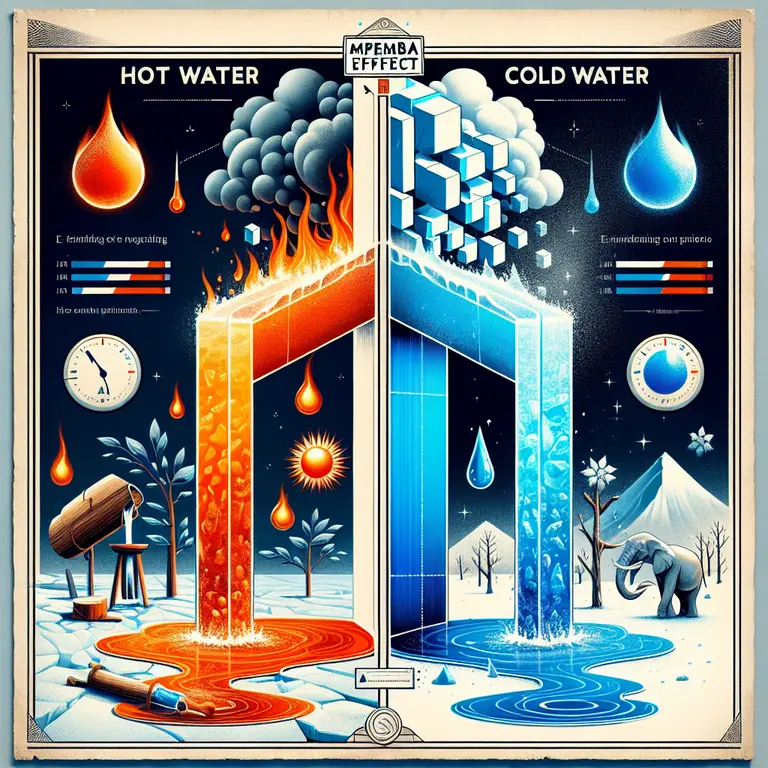
The Mpemba effect is a process where hot water can freeze faster than cold. It's named after a Tanzanian student who sought to explain this phenomenon.
Introduction
In the 1960s, a Tanzanian secondary school student named Erasto B. Mpemba made an observation that would puzzle physicists for decades. While rushing to complete a school assignment involving the preparation of ice cream, Mpemba noticed something that seemed to contradict basic thermodynamic logic: his warm ice cream mixture froze before the cooler mixtures prepared by his classmates. Rather than dismissing the observation as a fluke or an error, Mpemba pursued the question with genuine curiosity, eventually bringing it to the attention of Denis G. Osborne, a physicist visiting his school. Osborne, to his credit, took the student seriously. Together, they conducted experiments and published their findings in 1969 in the journal Physics Education, formally introducing the phenomenon to the scientific world.
What makes this story remarkable is not just the counterintuitive nature of the observation itself, but also the social context in which it arose. Mpemba was initially ridiculed by his teacher and peers for suggesting that hot water could freeze faster than cold water. The idea seemed absurd on its face. Common sense dictates that a hotter substance has more thermal energy to lose before reaching the freezing point, and should therefore take longer to freeze. Yet the observation persisted, and the question it raised has refused to disappear from scientific discourse. The Mpemba effect, as it came to be known, sits at the intersection of thermodynamics, chemistry, and fluid dynamics, and continues to generate serious academic debate more than half a century after it was first formally described.
The Scientific Enigma at the Heart of the Effect
The Mpemba effect has been met with both fascination and deep skepticism from the scientific community. Part of what makes it so difficult to study is that it does not always occur. Numerous experimental attempts to reproduce the effect have yielded inconsistent results: some studies confirm that hot water can indeed freeze faster under certain conditions, while others find no such effect. This inconsistency has led some researchers to question whether the effect is real in any meaningful physical sense or an artifact of poorly controlled experimental conditions.
One of the central challenges in studying the Mpemba effect is that the outcome appears to depend heavily on a wide range of variables: the size and shape of the container, the composition of the water, the temperature of the freezer, air circulation within the freezer, and even the precise starting temperatures of the samples being compared. A 2016 study by Burridge and Linden published in Scientific Reports concluded that when experimental conditions are rigorously controlled, hot water does not consistently cool more quickly than cold water. Their findings suggested that many earlier confirmations of the effect may have been due to uncontrolled variables rather than a genuine thermodynamic anomaly.
Yet the debate did not end there. Other researchers have argued that dismissing the effect on the grounds of inconsistent reproducibility misses the point. The very fact that hot water can freeze faster than cold water under any conditions is itself scientifically significant and demands explanation. The question is not simply whether the effect always occurs, but rather what physical mechanisms make it possible when it does.
Theories Explaining the Mpemba Effect
Several competing theories have been proposed to explain how hot water might freeze faster than cold water, and each illuminates a different aspect of water’s complex physical behavior.
One of the most straightforward explanations involves evaporation. When hot water is placed in a freezer, it loses mass more rapidly than cold water does, because the higher temperature drives greater evaporation from the surface. As water molecules escape into the air, they carry thermal energy, thereby reducing the remaining liquid's total heat content. The result is a smaller volume of water that may reach the freezing point more quickly than a larger, cooler volume that has lost less mass. While this mechanism is plausible, critics point out that the mass difference caused by evaporation is generally too small to fully account for the observed effect, particularly when containers are sealed.
A second explanation centers on convection currents within the water. When a container of hot water begins to cool, the water near the walls and surface loses heat faster than the water at the center, creating temperature gradients that drive circulation. Warmer water rises while cooler water sinks, and this convective motion enhances the overall rate of heat transfer away from the liquid. Cold water, which has a smaller temperature gradient between its warmest and coolest regions, may not exhibit the same degree of convective mixing and, therefore, may dissipate heat more slowly. This mechanism is physically well-grounded and is considered by many researchers to be one of the more credible contributors to the effect.
Hydrogen bonding offers a third and more chemically nuanced explanation. Water molecules are held together by hydrogen bonds, and the structure of these bonds changes with temperature. When water is heated, hydrogen bonds stretch and become less organized. Some researchers have proposed that this altered molecular configuration allows hot water to release energy more efficiently as it cools, potentially making the transition to ice easier or faster. This hypothesis gained significant attention following a 2013 study by researchers at Nanyang Technological University in Singapore, who used molecular simulations to argue that the energy stored in stretched hydrogen bonds could be released during cooling, thereby accelerating freezing. However, this interpretation has also been contested, and the hydrogen bonding hypothesis remains a subject of active investigation.
A fourth theory focuses on dissolved gases. Cold water typically contains more dissolved oxygen and other gases than hot water does, because gases become less soluble as temperature increases. When hot water is heated, these dissolved gases are driven out of solution. Some researchers have proposed that dissolved gases in cold water interfere with the formation of ice crystals, thereby requiring additional energy for the freezing process to proceed. Hot water, having already expelled much of its dissolved gas content, may be better positioned to transition smoothly into ice. While this mechanism is difficult to isolate experimentally, it remains a plausible contributing factor.
Experimental Replications and the Ongoing Debate
The scientific literature on the Mpemba effect is extensive and, at times, contradictory. Early experimental work by researchers such as David Auerbach in the 1990s provided some of the most detailed investigations into the phenomenon, exploring the role of supercooling in the freezing process. Auerbach found that hot water tends to freeze from the bottom of a container upward, while cold water freezes from the top, and suggested that differences in nucleation behavior might play a role in the observed effect. Supercooling, the process by which water remains liquid below its nominal freezing point before abruptly crystallizing, may be more or less likely to occur depending on the water's thermal history, which could help explain some of the inconsistencies observed across experiments.
More recently, the Royal Society of Chemistry offered a prize in 2012 for the best explanation of the Mpemba effect, which attracted over 22,000 entries from around the world. The winning explanation emphasized the role of convection and dissolved gases, but the judges noted that no single mechanism had been definitively proven to account for the effect in all cases. This outcome reflects the broader state of the field: there is growing consensus that the Mpemba effect is real and physically meaningful, but no consensus on which mechanism or combination of mechanisms is primarily responsible.
Conclusion
The Mpemba effect challenges our intuitions about heat, temperature, and the behavior of one of the most familiar substances on Earth. What began as a schoolboy’s observation in Tanzania has grown into a legitimate and unresolved problem in physical science, one that touches on thermodynamics, fluid dynamics, molecular chemistry, and the philosophy of scientific inquiry. The story of Erasto Mpemba is also a reminder that important scientific questions can arise from unexpected places, and that curiosity paired with persistence is often the most powerful tool a researcher can possess.
The mechanisms behind the Mpemba effect may yet prove to be a combination of several interacting factors, each contributing under slightly different conditions, which would explain why the effect is so difficult to reproduce consistently. As experimental techniques improve and our understanding of water’s molecular behavior deepens, a clearer picture may eventually emerge. Until then, the Mpemba effect stands as a compelling example of how even the most familiar natural phenomena can harbor profound and surprising complexity.