
Discover the Unique Floating Post Office on Dal Lake
In India, a unique floating post office is located on Dal Lake, Srinagar.
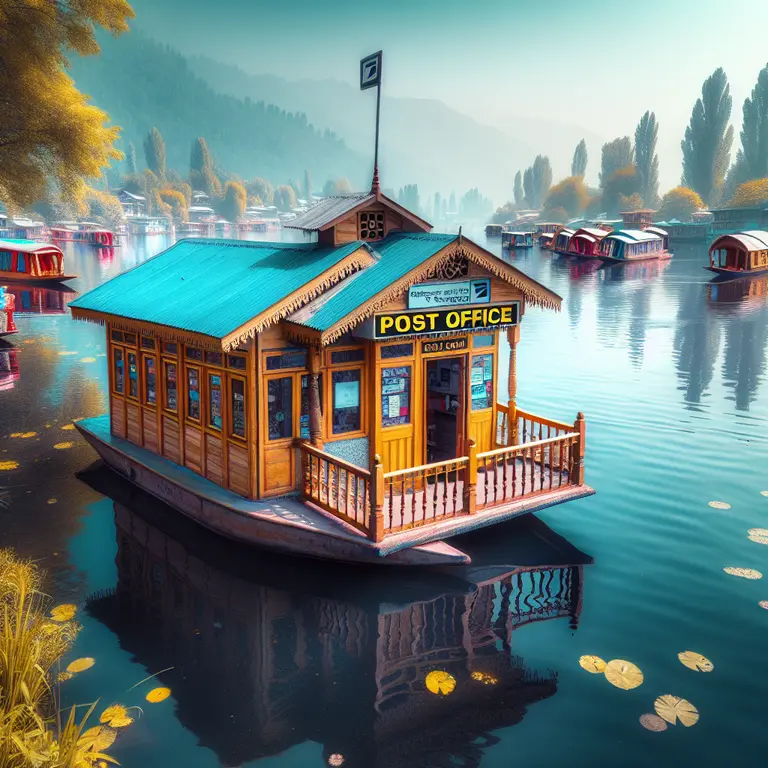
The Floating Post Office of Dal Lake: Where History, Culture, and Correspondence Meet the Water
Dal Lake in Srinagar, India, is one of the most photographed bodies of water in all of Asia. Its mirror-like surface reflects the snow-draped peaks of the Himalayas, and its shores are lined with centuries-old chinar trees whose leaves turn a blazing amber each autumn. Tourists arrive by the thousands to glide across its waters in hand-carved shikaras, to sleep aboard ornately decorated houseboats, and to wander through the floating vegetable markets that have sustained local communities for generations. Yet among all the remarkable features that define Dal Lake, one stands apart as genuinely singular on a global scale: a fully operational post office housed on a houseboat, bobbing gently at the water’s edge, offering postal services to locals and visitors alike. Declared a heritage site by Indian authorities, the floating post office of Dal Lake is considered the only one of its kind anywhere in the world, and its story is far richer than its modest wooden exterior might suggest.
Inauguration, Heritage Status, and Official Recognition
The floating post office as it exists today was formally inaugurated in August 2011 by Omar Abdullah, who was then serving as Chief Minister of Jammu and Kashmir. The inauguration was not merely a ceremonial gesture. It represented an official acknowledgment that this structure, long embedded in the daily rhythms of life on Dal Lake, deserved formal recognition and preservation. The designation as a heritage site elevated the post office from a functional curiosity into a protected institution, one that carries the weight of regional identity alongside its mailbags.
What makes the heritage designation particularly meaningful is the context in which it was granted. Jammu and Kashmir has faced decades of political instability, and cultural landmarks in the region have not always received the attention or protection they deserve. By formally recognizing the floating post office as a heritage site, authorities signaled an intention to preserve not just a building, but a living piece of Kashmir’s social and administrative history. The post office continues to operate under India Post, the national postal service, and is officially registered as a functioning branch, meaning the letters and parcels processed there carry the same legal weight as those sent from any post office on dry land.
Services, Philatelic Treasures, and the Museum Within
The houseboat that serves as the post office is equipped to handle a range of standard postal services. Visitors can send letters, purchase stamps, deposit money, and access basic banking services offered by India Post through its extensive network. For most tourists, however, the real draw is something far more collectible than a standard envelope. The post office issues its own special philatelic stamps that depict the scenic beauty of Dal Lake, featuring images of shikaras gliding across the water, houseboats framed by mountain silhouettes, and the distinctive lotus flowers that bloom across the lake’s surface each summer. These stamps have become highly sought after by philatelists, the dedicated community of stamp collectors who prize regional and commemorative issues above almost everything else.
The post office also houses a small but genuinely fascinating philatelic museum. The museum displays rare stamps from various periods of Indian postal history, offering visitors a condensed but informative journey through the evolution of correspondence and communication on the subcontinent. For those with even a passing interest in historical artifacts, the museum provides unexpected depth. Rare colonial-era stamps sit alongside more recent commemorative issues, and informational panels explain the significance of particular designs and printing methods. It is the kind of museum that rewards curiosity, where a five-minute visit can easily stretch into half an hour for anyone willing to look closely at the displays.
Historical Roots: From British Houseboats to a Living Landmark
The origins of the floating post office stretch back well before Indian independence in 1947, and understanding that history requires a brief detour into the peculiar circumstances of British colonial rule in Kashmir. During the height of the British Raj, the rulers of the princely state of Jammu and Kashmir imposed restrictions on land ownership by non-Kashmiris. British residents, eager to enjoy the cool mountain summers of Srinagar as an escape from the punishing heat of the plains, found themselves unable to purchase land or build permanent homes. Their solution was elegant and practical: they commissioned elaborate houseboats on Dal Lake, floating residences that technically sat on water rather than land and therefore circumvented the ownership restrictions entirely.
These houseboats became a defining feature of Kashmiri culture, and many of them served multiple purposes over the decades. The houseboat that would eventually become the floating post office had its own history of use and adaptation before being converted to its current function. The transition from private or semi-private use to a public postal service reflects a broader pattern in Kashmir’s history, where structures and spaces have been repeatedly reimagined in response to changing political and social circumstances. That a British-era houseboat should ultimately become a government-run post office serving independent India’s citizens carries a certain quiet irony that history occasionally delivers without announcement.
Economic and Social Impact on the Dal Lake Community
The floating post office does not exist in isolation. It sits within an ecosystem of commerce, culture, and daily life that revolves around Dal Lake, and its impact on that ecosystem is both practical and symbolic. From an economic standpoint, the post office draws visitors who might not otherwise make the journey to that particular part of the lake, and those visitors spend money on shikara rides, local handicrafts, and food from the floating vendors who congregate wherever tourists gather. The ripple effect of a single unusual attraction can be surprisingly significant in a region where tourism represents a primary source of income for thousands of families.
Socially, the post office holds a different kind of importance for the people who live and work on Dal Lake. The lake is home to a substantial permanent population, including the Hanji community, who have lived on its waters for generations and whose livelihoods depend almost entirely on what the lake and its visitors provide. For these residents, the floating post office is not a curiosity but a service, a place where they can send and receive correspondence without making the journey to shore. The postal workers who staff the office are known personally to many of the lake’s residents, and the office functions as a small community hub in the way that post offices in rural villages have always done, as a place where news travels, and neighbors occasionally linger.
Scenic Surroundings and the Resilience of a Remarkable Institution
To visit the floating post office is to experience one of those rare moments where the practical and the beautiful occupy exactly the same space. The houseboat sits on water that reflects the sky in shades of blue, grey, and gold depending on the hour, surrounded by the distant white peaks of the Himalayas and the closer green slopes of the Zabarwan range. Lotus flowers drift past in season, and the calls of kingfishers carry across the water with startling clarity. It is a setting that would make any building seem more significant, but the post office earns its significance independently of its backdrop.
What is perhaps most remarkable about this institution is its durability. It has survived decades of political conflict, periods of severe unrest that emptied the valley of tourists and disrupted normal life for years at a time, and the kind of harsh winters that Dal Lake occasionally endures when temperatures drop low enough to partially freeze its surface. Through all of it, the post office has continued to operate, sorting mail, selling stamps, and receiving visitors with the quiet consistency that defines institutions built on genuine purpose rather than novelty alone.
Conclusion
Dal Lake’s floating post office is a testament to how function and imagination, when combined with the right landscape and history, can produce something that transcends its original purpose entirely. What began as a practical solution to the logistical challenges of colonial-era Kashmir has become a globally recognized landmark, a heritage site, a philatelic destination, and a working post office all at once. Its continued operation is a reminder that the most enduring institutions are often those that serve real communities while telling a story larger than themselves. For anyone fortunate enough to visit Srinagar, a shikara ride to the floating post office is not merely a tourist activity. It is a quiet encounter with layers of history still very much alive on the water.