
The Surprising Link Between Iron and Ice in Earth's History
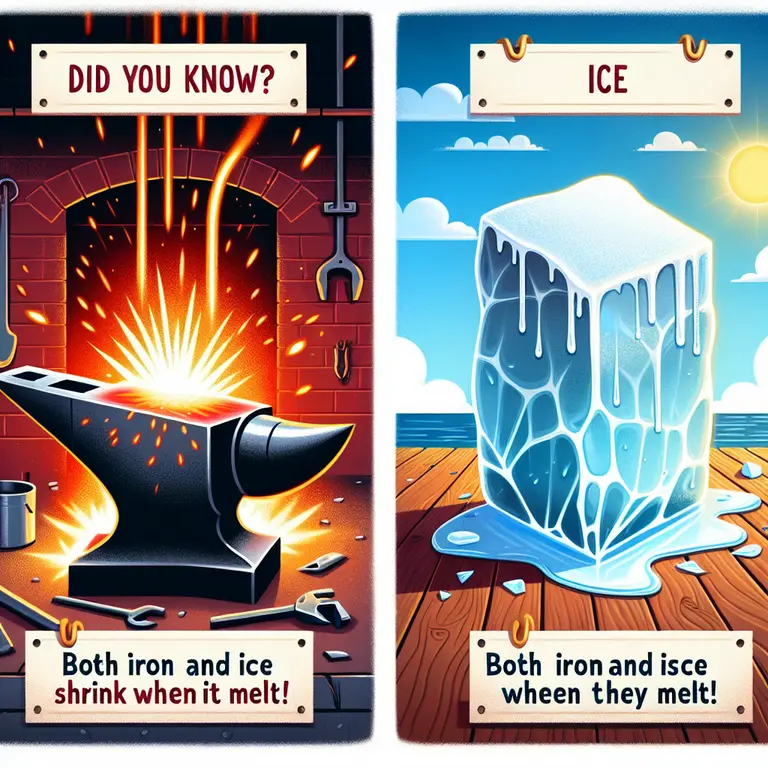
Did you know that iron and ice share a common property? They both are known to shrink when they melt!
 Watch on YouTube
 Watch on Rumble
When Things Shrink as They Melt: The Curious Cases of Iron and Ice
Iron and ice seem to have almost nothing in common. One is a dense, heavy metal forged in the cores of dying stars and extracted from the earth through industrial processes. The other is simply frozen water, something that forms in a freezer or falls from the sky on a winter morning. Yet these two substances share one of the more counterintuitive behaviors in all of materials science: when they melt, they do not expand. They shrink. This shared anomaly spans wildly different scales of physical and chemical organization, from the quantum-mechanical behavior of metallic electrons to the geometry of hydrogen bonds between water molecules. Understanding why this happens requires a closer look at what melting actually means at the atomic level, and why the rules that govern most substances simply do not apply to these two remarkable materials.
General Behavior of Substances During Melting
To appreciate how unusual iron and ice are, it helps to first understand what normally happens when a solid melts. In the vast majority of materials, the transition from solid to liquid is accompanied by an increase in volume. This is rooted in the nature of atomic and molecular arrangements. In a solid, particles are locked into a regular, repeating lattice structure. They vibrate in place but cannot move freely relative to one another. When enough thermal energy is added to break those bonds, the particles gain the freedom to move around, and in doing so, they tend to spread out. The average distance between particles increases, and the overall volume of the material grows.
This is why, for example, most metals expand when heated and why engineers must account for thermal expansion in bridges, rail lines, and pipelines. The expansion of materials upon melting is so universal that it forms a foundational assumption in many areas of physics and engineering. Density decreases, volume increases, and the solid sinks in its own liquid. This last point is worth emphasizing because one practical consequence of anomalous contraction upon melting is that the solid form of the substance floats in its liquid form. Ice floating on water is the most familiar example of this, but the principle applies to iron as well, at least in theory. A solid piece of iron, if placed in a pool of liquid iron, would float rather than sink. Both iron and ice defy the standard model in this respect, though for entirely different structural reasons.
Iron’s Atomic Structure and Phase Transition
The behavior of iron during melting is one of the more elegant stories in metallurgy, and it begins with how iron atoms organize themselves under different temperature and pressure conditions. At room temperature, iron adopts a body-centered cubic structure, often abbreviated as BCC. In this arrangement, iron atoms sit at each of the eight corners of an imaginary cube, with a single atom positioned at the very center of that cube. Each central atom, therefore, has eight nearest neighbors. This is a relatively open arrangement, meaning there is a fair amount of empty space between the atoms relative to how tightly they could theoretically be packed.
As iron is heated to around 912 degrees Celsius, something remarkable happens before it even reaches its melting point of approximately 1538 degrees Celsius. It undergoes a solid-state phase transition, shifting from the BCC structure into a face-centered cubic structure, known as FCC. In the FCC arrangement, atoms are located at each corner of the cube and also at the center of each of the six faces. This gives each atom twelve nearest neighbors instead of eight, and the overall packing of atoms becomes significantly denser. The atoms are, on average, closer together than they were in the BCC phase.
When iron ultimately melts into its liquid state, it does so from this already compact FCC structure, and the resulting liquid iron is denser than the BCC solid that existed at lower temperatures. The transition to the liquid state does not dramatically open the structure in the way it does for most metals. Instead, the liquid iron retains a degree of short-range order that keeps its density relatively high. The net result is that the volume of iron decreases upon melting, a direct consequence of the structural reorganization that accompanies its phase transitions. This is not merely a scientific curiosity. It has significant practical implications in metallurgy and casting, where the contraction of iron during solidification must be carefully managed to avoid defects in cast products.
Ice’s Unique Molecular Geometry
Ice contracts upon melting for reasons that are entirely distinct from iron’s phase behavior, rooted instead in the peculiar geometry of the water molecule and the nature of hydrogen bonding. Water molecules consist of one oxygen atom bonded to two hydrogen atoms at an angle of roughly 104.5 degrees. This bent geometry gives the molecule an uneven distribution of electrical charge, making it polar. The slightly negative oxygen end of one molecule is attracted to the slightly positive hydrogen end of another, forming a hydrogen bond.
In solid ice, specifically the form known as ice I, which is the ordinary ice encountered in everyday life, water molecules arrange themselves into a hexagonal lattice in order to maximize the number and strength of these hydrogen bonds. Each water molecule forms hydrogen bonds with four neighbors, and the resulting structure is beautifully ordered but also remarkably spacious. The hexagonal geometry enforces specific angles and distances between molecules, leaving a significant amount of empty space within the lattice. This is why ice is less dense than liquid water, and why a cubic centimeter of ice contains fewer water molecules than a cubic centimeter of liquid water at just above the freezing point.
When ice melts, the rigid hexagonal framework collapses. The hydrogen bonds do not disappear entirely in liquid water, but they become shorter-lived, more disordered, and less constrained by geometry. Water molecules in the liquid state can pack together more efficiently, partly filling the voids left by the crystalline structure of ice. The result is that liquid water at zero degrees Celsius is actually denser than ice at the same temperature, which is why ice floats. This property has consequences that extend far beyond the physics laboratory. Because ice floats, frozen lakes and ponds develop an insulating layer of ice on the surface rather than freezing solid from the bottom up, a fact that has been critical to the survival of aquatic life through countless ice ages and cold winters throughout Earth’s history.
Conclusion
Iron and ice stand as two of the most instructive anomalies in the study of matter, each demonstrating in its own way that the rules governing most substances are not universal. Iron contracts upon melting because its atomic structure reorganizes from a relatively open BCC arrangement into a denser FCC configuration before and during the transition to liquid. Ice contracts upon melting because the rigid, spacious hexagonal lattice enforced by hydrogen bonding collapses into a more efficiently packed liquid network. The mechanisms are completely different, operating at different scales and driven by different physical forces, yet the outcome is the same: a solid that is less dense than the liquid it becomes.
What makes this comparison particularly valuable is not just the scientific detail it illuminates, but the broader lesson it carries about the nature of physical laws. Nature does not always follow the most obvious path, and materials can arrive at similar behaviors through entirely different routes. For scientists and engineers, understanding these exceptions is not merely an academic exercise. It shapes how metals are cast, how climate systems are modeled, and how life on Earth has persisted through dramatic environmental changes. In the shared anomaly of iron and ice, we find a reminder that the most interesting science often lives in the exceptions.