
Nuclear Diamonds: Radioactive Waste to Clean Energy
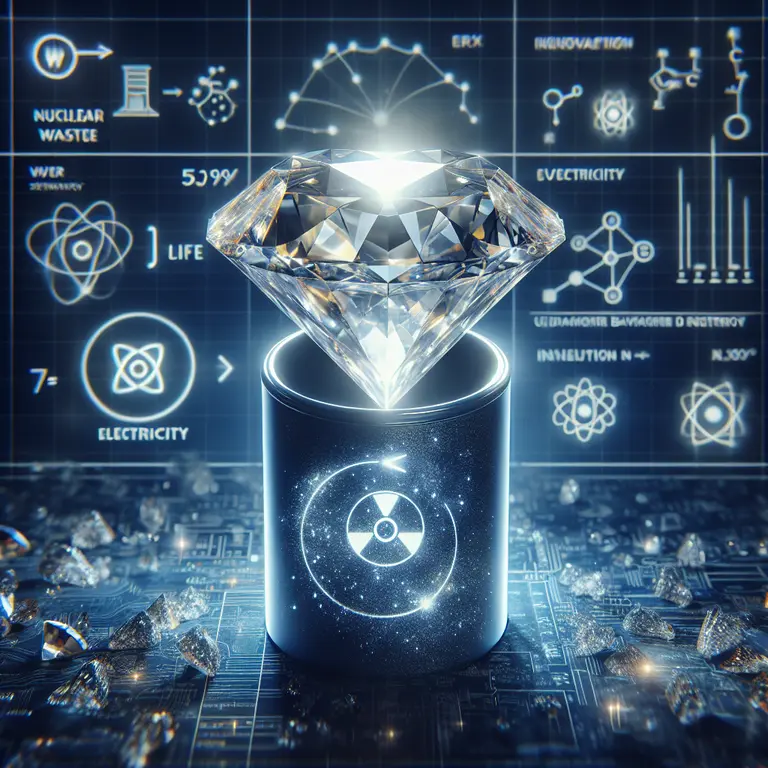
Scientists have figured out how to use nuclear waste to generate electricity in a nuclear-powered diamond battery, which can last over 5,000 years.
 Watch on YouTube
 Watch on Rumble
Introduction
Nuclear reactors generate hazardous waste as a by-product, including radioactive materials such as Plutonium-238. One of the most pressing challenges associated with nuclear energy is the safe disposal and management of this waste, which can remain dangerous for thousands of years and requires careful, costly containment in secure repositories around the world. However, researchers at the University of Bristol have uncovered an innovative way to turn this nuclear liability into an asset by developing a nuclear diamond battery. This breakthrough presents an exciting opportunity to harness nuclear waste for clean, long-lasting energy, and it challenges the conventional assumption that radioactive by-products are simply a burden to be managed rather than a resource to be used.
The concept sits at a fascinating intersection of nuclear physics, materials science, and electrical engineering. It draws on well-established principles while applying them in a configuration that was previously considered impractical at scale. Understanding why this development matters requires a closer look at the material at its core, the science that makes it work, and the range of applications it could eventually support.
The Properties of Plutonium-238
Plutonium-238 is a unique form of radioactive material unsuitable for nuclear weapons, as it cannot sustain a chain reaction. However, it is highly radioactive, emitting alpha radiation, with a half-life of 87.7 years. Alpha radiation is intense but has low penetration power, meaning that paper or even human skin can stop it. This makes it relatively safe to handle under controlled conditions compared to other radioactive isotopes that emit gamma rays or high-energy neutrons capable of penetrating dense materials.
What makes Plutonium-238 particularly interesting from an engineering perspective is this combination of high energy output and low penetration range. The alpha particles it releases carry a significant amount of kinetic energy, but that energy is deposited over a very short distance. This means that with the right containment material, the radiation can be captured almost entirely within the battery structure itself, preventing any meaningful exposure to the surrounding environment. It is this property that makes Plutonium-238 a more practical candidate for embedded power applications than many other radioactive isotopes.
It is also worth noting that Plutonium-238 already exists in substantial quantities as a by-product of nuclear reactor operations. It is not a material that needs to be specially produced for this purpose. Repositories around the world hold stockpiles of it, and finding a productive use for that existing material adds an additional layer of appeal to the nuclear diamond battery concept.
The Science Behind Nuclear Diamond Batteries
The research team from the University of Bristol discovered that alpha radiation could be harnessed in a novel and highly efficient way. When an alpha particle strikes a negatively charged layer in a material such as a diamond, it generates a small but measurable electric current. This direct conversion of radiation into electricity involves no moving parts, produces no emissions, and requires no maintenance, making it a remarkably simple and robust energy source.
The diamonds used in this process are not natural gemstones but rather artificial diamonds grown by chemical vapor deposition. This technique allows researchers to manufacture diamonds with precise structural properties and to incorporate radioactive material directly into the diamond lattice during growth. The result is a structure in which the radioactive source and the energy-harvesting medium are integrated into a single, sealed unit.
The diamonds serve a dual function. They act as a containment mechanism, safely trapping the harmful radiation within the battery structure, while simultaneously harvesting the energy released by radioactive decay and converting it into electrical current. This energy production method is both safe and sustainable. The diamond layer, being one of the hardest and most chemically stable materials known to science, ensures that the radioactive core remains isolated from the external environment under virtually all foreseeable conditions. The result is a battery that generates continuous power without any fuel input, any moving components, or any emissions whatsoever.
A Power Source Measured in Centuries
One of the most remarkable features of nuclear diamond batteries is their extraordinary lifespan. Plutonium-238 has a half-life of nearly 88 years, meaning that after that period, the material will have lost only half of its radioactive activity. The battery would therefore continue to produce meaningful power for hundreds of years and would still generate some level of electricity for thousands of years after its creation. This longevity far exceeds that of any conventional battery technology currently available, and it reframes what it means to design a long-lasting power source.
To put this into perspective, some estimates suggest that a nuclear diamond battery could outlast the entire recorded span of human civilization to date. The oldest known writing systems are roughly 5,000 years old. A battery powered by Plutonium-238 could still be generating electricity long after that same span of time has passed again. This is not merely a technical curiosity. It represents a genuinely different category of energy storage and generation, one that operates on geological rather than human timescales.
The power output of individual nuclear diamond batteries is admittedly modest compared to conventional chemical batteries. Current prototypes produce power in the microwatt-to-milliwatt range, which limits their immediate applicability to low-power devices. However, for applications where replacing a battery is difficult, dangerous, or simply impossible, even a small, uninterrupted power supply is extraordinarily valuable.
Practical Applications Across Critical Fields
Nuclear diamond batteries have numerous potential applications, especially in situations where conventional energy sources are impractical or unsustainable. One of the most compelling possibilities is their use in implantable medical devices such as cardiac pacemakers. Pacemakers currently require replacement surgery when their batteries are depleted, typically every 5 to 15 years, depending on the device and the patient. Each surgical procedure carries risks, particularly for elderly or medically vulnerable patients. A nuclear diamond battery capable of lasting the patient’s entire lifetime would eliminate this recurring risk, improving patient outcomes and reducing the long-term cost of care.
Space exploration represents another domain where the technology could have transformative effects. Deep space probes operate in environments where solar panels are ineffective due to the extreme distance from the Sun, and where temperature differentials are insufficient to reliably power thermoelectric generators. Nuclear diamond batteries could provide continuous, low-maintenance power for these probes over decades, enabling longer missions and reducing dependence on the relatively scarce supplies of Plutonium-238 that have traditionally been used in radioisotope thermoelectric generators. The Voyager probes, launched in 1977 and still transmitting data today, illustrate just how valuable a truly long-lasting power source can be in deep space contexts.
Beyond medicine and space, these batteries could serve a wide range of applications in low-power electronics. Remote sensors deployed in inhospitable environments, monitoring equipment installed in difficult-to-access locations, emergency beacons, and devices embedded in infrastructure with limited maintenance access are all areas where a maintenance-free power source lasting for centuries would offer clear advantages. The abundance of Plutonium-238 already held in nuclear waste repositories means that sufficient raw material exists to support widespread deployment of this technology as it matures.
Addressing Nuclear Waste and Future Prospects
A significant advantage of this technology is that it directly addresses one of the most persistent and expensive problems associated with nuclear energy: the long-term storage of radioactive waste. Plutonium-238 is already being stored in repositories worldwide at considerable cost and with ongoing concerns about containment integrity, security, and environmental risk. Finding a productive use for this material does not simply make it more convenient to store. It transforms the entire framing of the problem, converting a liability into a resource.
While the development of nuclear diamond batteries is still in its early stages, the research trajectory is encouraging. Scientists are investigating whether other radioactive isotopes, including Carbon-14, which is produced in large quantities as a by-product of nuclear reactor operation, could be similarly incorporated into diamond battery structures. Carbon-14 has a half-life of approximately 5,730 years, which would produce a battery with an even more extraordinary operational lifespan, though with different energy characteristics that would require careful engineering consideration.
As research progresses, improvements in the efficiency of radiation-to-electricity conversion and advances in artificial diamond manufacturing are likely to increase the practical power output of these devices. The technology is unlikely to replace grid-scale power generation in the foreseeable future, but that was never its intended purpose. Its value lies in filling a specific and currently underserved niche: applications that demand reliability, longevity, and zero maintenance over timescales that no conventional battery can approach.
Conclusion
The creation of nuclear diamond batteries from Plutonium-238 is an extraordinary example of how scientific innovation can address some of the most pressing challenges of our time. By transforming radioactive waste into a long-lasting, sustainable energy source, researchers have not only found a new way to manage hazardous materials but have also opened up genuine new possibilities for energy generation in critical applications across medicine, space exploration, and remote sensing.
The broader significance of this development extends beyond the technical details. It represents a meaningful shift in how we think about nuclear waste, moving away from the assumption that such materials are simply a burden to be contained indefinitely and toward a recognition that they may hold untapped value. Much work remains before nuclear diamond batteries become commercially available at scale, but the principles have been demonstrated, the materials are already available, and the potential applications are both real and consequential. In a world searching for sustainable, low-maintenance energy solutions, this technology offers a genuinely novel path forward, one forged from a material that most people would rather not think about at all.