
Cloud Command: Soviet Weather Control's Legacy and Impact
How the USSR built a vast, secret weather modification program during the Cold War, seeding clouds over cities and battlefields, and why that science is now being revived worldwide.
Introduction: Weather as Infrastructure
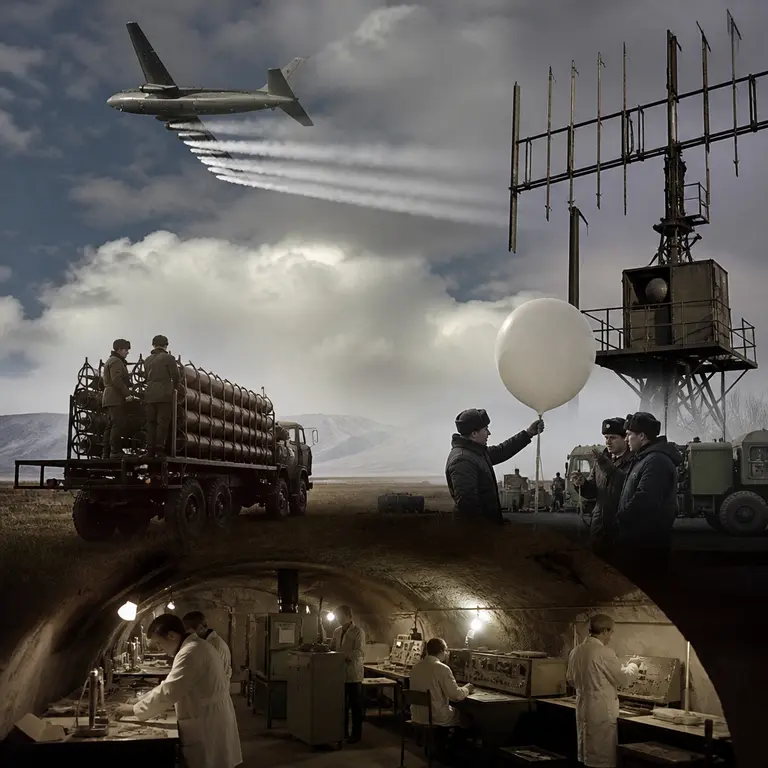
In the decades following World War II, the Soviet Union pursued weather modification not as a curiosity but as a matter of state policy. While Western nations experimented cautiously with cloud seeding — the process of dispersing silver iodide, dry ice, or other particles into clouds to induce precipitation — Soviet scientists treated atmospheric control as a branch of national infrastructure, as serious and as funded as dam construction or nuclear engineering. The ideological context matters here: the Soviet state had long embraced the idea that nature was a problem to be solved, a set of obstacles to be overcome through collective will and scientific planning. Rivers were dammed, forests were cleared, and steppes were plowed under in the name of progress. The sky, in this worldview, was simply the next frontier.
By the 1960s, the USSR had a dedicated network of aircraft, ground-based generators, and research institutes devoted entirely to altering the weather. The program was not a fringe experiment. It was a bureaucratic machine with its own ministries, its own funding lines, and its own cadre of trained specialists. Weather modification sat alongside other grand Soviet engineering ambitions — the reversal of Siberian rivers, the draining of the Aral Sea’s tributaries for cotton irrigation — as an expression of a civilization that believed human intelligence could and should override natural systems. The difference was that weather modification, unlike those other interventions, was conducted largely in silence, away from the scrutiny of Western scientists and the international press.
The scientific foundation was laid in part by Nikolai Semyonov, a Nobel laureate in chemistry, and by a generation of atmospheric physicists who believed that cloud microphysics — the behavior of supercooled water droplets and ice nuclei — could be reliably manipulated. The Soviet state saw in this possibility a tool for agricultural rescue, drought relief, and eventually something far more ambitious: the suppression of rain over cities during public events, and the enhancement of snowpack over reservoirs. The program was not uniformly successful, but it was vast and operated for decades, largely invisible in Western scientific literature.
Silver Iodide and the Architecture of a Hidden Program
Cloud seeding itself was not a Soviet invention. The American chemist Vincent Schaefer first demonstrated dry ice seeding in 1946, working at General Electric’s research laboratory in Schenectady, New York. His colleague Bernard Vonnegut — brother of novelist Kurt Vonnegut — identified silver iodide as a far more effective seeding agent in 1947. Its crystalline structure mimics ice, tricking supercooled water droplets into freezing and eventually falling as precipitation. These discoveries were published openly, and Soviet scientists read them with considerable interest.
What the Soviets built from that foundation, however, was structurally different from anything in the West. The USSR established the High-Mountain Geophysical Institute in Nalchik, in the North Caucasus, as a central hub for weather modification research. From there, researchers developed hail suppression programs over Georgian vineyards and grain fields in Ukraine. Hail suppression — disrupting the formation of large hailstones by seeding storm cells early — became one of the program’s most operationally consistent achievements. Soviet agronomists claimed reductions in hail damage of 50 to 80 percent in protected zones, figures that Western meteorologists received with considerable skepticism but could not easily refute, given the closed nature of Soviet data.
The operational scale was unlike anything in the West. By the 1970s, the Soviet hail suppression network employed hundreds of aircraft and thousands of ground-based rocket launchers capable of firing silver iodide shells into approaching storm cells. The program covered millions of hectares of farmland across the Caucasus, Central Asia, and parts of Siberia. It was, in effect, a weather air force — one that operated with the logistical seriousness of a military branch, complete with command structures, operational protocols, and performance metrics reported upward through the state apparatus.
That last detail matters. Performance metrics reported to a centralized political authority created powerful incentives to overstate results, a problem that would shadow the program’s entire history. Scientists who reported failure risked losing funding, prestige, and in earlier decades, far worse. Scientists who reported success were rewarded. The structural pressure toward optimistic reporting was baked into the system from the beginning, making retrospective evaluation of the program’s actual achievements genuinely difficult. What the archives show is a program that believed in itself, or at least convincingly performed belief, enough to sustain decades of state investment.
The Chernobyl Intervention and the Politics of Rain
The most dramatic — and most contested — deployment of Soviet weather modification came in the aftermath of the Chernobyl nuclear disaster in April 1986. As radioactive clouds drifted northwest from the destroyed reactor in Ukraine, Soviet authorities reportedly ordered cloud seeding missions to force precipitation over rural Belarus rather than allow contaminated rain to fall on Moscow or other major population centers. The operation, if it occurred as described, deliberately redirected radioactive fallout onto a less politically significant population. It represents, if true, one of the most consequential and morally troubling uses of environmental technology in modern history.
The evidence for this specific operation is fragmentary and disputed. Belarusian scientists and officials, including those who later worked with the United Nations on Chernobyl health assessments, have claimed that anomalously high radiation readings in parts of the Gomel region of Belarus corresponded to areas where precipitation was artificially induced. The Soviet government never officially acknowledged the operation. Russian authorities have continued to deny it. But the claim has been examined seriously enough that the European Parliament requested a formal investigation in 2016, and Belarusian researchers have continued to publish data suggesting that rainfall patterns in the days following the explosion were inconsistent with natural meteorological conditions alone.
The difficulty of definitive proof reflects a broader challenge in weather modification research. Rainfall is inherently variable, and distinguishing artificially induced precipitation from natural precipitation requires baseline data, controlled comparisons, and independent verification — none of which were available in the chaotic days following the Chernobyl explosion. The Soviet state controlled the data, controlled the aircraft, and controlled the narrative. Whether the seeding happened as alleged, the conditions that would have made it possible — the infrastructure, the institutional willingness, the political logic — were all unambiguously present.
Whether or not the Chernobyl seeding occurred as described, the episode illustrates the degree to which Soviet weather modification had moved from agricultural support into the territory of political and strategic decision-making. Rain was no longer just weather. It was a resource to be managed, redirected, and, if necessary, weaponized against one’s own population in the service of protecting the political center.
What the Program Actually Achieved
Separating genuine meteorological effect from Soviet statistical reporting is difficult even now. The USSR had strong institutional incentives to overstate results, and the absence of independent verification meant that many claimed successes went unchallenged internally. Western atmospheric scientists who gained access to Soviet data after the Cold War found a mixed picture that resists simple summary.
Hail suppression over agricultural zones provided credible evidence of effectiveness, consistent with the underlying physical mechanisms. When storm cells are seeded early, the competition for available moisture among more ice crystals produces smaller hailstones that cause less damage upon impact. The physics is sound, and Soviet field data, even accounting for reporting bias, showed patterns consistent with genuine suppression effects. This is the area where the program’s legacy is most defensible.
Precipitation enhancement — making it rain more in drought-affected areas — produced far less convincing results. The fundamental problem, which Soviet scientists understood but political pressure discouraged them from emphasizing, is that cloud seeding can only enhance precipitation from clouds that already contain sufficient moisture. It cannot create rain from clear skies or coax water from air that does not carry it. In drought conditions, when clouds are sparse and dry, seeding achieves little. The program’s agricultural rescue missions during Soviet droughts in the 1970s appear to have been largely ineffective for this reason, though the official reports at the time suggested otherwise.
The most durable legacy of the Soviet program may be methodological rather than operational. Soviet researchers accumulated decades of observational data on cloud microphysics, ice nucleation, and storm cell behavior under a variety of atmospheric conditions across an enormous geographic range. Some of that data, now accessible through post-Soviet scientific exchanges, has informed contemporary cloud seeding research in China, the United Arab Emirates, and the United States. The program’s contribution to science was real, even where its contribution to rainfall was not.
Present-Day Revival: Cloud Seeding in a Warming World
In 2023 and 2024, cloud seeding has moved from Cold War curiosity to urgent policy consideration, driven by the accelerating disruption of global water cycles under climate change. The United Arab Emirates operates one of the world’s most active cloud seeding programs, running regular missions over the Arabian Peninsula using aircraft equipped with flares loaded with hygroscopic salts. The program is motivated by a straightforward crisis: the UAE receives less than 100 millimeters of rainfall per year on average, and its groundwater reserves are being depleted at unsustainable rates. Cloud seeding is not a solution, but it is one of the few tools available that might incrementally improve the situation.
China’s Tianhe Project, announced in 2020 and continuing through 2024, aims to modify weather across an area roughly three times the size of Spain using a network of ground-based burners and aircraft. The program targets the Tibetan Plateau and surrounding regions to increase rainfall flowing into the Yellow and Yangtze rivers, both of which have experienced reduced flow in recent decades as glaciers retreat and monsoon patterns shift. The scale of the Chinese program is closer to the Soviet model than to anything the West has attempted, and it raises analogous questions about effectiveness, verification, and transboundary consequences.
In the United States, a 2023 report from the National Academies of Sciences, Engineering, and Medicine called for a coordinated federal research program into weather modification, noting that the science has advanced significantly but that rigorous randomized field trials — the kind that would settle questions about effectiveness once and for all — have rarely been conducted. The state of Utah has invested in cloud seeding over the Wasatch Mountains to increase winter snowpack, and the Colorado River Basin states have collectively funded seeding operations as a response to the ongoing megadrought in the American West. The desperation driving these investments is not so different from the desperation that drove Soviet agricultural ministries to fund weather modification in the 1960s.
The Soviet program, for all its opacity and political distortion, was asking the same questions that contemporary researchers are now asking under conditions of climate stress: Can we move water from where it falls to where it is needed? Can we protect crops from hail? Can we fill reservoirs from the sky? The answers remain incomplete, but the questions have never been more pressing.
The Ethical Atmosphere
The Soviet experience also left behind a set of ethical problems that contemporary weather modification programs have not fully resolved. When one nation or region seeds clouds, it may be drawing moisture away from a downwind neighbor. Clouds do not recognize political boundaries, and precipitation produced in one location may represent precipitation that would otherwise have fallen elsewhere. This transboundary dimension of weather modification has no settled legal framework. The 1977 Environmental Modification Convention, known as ENMOD, prohibits hostile weather modification in warfare, but it says nothing about civilian programs that inadvertently — or deliberately — alter precipitation patterns across borders.
The alleged Chernobyl seeding operation represents an extreme version of a problem that exists in milder forms wherever cloud seeding is practiced: the question of who decides where the rain falls, and who bears the consequences when it falls in the wrong place. Soviet authorities made that decision unilaterally, in secret, with consequences for Belarusian communities that persisted for decades in the form of elevated cancer rates, contaminated soil, and the long-term displacement of hundreds of thousands of people. Contemporary programs in China, operating at continental scale, raise analogous questions about downstream effects on neighboring countries — India, Bangladesh, Vietnam — that have no seat at the table when seeding missions are authorized over the Tibetan Plateau.
There is also a subtler ethical dimension that rarely receives attention. Weather modification programs, even well-intentioned ones, may reduce the political pressure to address the underlying causes of water scarcity. If a drought-stricken region can be partially relieved through cloud seeding, the urgency of reducing greenhouse gas emissions, reforming agricultural water use, or investing in desalination may diminish. The technology becomes a way of managing symptoms rather than treating the disease. The Soviet Union used weather modification partly as a substitute for agricultural reform, and the results — in terms of long-term food security and environmental health — were not encouraging.
The history of Soviet weather modification is not simply a story about atmospheric chemistry or Cold War competition. It is a story about the relationship between scientific capability and political power, about what happens when the ability to alter a shared natural system is concentrated in the hands of a state with no obligation to explain itself. That story is not over. It has simply acquired new actors, new technologies, and a new climate in which the stakes are considerably higher than anything Soviet planners could have imagined when they first looked up at the clouds and decided to take control.
Sources & Further Reading
- National Academies of Sciences, Engineering, and Medicine. Reflections on the Future of Weather Modification Research in the United States. National Academies Press, 2023. https://nap.nationalacademies.org/catalog/26899
- Vonnegut, B. The Nucleation of Ice Formation by Silver Iodide. Journal of Applied Physics, 1947.
- Zanetti, V. Weather Modification: A State of the Art Review. World Meteorological Organization, 2000.
- Feshbach, M. and Friendly, A. Ecocide in the USSR: Health and Nature Under Siege. Basic Books, 1992.