
Dorothy Hodgkin: Nobel Laureate Who Transformed Medicine
Dorothy Crowfoot Hodgkin used X-ray crystallography to reveal the atomic structures of penicillin, vitamin B12, and insulin — discoveries that reshaped medicine and earned her a Nobel Prize few remember she won.
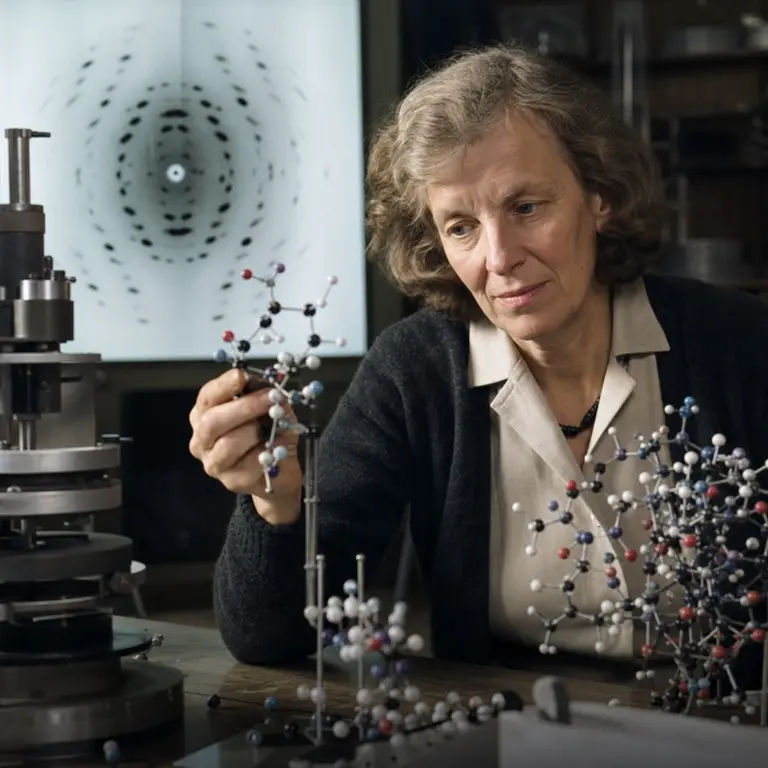
A Scientist Who Saw What Others Could Not
In 1964, Dorothy Crowfoot Hodgkin became the third woman ever to receive the Nobel Prize in Chemistry — and the only British woman to have won a Nobel Prize in any scientific discipline. Yet her name rarely appears in lists of celebrated scientists, and her work, which underpins the design of nearly every modern pharmaceutical, is largely unknown outside specialist circles. Her tool was X-ray crystallography, a technique that fires beams of X-rays through crystallized molecules and reads the scattered patterns to reconstruct atomic architecture in three dimensions. In Hodgkin’s hands, it became something close to a superpower.
Born Dorothy Mary Crowfoot in Cairo in 1910, she grew up largely in England and Sudan, raised in part by friends of the family while her parents worked in Egypt. Her childhood was peripatetic and unusual, defined less by formal instruction than by genuine intellectual curiosity. She developed an obsession with crystals and chemistry as a child, encouraged by a neighbor who gave her a home chemistry kit and a book on mineral analysis. That early gift set the trajectory of her entire scientific life. By the time she arrived at Oxford in 1928, she was already conducting her own crystallography experiments, years ahead of most of her peers in both ambition and technical understanding. She completed her doctorate at Cambridge under the crystallographer John Desmond Bernal, who recognized her exceptional spatial reasoning and technical precision and gave her access to some of the most advanced equipment available at the time. Bernal himself was a towering figure in the field, but many of his students and collaborators would later acknowledge that Hodgkin surpassed her mentor in the sheer difficulty of the problems she pursued and the reliability of the answers she produced.
What made Hodgkin extraordinary was not just technical skill but a particular quality of scientific patience. She was willing to commit years, sometimes decades, to a single problem, accumulating data and refining methods long before the computational tools existed to make the final analysis tractable. She was, in a sense, always working slightly ahead of what the technology of her era could support, and she had the discipline to wait for the technology to catch up rather than abandon the problem or accept an incomplete answer.
Penicillin’s Hidden Architecture
Hodgkin’s first landmark achievement came during World War II, when Allied medical authorities desperately needed to understand the chemical structure of penicillin in order to synthesize it on an industrial scale. The molecule was notoriously difficult to analyze — it was unstable, complex, and chemists disagreed sharply about its structural arrangement. Some believed the core ring structure was chemically impossible. The scientific community was divided not just over the details but over the fundamental question of whether the molecule could even take the form some researchers were proposing.
Working at Oxford between 1942 and 1945, Hodgkin and her team used X-ray diffraction data combined with early computational techniques — including some of the first uses of electronic computers for scientific calculation — to map penicillin’s atomic structure. The computational dimension of this work deserves particular emphasis. At a time when most scientific calculations were performed by hand or with mechanical calculators, Hodgkin was already recognizing that the sheer volume of data produced by crystallographic analysis would require machines to process. Her willingness to embrace computation as a scientific tool placed her years ahead of the mainstream in her field.
Her 1945 result confirmed the existence of the beta-lactam ring, the structural feature that gives penicillin its antibiotic properties, and silenced the skeptics. The work was classified by the British government during the war and only published afterward, meaning that its scientific significance was initially hidden from the broader research community. Without it, the mass production and rational modification of antibiotics would have been delayed by years, with consequences that are difficult to overstate given the role that penicillin played in reducing wartime mortality and transforming postwar medicine.
This was not a minor refinement. The structural knowledge Hodgkin produced became the foundation for designing the entire family of beta-lactam antibiotics — including ampicillin, amoxicillin, and the cephalosporins — that together account for billions of doses administered globally every year. Every time a physician prescribes one of these drugs, the prescription rests on a foundation that Hodgkin laid in a wartime Oxford laboratory with instruments that would be considered primitive by any modern standard.
Vitamin B12 and the Limits of Possibility
If penicillin was impressive, vitamin B12 was extraordinary. The molecule is among the most structurally complex non-polymer compounds found in nature, containing a cobalt atom at its center, a corrin ring system, and a nucleotide loop — a configuration so intricate that many chemists believed it could not be solved by crystallography alone. Linus Pauling, who himself won two Nobel Prizes and was perhaps the most celebrated chemist of the twentieth century, reportedly doubted the problem was tractable. The scientific consensus, to the extent one existed, was that certain molecules were simply too complex for the tools then available.
Hodgkin began working on B12 in 1948 and published the complete structure in 1956, a project that required eight years of painstaking data collection and analysis. The work involved collaborators at UCLA, including Kenneth Trueblood, who performed computational analysis on an early IBM computer — one of the first intercontinental scientific collaborations conducted via airmail exchange of punch cards. The logistical challenge of that collaboration alone was remarkable. Data generated in Oxford had to be physically transported across the Atlantic, processed on machines that occupied entire rooms, and the results mailed back for interpretation. The process was slow, expensive, and entirely without precedent, and Hodgkin managed it with the same methodical care she brought to every other aspect of her work.
The B12 structure comprised 181 atoms, a record at the time for crystallographic analysis. It was this achievement, more than penicillin, that the Nobel committee cited when awarding her the prize in 1964. The citation acknowledged not just the specific result but the demonstration that crystallography could be pushed into territory that the scientific community had considered inaccessible. In solving B12, Hodgkin did not simply answer a question — she expanded the definition of what questions could be asked.
The structural knowledge enabled chemists to understand how B12 functions as a coenzyme in DNA synthesis and neurological maintenance, and later allowed researchers to develop treatments for pernicious anemia, a previously fatal condition caused by B12 deficiency. The cobalt-centered architecture of the molecule, once mapped, revealed a biochemical mechanism unlike anything previously characterized, opening entirely new lines of inquiry in both chemistry and medicine.
Insulin and a Thirty-Five-Year Pursuit
Hodgkin’s most personally meaningful project was also her longest. She began attempting to solve the structure of insulin in 1934, when she was still a graduate student. Insulin was the first protein ever subjected to X-ray crystallography, and the attempt was largely symbolic at the time — the technology and computational power needed to complete the job did not yet exist. She was, in effect, planting a flag on a summit she could not yet climb, documenting the first diffraction patterns from insulin crystals and preserving them as a starting point for future work. She returned to the problem repeatedly over three decades, refining her methods, training new students, and accumulating data with a consistency of purpose almost without parallel in the history of science.
In 1969, thirty-five years after she first photographed an insulin crystal, Hodgkin’s team published the complete three-dimensional structure of insulin. She was fifty-nine years old and had been working with severe rheumatoid arthritis since her late twenties, a condition that progressively deformed her hands and eventually confined her to a wheelchair. She conducted much of her later work with hands she could barely close into a fist, operating delicate equipment and manipulating fragile crystals under conditions that would have ended most scientific careers. The physical determination required to continue this work, entirely apart from its intellectual demands, represents an aspect of her achievement that is rarely discussed but impossible to ignore.
The insulin structure she revealed made it possible to understand how the hormone binds to receptors, why certain mutations cause diabetes, and how to engineer modified insulin analogs — including the long-acting and rapid-acting insulin variants now used by tens of millions of diabetic patients worldwide. The global diabetes treatment industry, worth hundreds of billions of dollars annually and sustaining the lives of hundreds of millions of people, rests in part on the structural knowledge that Hodgkin spent thirty-five years assembling. Structural biology, as a pharmaceutical design discipline, traces a direct line to her insulin work, and the logic of that discipline — that understanding molecular shape is the key to understanding biological function — has become one of the organizing principles of modern medicine.
A Legacy Embedded in Modern Medicine
Hodgkin trained or influenced a remarkable number of scientists who went on to distinguished careers, including Margaret Thatcher, who studied under her at Oxford before entering politics and later cited Hodgkin as a formative scientific mentor. The relationship between the future prime minister and her crystallography supervisor is one of the stranger footnotes in twentieth-century history, and Thatcher kept a portrait of Hodgkin in Downing Street during her years in office — a detail that complicates any simple narrative about either woman. Hodgkin was also a committed peace activist, serving as president of the Pugwash Conferences on Science and World Affairs from 1976 to 1988, an organization founded to reduce the dangers of weapons of mass destruction. She held this role during the height of Cold War nuclear tensions, and her scientific credibility lent her advocacy a weight that purely political voices could not match.
Her broader legacy is both institutional and scientific. The techniques she refined for handling biological macromolecules became standard methods in structural biology, and her insistence on computational rigor helped establish the norm of depositing crystallographic data in shared databases — a practice that now underpins the entire field of protein structure prediction, including the AI systems such as AlphaFold that have recently transformed drug discovery. When DeepMind announced in 2020 that AlphaFold had solved the protein-folding problem with a degree of accuracy that stunned the research community, the achievement was celebrated as a triumph of artificial intelligence. It was also, less visibly, a vindication of the data-sharing culture that Hodgkin helped create. Without the accumulated structural databases that her generation built and normalized, AlphaFold would have had nothing to learn from.
Dorothy Hodgkin died in 1994 at the age of eighty-four. A Royal Mail stamp, a Google Doodle on her birthday, and a prestigious annual lecture at the Royal Society bear her name. These are honorable gestures, but they are also somewhat inadequate to the scale of the contribution. The molecules she mapped — the antibiotics in every hospital cabinet, the insulin in every diabetes clinic, the B12 in every multivitamin — are a more enduring monument than any of them. She saw the invisible architecture of life at a time when no one else could, and the world she helped build is one in which millions of people are alive who would not otherwise be. That is a legacy that does not require a stamp or a doodle to be real. It is present in every pharmacy, every clinic, and every body that has ever benefited from a drug whose design began with understanding the precise shape of a molecule.
Sources & Further Reading
- Ferry, Georgina. Dorothy Hodgkin: A Life. Granta Books, 1998.
- Nobel Prize Committee. Dorothy Crowfoot Hodgkin: Nobel Prize in Chemistry 1964. NobelPrize.org, 1964. https://www.nobelprize.org/prizes/chemistry/1964/hodgkin/biographical/
- Janssen, Laura E. et al. 'Vitamin B12: A Structural Overview.' Chemical Reviews, American Chemical Society, 2021.
- Royal Society. Dorothy Hodgkin Lecture Series. royalsociety.org. https://royalsociety.org/grants-schemes-awards/awards/dorothy-hodgkin-lecture/