
From Submarines to Science: The Secret Life of Sosus
How a wartime sound-surveillance network originally built to track Soviet submarines accidentally became one of the most powerful tools in ocean science, detecting underwater volcanoes, whale migrations, and even meteor impacts.
 Watch on YouTube
 Watch on Rumble
A Cold War Ear Beneath the Waves
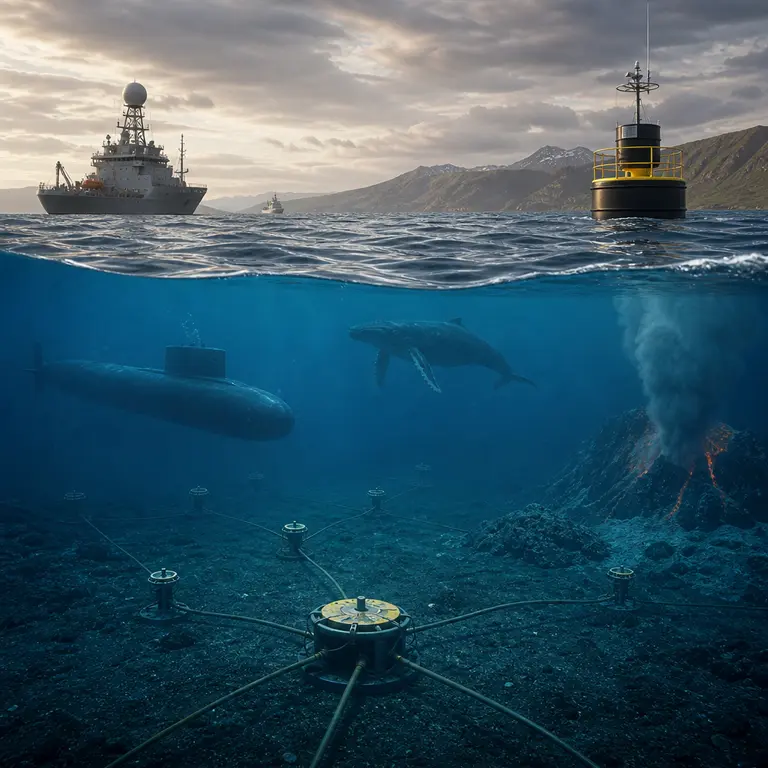
In 1949, the United States Navy began installing an extraordinary network of hydrophone arrays along the floors of the world’s oceans. The project, classified for decades as SOSUS (Sound Surveillance System), was designed with a single strategic purpose: to detect the acoustic signatures of Soviet submarines operating in the North Atlantic. The physics behind the system exploited a remarkable natural phenomenon called the SOFAR channel, short for Sound Fixing and Ranging channel, a horizontal layer of water sitting at depths between roughly 600 and 1,200 meters, where temperature, pressure, and salinity combine to create a natural acoustic waveguide. Sound waves traveling through this channel bend back toward the center rather than dispersing outward, allowing low-frequency noise to travel thousands of kilometers with almost no energy loss. A whale calling off the coast of Bermuda could, under the right conditions, be detected by a hydrophone anchored near the Canary Islands.
The physics of the SOFAR channel had actually been theorized decades before SOSUS was built. In 1944, Maurice Ewing and J. Lamar Worzel at Columbia University published classified research demonstrating that the ocean possessed a natural acoustic waveguide that could theoretically be used to locate distressed sailors by having them detonate small explosive charges underwater. The Navy absorbed this research and quietly redirected its implications toward strategic surveillance. The transition from a humanitarian location tool to a continental-scale intelligence network happened entirely out of public view, and the scientists who first described the channel’s properties had no idea what their work would eventually become. This kind of institutional repurposing of basic scientific discovery is common in military history, but the gap between the original intent and the final application has rarely been quite so wide.
For nearly four decades, SOSUS remained one of the most tightly guarded intelligence assets in American military history. The network eventually stretched across the Atlantic and Pacific basins, with listening stations linked by undersea cables to shore-based processing facilities staffed around the clock by Navy analysts. During the Cuban Missile Crisis of 1962, the system tracked Soviet submarines in real time, giving American commanders a situational awareness of underwater threats that their Soviet counterparts could not have imagined. During the Cold War’s tensest years, SOSUS operators developed an almost forensic familiarity with the acoustic fingerprints of individual submarine classes, learning to distinguish one vessel from another by the particular rhythm of its propeller cavitation or the resonant frequency of its hull under pressure. The existence of the network was not officially acknowledged until 1991, when the end of the Cold War prompted a classified review of which technologies might be responsibly declassified for scientific use.
When Spy Technology Became a Scientific Instrument
The transition from military secrecy to scientific instrumentation occurred with unusual speed once the political will existed to do so. In 1991, the National Oceanic and Atmospheric Administration, known as NOAA, negotiated partial access to SOSUS arrays for civilian researchers. The agreement was carefully bound: scientists could receive processed acoustic data from specific geographic regions, but the precise locations of individual hydrophones and the full technical specifications of the network remained classified. Even this partial access, however, was enough to transform several fields of earth science almost immediately.
The following year, scientists at NOAA’s Pacific Marine Environmental Laboratory in Newport, Oregon, began using the network to monitor a stretch of the Juan de Fuca Ridge off the coast of Oregon and Washington, one of the most geologically active spreading centers in the northeastern Pacific. Mid-ocean ridges are the seams along which tectonic plates slowly pull apart, allowing magma from the mantle below to well up and create new oceanic crust. Geologists had long known that this process was accompanied by earthquakes and volcanic eruptions, but because the ridges lie beneath two to three kilometers of water and thousands of kilometers from the nearest land, direct observation had been essentially impossible. SOSUS changed that overnight.
In June 1993, SOSUS detected a swarm of more than 9,000 seismic events along the CoAxial segment of the Juan de Fuca Ridge over a period of just a few days. The acoustic signals, traveling through the SOFAR channel, arrived at hydrophone arrays with sufficient precision for researchers to triangulate the source location to within a few kilometers. A research vessel dispatched to the site found fresh lava flows on the seafloor and a rising plume of hydrothermal water streaming from newly opened vents, carrying with it heat, minerals, and the chemical signatures of freshly erupted rock. This was the first time a submarine volcanic eruption had been detected in near real time and investigated while it was still active. The discovery fundamentally changed how volcanologists thought about the pace and frequency of seafloor spreading events. Prior to SOSUS access, the prevailing assumption had been that such eruptions were rare and widely spaced in time. The continuous acoustic record revealed they were far more common than anyone had imagined, occurring perhaps dozens of times per year across the global ridge system.
Between 1993 and 2001, NOAA’s hydroacoustic monitoring program detected dozens of previously unknown submarine volcanic events, tracked the lateral propagation of magma through oceanic crust in real time, and recorded the distinctive acoustic signatures of iceberg calving events in Antarctica. Researchers also discovered that certain categories of low-frequency sound, which they labeled T-phase events, could serve as reliable proxies for earthquake magnitude in submarine environments where traditional seismometers had no coverage. In regions of the ocean where no seismic station existed within 1,000 kilometers, the SOSUS-derived hydroacoustic network suddenly began providing earthquake catalogs of unprecedented completeness.
The Whale That Changed Everything
Perhaps the most unexpected scientific dividend of the declassified SOSUS network came not from geology or seismology but from marine biology. Christopher Clark, a bioacoustician at Cornell University’s Bioacoustics Research Program, gained access to archived SOSUS tapes in the early 1990s and began systematically analyzing recordings that Navy operators had previously flagged as unidentified biological signals. What Clark and his colleagues found in those tapes rewrote the scientific understanding of baleen whale communication, migration, and population structure.
Blue whales, fin whales, and bowhead whales produce calls in the infrasonic range, below 20 hertz, at frequencies entirely inaudible to the human ear but ideally suited for propagation through the SOFAR channel across entire ocean basins. Before SOSUS, researchers studying whale acoustics had to deploy their own hydrophones from research vessels, limiting them to small geographic areas and short observation windows. The SOSUS archive offered something radically different: decades of continuous recordings from fixed arrays spanning entire ocean basins, capturing whale calls that no human had ever intentionally listened for.
Clark’s analysis demonstrated that individual blue whales could be tracked continuously over thousands of kilometers of open ocean, their calls serving as acoustic identification tags sufficiently distinctive to distinguish one animal from another. This finding alone overturned assumptions about blue whale ranging behavior that had been built on the much more limited data available from visual surveys and tagging studies. More significantly, the recordings revealed that blue whale populations in the North Pacific were producing calls that had been shifting downward in frequency by roughly 0.3 hertz per year since at least the 1960s. The cause of this decades-long frequency shift remains actively debated among researchers, with proposed explanations ranging from population recovery after the end of commercial whaling, which would allow individuals to communicate at lower frequencies without being drowned out by fewer conspecifics, to changes in ambient ocean noise levels driven by the dramatic increase in commercial shipping traffic since the mid-twentieth century. The SOSUS archive, stretching back in some locations to the 1950s, provided the only acoustic baseline long enough to detect this trend at all. Without the classified recordings, the shift would have been invisible.
In 1992, a SOSUS array in the Pacific detected a signal that Clark’s team could not attribute to any known whale species. The call, recorded at a frequency of approximately 52 hertz, far above the typical range of any baleen whale, appeared repeatedly over subsequent years and was eventually nicknamed the 52-hertz whale, sometimes referred to in popular press coverage as the loneliest whale on Earth. The phrase captured public imagination in a way that few oceanographic discoveries do, suggesting an animal calling in a frequency no other member of its species could hear. Whether the signal represents a hybrid animal, a malformed individual with an unusual vocal anatomy, or an entirely unknown species remains unresolved as of 2025, and the source has never been visually identified despite decades of interest.
The Meteor Nobody Saw and the Impacts Nobody Counted
The SOSUS network’s sensitivity extended beyond the ocean floor and into the atmosphere above. Sound generated by large atmospheric explosions couples into the ocean via pressure waves at the sea surface, and the SOFAR channel then carries those signals across basin-scale distances just as efficiently as it carries geological or biological noise. This property of the system turned out to have implications that nobody had anticipated when the network was designed.
In April 1988, before civilian access was granted, Navy analysts recorded an anomalous hydroacoustic signal in the South Pacific that did not match any known submarine, geological, or biological source. The signal was logged, flagged as unresolved, and filed away. Years later, when the recordings were reviewed by civilian scientists with access to a broader range of reference signals, the event was identified as the acoustic signature of a large meteor entering the atmosphere and exploding at high altitude, a bolide event of considerable scale that had gone completely undetected by any other monitoring system on Earth. The energy released in the explosion was subsequently estimated at roughly 1,000 kilotons, comparable to a moderate nuclear detonation, yet it had produced no seismic signal detectable on land, no optical record, and no reports from ships in the area.
This discovery prompted a systematic review of archived SOSUS recordings for similar events. Researchers identified multiple previously unknown bolide impacts scattered across decades of recordings, providing the first statistically meaningful sample of large meteor impacts over the open ocean. The data suggested that significant impact events were occurring at a rate several times higher than ground-based observation networks had implied, simply because the vast majority of Earth’s surface is ocean and therefore largely invisible to the optical and seismic detection systems concentrated on land. The implications for planetary defense assessments were sobering: the threat from incoming objects had been systematically underestimated because the evidence of past impacts had been falling into the sea and going unheard, except by a military surveillance network that was listening for something else entirely.
A Permanent Fixture in Earth Monitoring
Today, the civilian successor to SOSUS, integrated into the Comprehensive Nuclear-Test-Ban Treaty Organization’s global hydroacoustic network, maintains eleven certified hydrophone stations distributed across the world’s major ocean basins. These stations serve the dual function of monitoring for clandestine nuclear tests under the terms of the 1996 Comprehensive Nuclear-Test-Ban Treaty and providing continuous acoustic surveillance of the ocean environment for scientific purposes. The treaty network represents a rare case of arms control infrastructure and environmental monitoring infrastructure sharing the same physical sensors, a practical fusion born directly from the experience of the SOSUS declassification.
The legacy of SOSUS illustrates a pattern that recurs throughout the history of surveillance technology: instruments designed to monitor human adversaries frequently prove more enduringly valuable as monitors of the natural world. The ocean, it turns out, is extraordinarily loud, filled with the overlapping sounds of tectonic plates shifting, volcanoes erupting, ice shelves fracturing, whales calling across hemispheres, and occasionally, rocks falling from space. For nearly four decades, the only ears sensitive enough to hear all of this belonged to the United States Navy, and the recordings sat in classified archives, inaccessible to the scientists who might have known what to do with them. The partial opening of those archives after 1991 produced a cascade of discoveries that continues to shape oceanography, seismology, volcanology, and marine biology to the present day. It is worth pausing to consider how many other such archives exist, in how many countries, containing how many decades of inadvertent observations of a natural world that was never the intended subject, waiting for the political conditions that would allow someone to finally listen.
Sources & Further Reading
- National Oceanic and Atmospheric Administration. SOSUS: The Secret Weapon of Undersea Surveillance. NOAA Pacific Marine Environmental Laboratory, 2004. https://www.pmel.noaa.gov/acoustics/sosus.html
- Fox, Christopher G., et al. Acoustic Detection of a Sea-Floor Spreading Episode on the Juan de Fuca Ridge Using Military Hydrophone Arrays. Nature, Vol. 378, 1995.
- Clark, Christopher W., and William T. Ellison. Calibration and Comparison of the Acoustic Location Methods Used During the Spring Migration of the Bowhead Whale. Journal of the Acoustical Society of America, Vol. 107, 2000.
- ReVelle, Douglas O. Historical Detection of Atmospheric Impacts by Large Bolides Using Acoustic-Gravity Waves. Annals of the New York Academy of Sciences, Vol. 822, 1997.