
Medieval Palimpsests: Unveiling Ancient Texts with Science
Medieval scribes scraped parchment clean to reuse it, unknowingly preserving ancient texts beneath. Modern imaging technology is now recovering lost works of Archimedes, Cicero, and others from these layered manuscripts.
 Watch on YouTube
 Watch on Rumble
Introduction
There is a particular kind of historical irony in the fact that some of the most important texts of the ancient world survived precisely because medieval monks decided they were not worth keeping. Faced with the chronic expense of parchment and the practical demands of a working scriptorium, monks across Europe and the Byzantine Empire made a routine decision: scrape the old writing off, and write something new on top. They were not vandals. They were administrators managing scarce resources. And in doing so, they accidentally created one of the most consequential archival phenomena in the history of human knowledge.
The objects they produced are called palimpsests, from the Greek palimpsestos, meaning scraped again. They are manuscripts written over earlier manuscripts, layered documents in which centuries of human thought occupy the same physical surface. For most of their existence, palimpsests were simply old books, unremarkable to anyone without the means to read through one layer of text to find another. But advances in imaging science, particle physics, and machine learning have transformed them into something closer to time capsules. The hidden layer is no longer hidden. And what has emerged from beneath centuries of liturgical text has repeatedly rewritten the history of mathematics, law, literature, and philosophy.
Parchment Was Too Valuable to Waste
In the medieval scriptoria of Europe and the Byzantine Empire, parchment was not merely expensive. It was a material of extraordinary labor. A single Bible required the skins of roughly 250 sheep. The preparation of each skin involved soaking, scraping, stretching, and drying under tension, a process that demanded skill and time before a single word was written. Monasteries that needed writing surfaces but lacked the resources to acquire fresh materials did the practical thing: they scraped existing manuscripts clean and wrote over them. The resulting objects became one of history’s most consequential economic accidents.
What the scribes could not know was that their scraping was imperfect in a chemically meaningful way. Iron gall and carbon-based inks of antiquity did not merely sit on the surface of vellum. They chemically bonded with the collagen of the animal skin beneath. The iron ions in iron gall ink, in particular, formed coordination complexes with the parchment's protein structure, penetrating the material at the molecular level. No amount of pumice stone or moisture could fully erase that bond. The words were invisible to the naked eye, but they were still there, encoded in trace minerals and altered protein structures, waiting for a technology that would not arrive for a thousand years. The monks who scraped these pages were not destroying the past. They were laminating it without intending to.
Archimedes Beneath a Prayer Book
The most celebrated palimpsest recovery in modern history began with a Byzantine prayer book sold at Christie’s auction house in New York in 1998 for $2 million. The buyer, an anonymous American collector who has since been identified as software entrepreneur Jeff Waldman, suspected the book concealed something older. He was correct. Beneath the 13th-century liturgical text lay the only surviving copy of Archimedes’ treatise The Method of Mechanical Theorems, a work in which the Greek mathematician from Syracuse revealed how he actually discovered his results before constructing formal proofs. The process he described was closer to modern calculus than anyone had previously suspected, involving a kind of mechanical reasoning about infinitely thin slices of geometric figures that anticipates the integral calculus developed by Newton and Leibniz by nearly two thousand years.
The Archimedes Palimpsest, as it became known, also contained previously unknown sections of his works On Floating Bodies and Stomachion, the latter being what scholars now believe is the world’s oldest combinatorics puzzle. The recovery project, led by imaging scientist Roger Easton of the Rochester Institute of Technology and classicist Reviel Netz of Stanford University, used multispectral imaging, X-ray fluorescence mapping at the Stanford Linear Accelerator Center, and ultraviolet fluorescence photography between 1999 and 2008. The X-ray technique was particularly decisive. Iron in the original ink fluoresced under synchrotron radiation, making the ancient letters visible even where later scribes had painted over the parchment with religious imagery.
The theological irony was not lost on scholars. A 13th-century forger had painted portraits of saints directly over Archimedes’ mathematics. The synchrotron light that finally read through those portraits was generated by technology Archimedes himself had theoretically anticipated in his work on levers and centers of gravity. The man whose ideas, across centuries and through intermediaries, contributed to the machines that finally recovered his words had been buried under images of saints for seven hundred years. The recovery of The Method, in particular, changed scholarly understanding of ancient Greek mathematics in a fundamental way, suggesting that Archimedes possessed an informal yet genuine intuition of limiting processes that the formal mathematics of his era could not fully express.
Cicero, Plautus, and the Palimpsests of Bobbio
The Archimedes manuscript was dramatic, but it was not the first or only such recovery. The monastery of Bobbio in northern Italy, founded by the Irish monk Columbanus in 614 CE, was a prolific producer of palimpsests. Its monks scraped and reused classical Latin texts with particular enthusiasm, apparently viewing the pagan literature of Rome as raw material rather than cultural inheritance. From Bobbio’s discarded materials, 19th-century scholars recovered portions of Cicero’s De Re Publica, lost since antiquity, found beneath a commentary by Saint Augustine. The discovery in 1819 by Cardinal Angelo Mai, then prefect of the Ambrosian Library in Milan, caused a sensation across European intellectual circles. De Re Publica had been known only through quotations and references in other ancient authors. Finding even a substantial fragment of the original was, in the scholarly culture of the time, comparable to finding a lost gospel.
Also recovered from palimpsest traditions are the comedies of the Roman playwright Plautus, discovered by Mai in the Vatican Library in 1815, and the Institutes of Gaius, a foundational Roman legal text discovered in Verona in 1816 by the historian Barthold Georg Niebuhr. The Institutes had been the primary textbook of Roman law for centuries, and its disappearance from the medieval record had forced legal scholars to reconstruct Roman jurisprudence from later summaries and commentaries. Its recovery beneath a text of Saint Jerome’s letters provided direct access to the legal reasoning of the classical period and reshaped the study of Roman law across European universities.
These recoveries came before any imaging technology. They relied on oblique lighting, chemical reagents, and the painstaking patience of scholars who could read Latin in deteriorated, overlapping scripts under difficult conditions. The chemical reagents used in the 19th century, particularly gallic acid and ammonium hydrosulfide, often darkened the recovered text temporarily but caused long-term damage to the parchment, accelerating the very decay they were meant to reverse. This is a problem that haunts conservators today. Many manuscripts treated with reagents in the 19th century are now in worse condition than untreated palimpsests of comparable age, a reminder that the history of manuscript recovery includes its own record of well-intentioned destruction.
The Technology Transforming Recovery in the 21st Century
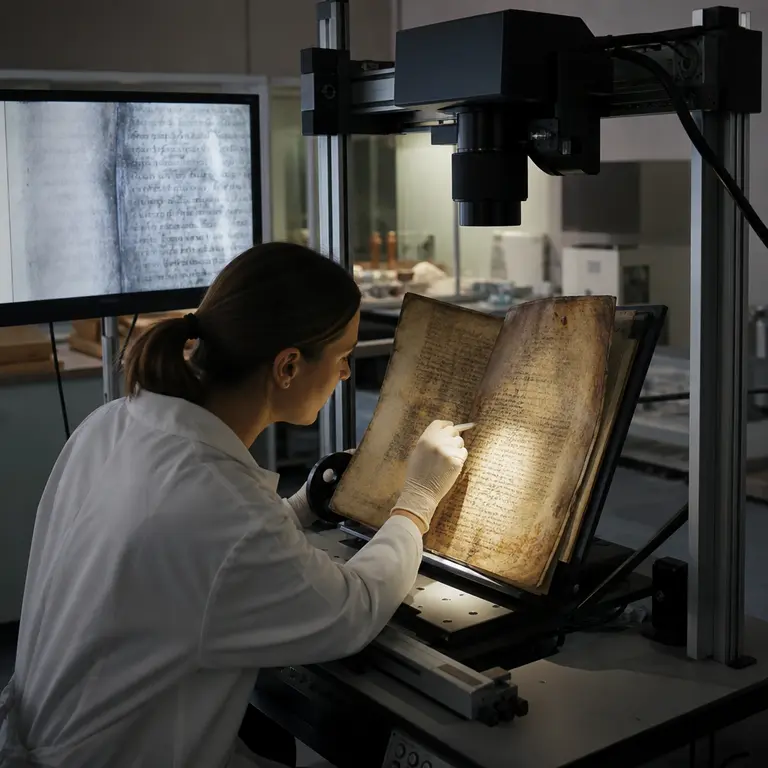
Modern palimpsest research has moved far beyond chemical treatments and UV lamps. Multispectral imaging now captures manuscripts at wavelengths ranging from 365 nanometers in the ultraviolet to 1050 nanometers in the near-infrared, allowing researchers to select the precise wavelength at which erased ink contrasts most sharply with the parchment background. Different inks respond differently across this spectrum, meaning that a wavelength which reveals one layer of text may obscure another, and the selection of imaging parameters requires both technical expertise and knowledge of the manuscript’s history. Reflectance transformation imaging, developed at Hewlett-Packard Laboratories by Tom Malzbender and Dan Gelb in 2001, captures surface texture at multiple lighting angles and reconstructs a virtual object that can be relit digitally, revealing physical traces of letters pressed into vellum even when the ink itself is entirely gone.
The most powerful tool remains X-ray fluorescence mapping, which can detect iron, copper, zinc, and other metallic elements in historical inks at parts-per-million concentrations. At the European Synchrotron Radiation Facility in Grenoble, France, and at Diamond Light Source in Oxfordshire, England, researchers have mapped manuscripts too damaged or too faint for any optical technique. In 2017, a team at University College London used this method to read a 6th-century BCE Greek text from a carbonized Herculaneum scroll, a manuscript that had been physically fused into a solid cylinder by the eruption of Vesuvius in 79 CE and had resisted every previous attempt to read it.
The Vesuvius Challenge, launched in 2023 by entrepreneur Nat Friedman and papyrologist Brent Seales of the University of Kentucky, applied machine learning to this problem at scale. Seales had spent decades developing virtual unwrapping techniques for damaged scrolls, using computed tomography scans to map the three-dimensional structure of carbonized papyrus and computationally flatten it into a readable surface. The challenge offered prize money to teams that could train neural networks to read the Herculaneum scrolls from micro-CT scans alone, without physically unrolling them. By early 2024, winners had successfully decoded substantial passages of previously unread Greek philosophical text, believed to be from the library of the Epicurean philosopher Philodemus. The recovered text discusses the nature of pleasure, a fitting subject for a library buried under volcanic ash for two millennia, and raises the possibility that the Villa of the Papyri at Herculaneum, which has been only partially excavated, contains hundreds more readable scrolls still underground.
What Remains Hidden
Scholars estimate that palimpsests account for a significant but still uncounted fraction of surviving medieval manuscripts. The British Library, the Vatican Apostolic Library, the Bibliothèque nationale de France, and dozens of monastery collections still hold manuscripts that have never been fully imaged, and some that have never been cataloged in a way that would identify them as palimpsests at all. Identifying a palimpsest from its exterior is not always straightforward. Some show visible traces of earlier writing in raking light. Others give no external indication of what lies beneath.
The Sinai Palimpsests Project, a collaboration between UCLA and Saint Catherine’s Monastery in Egypt’s Sinai Peninsula, has since 2011 been imaging that monastery’s collection of roughly 160 palimpsest folios. The project has already recovered texts in Christian Palestinian Aramaic, a liturgical language with very few surviving documents, and has found evidence of a previously unknown early Christian hymn tradition that predates the standardized liturgies of the major Eastern churches. Saint Catherine’s is one of the oldest continuously inhabited Christian monasteries in the world, and its library, which survived intact because the monastery itself was never sacked or dissolved, may contain further recoveries of comparable significance.
The field now sits at an unusual intersection of classical philology, conservation science, particle physics, and computer vision. It is one of the few areas of humanities research where a synchrotron or a machine learning model is as essential as knowledge of ancient Greek or Latin. Scholars who work in this space must be conversant with both the scribal conventions of the 9th century and the physics of X-ray fluorescence, a combination that did not exist as a professional identity a generation ago.
Conclusion
What began as a medieval monk’s practical decision to save money on parchment has become, through the patient application of physics and computation, one of the most productive forms of archaeological recovery of the last thirty years, conducted entirely in libraries, on manuscripts that never left their shelves. The texts that survive in palimpsests are not the texts anyone chose to preserve. They are the texts that someone chose to erase, and that survived anyway, written into the molecular structure of animal skin by the chemistry of ancient ink. Every recovery is a reminder that the archive of the past is larger than the archive we can currently read, and that the boundary between the lost and the recoverable shifts with every advance in the tools we bring to the page.
Sources & Further Reading
- Netz, Reviel, and William Noel. The Archimedes Codex. Da Capo Press, 2007.
- Seales, W. Brent, et al. "From Damage to Discovery via Virtual Unwrapping." Science Advances, Vol. 2, No. 2, 2016. https://doi.org/10.1126/sciadv.1600250
- Sinai Palimpsests Project. UCLA Digital Library. https://sinai.library.ucla.edu
- Vesuvius Challenge. "2023 Grand Prize Awarded." https://scrollprize.org, 2024.