
Unexpected Radiation Metabolism: Fungi Thriving at Chernobyl
Radiotrophic fungi discovered thriving inside Chernobyl's ruins use melanin to harvest ionizing radiation as an energy source, challenging fundamental assumptions about life's limits and inspiring new research in radiation shielding, astrobiology, and cancer medicine.
 Watch on YouTube
 Watch on Rumble
Introduction
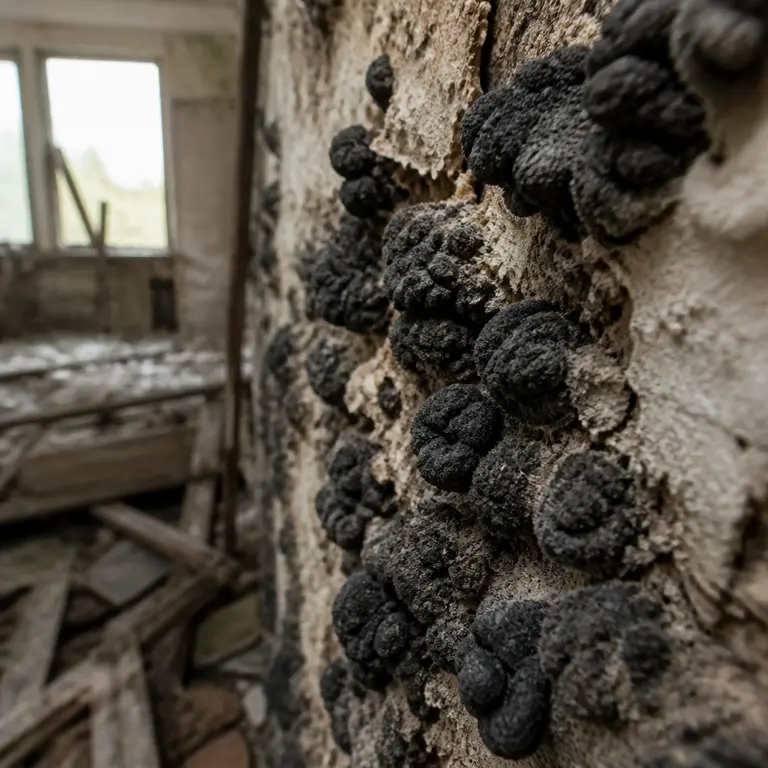
In 1991, five years after the explosion that rendered Reactor No. 4 at Chernobyl uninhabitable for human beings, robotic cameras sent into the ruins returned footage of something unexpected: thick black growths colonizing the walls. The substance was not soot or chemical residue. It was alive. Researchers eventually identified several species of melanin-rich fungi thriving in radiation levels thousands of times higher than those lethal to most organisms. Among them were Cladosporium sphaerospermum, Cryptococcus neoformans, and Wangiella dermatitidis — species already known to science, but never suspected of possessing this particular ability.
What made the Chernobyl fungi scientifically extraordinary was not merely their survival. Survival in hostile environments, while rare, is documented across biology. Tardigrades can withstand the vacuum of space, certain bacteria thrive in boiling hydrothermal vents, and some archaea metabolize sulfur in conditions that would dissolve most cellular machinery. What startled researchers about the Chernobyl fungi was the evidence that these organisms were not simply tolerating radiation — they appeared to be using it. This distinction, between endurance and exploitation, would eventually reframe how scientists think about the boundary between chemistry and life, and raise uncomfortable questions about how many metabolic strategies biology has quietly developed without our knowledge.
The discovery did not arrive with fanfare. It emerged gradually, through a series of careful experiments conducted over more than a decade following the initial identification of the organisms. The story of radiotrophic fungi is, in many ways, a story about the limits of scientific assumptions and what happens when an organism refuses to behave as theory predicts.
Melanin as a Radiation Harvesting Pigment
The mechanism at the center of this phenomenon is melanin, the same pigment responsible for skin darkening in humans and coloration in countless animals. In most organisms, melanin functions primarily as a shield, absorbing ultraviolet radiation and dissipating it as heat, thereby protecting underlying tissues from DNA damage. Sunscreen formulations often attempt to replicate this property chemically. In radiotrophic fungi, however, the pigment appears to perform a more sophisticated and entirely different function.
In 2007, a team led by Ekaterina Dadachova at the Albert Einstein College of Medicine in New York published findings in the journal PLOS ONE demonstrating that melanized fungi exposed to ionizing radiation grew significantly faster than those kept in radiation-free environments. The effect was not marginal. The melanized fungi outpaced their non-melanized counterparts in a way that strongly suggested active energetic benefit rather than coincidental resilience. The researchers proposed that melanin undergoes a structural change when struck by ionizing radiation, altering its electrochemical properties in a way that allows the fungus to channel that energy into metabolic processes. The analogy most often drawn is to chlorophyll in plants, which harvests photons from sunlight and converts them into chemical energy through a cascade of electron transfer reactions. In radiotrophic fungi, melanin may instead be harvesting gamma rays and beta particles, performing a conceptually similar transformation in a chemically distinct way.
This process, which researchers began calling radiosynthesis, has not yet been fully characterized at the molecular level. Melanin is itself a structurally complex and poorly understood molecule, existing not as a single compound but as a family of related polymers whose properties vary with their origin and the conditions under which they formed. The exact pathway by which radiation-altered melanin feeds into fungal metabolism, whether through direct coupling to ATP synthesis or through some intermediate electrochemical mechanism, remains under active investigation. But the growth data from Dadachova’s experiments, replicated in subsequent studies, strongly support the conclusion that these organisms derive a genuine energetic benefit from ionizing radiation rather than simply surviving it. The burden of proof for a claim this significant is high, and researchers have been appropriately cautious in their language, but the experimental evidence has continued to accumulate in the same direction.
Deep Roots in an Overlooked Research Area
The story of radiotrophic fungi did not begin at Chernobyl. As early as the 1950s, scientists noticed that certain fungal species appeared in unusually high concentrations around uranium mines and nuclear facilities. Samples collected from the walls of uranium processing plants and from soil adjacent to nuclear test sites showed elevated fungal populations dominated by melanin-rich species. These observations were largely filed away as curiosities, generating little follow-up research. The prevailing assumption in radiation biology was that ionizing radiation damages biological molecules — DNA in particular — and that any organism exposed to significant doses would be harmed, not helped. The idea that a living thing might seek out radiation, as a plant seeks sunlight, was not a hypothesis that fit comfortably within the existing framework.
The bacterium Deinococcus radiodurans, discovered in 1956 inside a can of meat that had been sterilized by gamma radiation yet still contained living organisms, had already complicated this assumption by demonstrating extraordinary resistance to radiation through a mechanism of rapid and highly accurate DNA repair. A single cell of Deinococcus radiodurans can reassemble its shattered genome from hundreds of fragments with remarkable fidelity. But Deinococcus was understood as a survivor, an organism with exceptional damage-control machinery, not a beneficiary of the energy source doing the damage. The Chernobyl fungi pushed the question into genuinely new territory.
Researcher Arturo Casadevall, a microbiologist at Johns Hopkins Bloomberg School of Public Health who has collaborated extensively on radiotrophic fungal research, has argued that radiosynthesis may represent a genuinely ancient metabolic strategy rather than a recent evolutionary novelty. Ionizing radiation from radioactive elements in Earth’s crust, particularly uranium, thorium, and potassium-40, has been present since the planet formed, and was significantly more intense in the early Archean era than it is today. If melanin-based energy harvesting evolved early enough, it may have predated photosynthesis as a biological energy strategy by hundreds of millions of years, potentially representing one of the earliest solutions life found for capturing environmental energy. This hypothesis remains speculative and awaits the kind of molecular phylogenetic evidence that would allow researchers to date the emergence of the relevant biochemical pathways. But it is taken seriously within astrobiology circles precisely because it does not require any exotic chemistry, only a novel application of a pigment that is already widespread across the tree of life.
Applications in Space Medicine and Radiation Shielding
The practical implications of radiotrophic fungi have attracted sustained interest from NASA and the broader space medicine community, and for reasons that go beyond scientific curiosity. Astronauts aboard the International Space Station face chronic exposure to cosmic radiation at levels that accumulate dangerously over the course of long missions. The ISS sits within Earth’s magnetosphere, which provides partial shielding, but even at that relatively protected altitude, radiation exposure is measurably higher than on the surface. On a transit to Mars, which would take approximately six to nine months each way through interplanetary space largely unshielded by any planetary magnetic field, radiation exposure represents one of the most significant health risks facing crew members, potentially increasing lifetime cancer risk by several percentage points depending on the mission profile and solar activity during the transit window.
Conventional radiation shielding relies on dense materials such as lead or thick polyethylene, both of which incur substantial mass penalties that translate directly into launch costs and mission complexity. A biological shielding system that grows, self-repairs, and potentially generates its own energy from the very radiation it is absorbing would represent a conceptually elegant solution to a genuine engineering problem.
In 2018 and 2019, researchers sent samples of Cladosporium sphaerospermum to the ISS to study its behavior in the space radiation environment. The fungus exhibited what appeared to be negative gravitropism in reverse, growing toward radiation sources rather than away from them, a behavior consistent with the radiosynthesis hypothesis. Results published in 2020 in the journal Biofilm indicated that a thin layer of the fungus, roughly 1.7 millimeters thick, reduced radiation levels by approximately 2.17 percent. While that figure sounds modest in isolation, researchers noted that a thicker self-regenerating biological shield, one that grows and repairs itself continuously in space without requiring resupply, could theoretically provide meaningful protection over long voyages. Mathematical modeling in the same paper suggested that a 21-centimeter layer of the fungus could reduce radiation exposure to near-Earth-surface levels during a Mars transit, a finding that has generated significant interest even as researchers acknowledge that engineering such a system presents enormous practical challenges.
Separately, Dadachova’s group has explored whether melanin extracted from radiotrophic fungi could be incorporated into materials for use in radiation therapy or as a protective agent for medical workers and nuclear industry personnel. The idea is not to replicate the fungus's full metabolic trick, but to exploit melanin’s radiation-absorbing and electrochemical properties in engineered composites that could be manufactured into protective garments, coatings, or implantable materials for patients undergoing repeated diagnostic imaging.
What Radiotrophic Fungi Reveal About Life’s Possibilities
Beyond the engineering applications, the existence of radiotrophic fungi has broader implications for the search for life elsewhere in the universe, implications that astrobiologists have been careful not to overstate but equally careful not to dismiss. Mars is bathed in radiation due to its thin atmosphere and lack of a global magnetic field, conditions that most researchers have historically cited as a significant obstacle to surface habitability. Europa and Enceladus, moons of Jupiter and Saturn, respectively, harbor subsurface oceans potentially rich in chemical energy but also exposed to intense radiation from their parent planets’ powerful magnetospheres. If life can not only tolerate but metabolically exploit ionizing radiation, then environments previously dismissed as biologically sterile deserve a more rigorous second look. The question is no longer simply whether radiation kills life, but whether certain forms of life have found ways to make radiation pay.
The fungi also raise unresolved and genuinely foundational questions about what counts as a primary energy source for life. Biology textbooks describe three broad categories of energy acquisition: photosynthesis, which captures light; chemosynthesis, which extracts energy from chemical reactions between inorganic compounds; and heterotrophy, the consumption of organic molecules produced by other organisms. Radiosynthesis, if confirmed as a genuine and distinct metabolic pathway, would represent a fourth category, one that has been operating in Earth’s ecosystems for an unknown period of time without being recognized. Establishing it with the same rigor as the others requires a complete biochemical account of how melanin’s radiation-induced structural changes are coupled to the production of ATP or equivalent energy currency molecules, and that account has not yet been fully written. The work is ongoing, and the researchers involved are aware that they are attempting to characterize something that does not fit neatly into existing biochemical frameworks.
What is already clear is that the black growths on Chernobyl’s reactor walls represent something more than a biological curiosity or a footnote in the history of nuclear disaster. They are a reminder that life’s chemistry continues to surprise researchers who assume they have mapped its outer limits, and that the most hostile environments on Earth, or elsewhere, may harbor organisms that do not merely endure those conditions but depend on them. The history of biology is in many ways a history of assumptions overturned, and the radiotrophic fungi of Chernobyl may yet prove to be one of the more consequential overturnings of the century just begun.
Sources & Further Reading
- Dadachova, E. et al. Ionizing Radiation Changes the Electronic Properties of Melanin and Enhances the Growth of Melanized Fungi. PLOS ONE, 2007. https://doi.org/10.1371/journal.pone.0000457
- Shunk, Graham K. et al. Shielding Astronauts from Cosmic Radiation Using Melanized Fungi: Radiotrophic Fungi on the ISS. Biofilm, 2020. https://www.biorxiv.org/content/10.1101/2020.07.16.205534v1
- Casadevall, Arturo, et al. Melanin and Fungi. Current Opinion in Microbiology, 2012. https://doi.org/10.1016/j.mib.2011.12.007
- NASA Ames Research Center. Fungi as Radiation Shields for Deep Space Travel. NASA Technical Reports, 2019. https://www.nasa.gov/