
Roquefort Caves: Cradle of Cheese and Microbial Evolution
How Penicillium roqueforti, a cave-dwelling mold discovered in southern France, became the biological engine behind blue cheese and a window into industrial fermentation science.
 Watch on YouTube
 Watch on Rumble
The Cave That Flavored a Continent
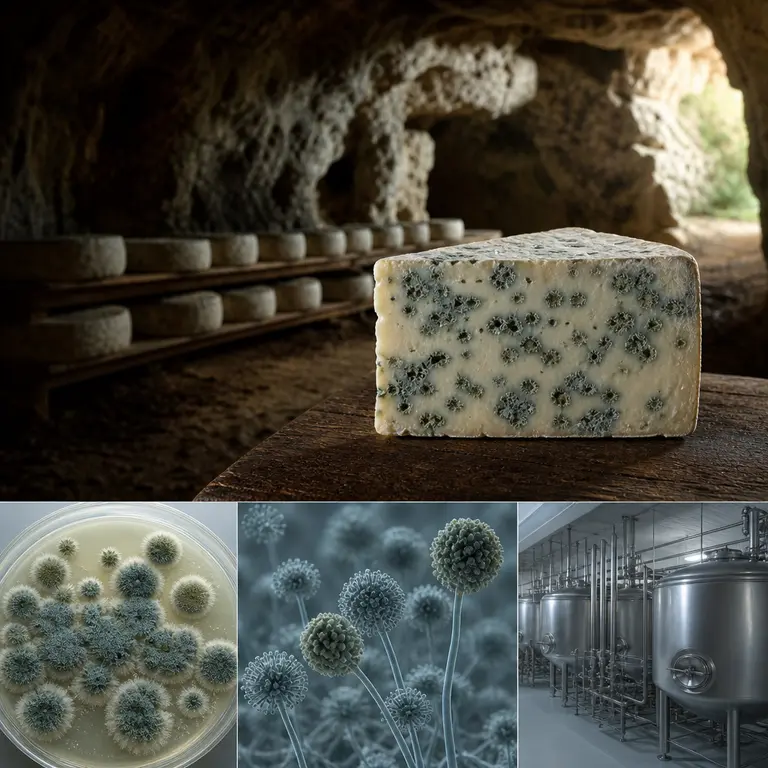
In the limestone plateau of Combalou, near the village of Roquefort-sur-Soulzon in southern France, a specific network of underground fissures called fleurines channels cold, moist air from the surface into natural cellars. For at least a thousand years, wheels of sheep’s milk cheese have been aged in these caves, acquiring their characteristic blue-green veins and sharp, pungent flavor. The organism responsible is Penicillium roqueforti, a filamentous fungus whose biology is far more complex and globally consequential than its culinary reputation suggests.
The earliest documented legal protection of Roquefort cheese dates to a 1411 charter granted by King Charles VI of France, making it one of the oldest protected food designations in European history. But the fungus itself had been doing its work in those caves long before anyone understood what a fungus was. Medieval shepherds and cheesemakers in the region almost certainly noticed that wheels left to age in the caves developed a distinctive appearance and flavor unlike anything produced elsewhere, and they passed down the practice of cave aging as tradition without the faintest understanding of the microbial machinery driving it. It was not until the late nineteenth century, when Louis Pasteur and his contemporaries established germ theory, that scientists began to appreciate that the blue veins threading through aged cheese were the mycelium of a living microorganism actively transforming the cheese’s chemistry. What had been attributed to the mystical properties of a particular landscape was, in fact, the metabolic output of a single fungal species doing what it had evolved to do in cool, humid, oxygen-limited environments.
What Penicillium Roqueforti Actually Does
P. roqueforti belongs to the same genus as P. chrysogenum, the mold from which Alexander Fleming’s penicillin was eventually mass-produced. But where P. chrysogenum became famous for killing bacteria, P. roqueforti became indispensable for creating flavor. Its enzymatic toolkit is extraordinary, and understanding it helps explain why blue cheese tastes the way it does at a chemical level that goes far beyond simple description.
The fungus secretes lipases that break down milk fats into free fatty acids, particularly shorter-chain acids like butyric and capric acid, which produce the sharp, slightly rancid notes characteristic of blue cheese. It also produces proteases that degrade casein proteins into peptides and amino acids, contributing to the creamy, crumbling texture and savory depth that distinguishes a well-aged Roquefort from a younger, milder cheese. These two processes, lipolysis and proteolysis, proceed simultaneously over weeks and months of aging, and their balance determines the final character of the cheese. Too much lipolytic activity and the product becomes overwhelmingly pungent. Too little and the flavor never fully develops. The cave environment, with its stable temperature and humidity, naturally regulates the pace of these reactions in ways that industrial cheesemakers have spent decades trying to replicate artificially.
Critically, P. roqueforti is one of the few food-grade fungi capable of growing at very low oxygen concentrations. Traditional cheesemakers skewer wheels of maturing cheese with thick needles to create air channels, allowing just enough oxygen to penetrate without drying the interior. The fungus grows along these channels, producing the branching blue-green streaks that define Roquefort, Gorgonzola, Stilton, and dozens of regional variants worldwide. Without this precise oxygen management, the mold would either fail to grow or overgrow, ruining the cheese entirely. The needling process, which looks almost surgical when performed by experienced cheesemakers, is in effect a form of microbial habitat engineering, creating the exact conditions the fungus needs to express its enzymatic potential in a controlled and aesthetically pleasing pattern.
The fungus also synthesizes secondary metabolites, including roquefortine C, a mycotoxin that is mildly toxic to mammals at high doses but present at such low concentrations in finished cheese that regulatory agencies in the European Union, the United States, and elsewhere have consistently found it poses no meaningful health risk at normal consumption levels. This distinction between a toxin-producing organism and a safe food product is itself a lesson in dose-dependent toxicology that researchers continue to study. The presence of roquefortine C also raises an interesting evolutionary question: why does a fungus living in a food environment continue to produce a compound that serves no obvious purpose in cheese aging? The most likely answer is that the gene clusters responsible for mycotoxin synthesis are ancient and deeply embedded in the organism’s genome, maintained because they confer advantages in other ecological contexts, even if those advantages are irrelevant inside a wheel of cheese.
Industrial Divergence and Genetic Secrets
For most of the twentieth century, P. roqueforti spores used in commercial cheesemaking were sourced directly from the Combalou caves, propagated on rye bread left to mold in the traditional manner, then dried and added to milk during cheese production. The rye bread method, which sounds almost alchemical by modern standards, was a practical solution to the problem of maintaining a viable fungal culture before refrigeration and laboratory fermentation were available. Cheesemakers would leave loaves in the caves, allow them to become thoroughly colonized by the resident mold, then dry and grind the bread into a powder that could be stored and used as an inoculant. By the 1970s and 1980s, industrial dairies began maintaining proprietary laboratory strains, selecting for consistent flavor profiles, predictable growth rates, and reduced mycotoxin output.
A landmark genomic study published in Current Biology in 2015 by researchers at INRAE, the French National Research Institute for Agriculture, Food and Environment, revealed something unexpected: the global population of P. roqueforti used in cheesemaking had undergone significant genetic domestication. Unlike wild strains collected from soil and decomposing plant matter, cheese-associated strains showed evidence of horizontal gene transfer, meaning they had acquired entire gene clusters from other fungal species. Two such clusters, named Wallaby and CheesyTer, appear to have been transferred wholesale from distantly related fungi and confer advantages in the cheese environment, including an enhanced ability to metabolize lipids and to tolerate the salt and acid conditions of aging cheese.
This was among the first demonstrations that domestication-level genetic change, long studied in plants and animals, had also occurred in an industrial fungus. The implication was significant: humans had, through centuries of selective cheese aging, inadvertently driven the evolution of a microorganism in ways that parallel the selective breeding of crops. Farmers who domesticated wheat or cattle understood, at least intuitively, that they were shaping future generations through selective pressure. The cheesemakers of Roquefort-sur-Soulzon had no such awareness, yet the outcome was genetically comparable. By consistently returning to the same caves, using the same aging techniques, and selecting wheels that tasted best, they created an environment that rewarded particular fungal traits and punished others over centuries.
Beyond Cheese: Biotechnology and the Roqueforti Genome
The biotechnological relevance of P. roqueforti extends well beyond food science. Its robust lipase enzymes have attracted interest from detergent manufacturers and biodiesel researchers, because lipases capable of functioning in cold, acidic, or low-water environments are valuable industrial catalysts. Most enzymatic reactions used in industrial chemistry require carefully controlled temperatures and pH ranges, and enzymes that tolerate extreme conditions can dramatically reduce the cost and complexity of large-scale chemical processes. Several research groups have cloned P. roqueforti lipase genes and expressed them in bacterial hosts for large-scale enzyme production, effectively borrowing the fungus’s molecular tools without culturing the fungus itself.
The fungus’s tolerance for low oxygen also makes it a subject of interest in fermentation engineering. Most industrially useful fungi require well-oxygenated conditions, which demands expensive aeration equipment in bioreactors. A fungus that thrives in near-anaerobic environments could reduce production costs for fermented products ranging from organic acids to pharmaceutical precursors. Researchers have also noted that P. roqueforti’s ability to compete successfully against bacteria and other molds in the cheese environment suggests it produces antimicrobial compounds beyond roquefortine C, some of which have not yet been fully characterized. The search for novel antifungal and antibacterial compounds from food-associated molds is an active area of research, motivated partly by the growing problem of antibiotic resistance and the need for new classes of antimicrobial agents.
Furthermore, the discovery of horizontal gene transfer in P. roqueforti has opened new questions about how common this mechanism is in food-associated microbes. Horizontal gene transfer, the movement of genetic material between organisms that are not in a parent-offspring relationship, was once thought to be largely confined to bacteria. Finding it in eukaryotic fungi was surprising, and finding it in fungi that humans had been cultivating for centuries raised the possibility that the food environment itself had created conditions favorable for such transfers. Subsequent research has found similar transferred gene clusters in Penicillium camemberti, the white mold responsible for the rind of Camembert and Brie, and in some strains of Aspergillus used in soy sauce and sake production. The cave at Roquefort-sur-Soulzon, it turns out, was not just preserving cheese. It was, over centuries, hosting a slow-motion experiment in fungal evolution.
A Protected Organism in a Protected Place
Roquefort cheese received Appellation d’Origine Contrôlée status in France in 1925, and Protected Designation of Origin status under European Union law in 1996. By law, genuine Roquefort must be made from the raw milk of Lacaune sheep, aged exclusively in the Combalou caves, and inoculated with P. roqueforti originating from that region. Approximately 19,000 tonnes of Roquefort are produced annually, making it France’s second best-selling cheese after Comté. The legal framework protecting Roquefort is not merely a trade regulation. It is, in effect, also a conservation measure for a specific microbial ecosystem, ensuring that the particular community of organisms inhabiting the Combalou caves continues to define the character of the cheese rather than being displaced by cheaper, more standardized industrial alternatives.
The caves themselves are a geological oddity that deserves more attention than it typically receives outside of specialist literature. The Combalou plateau collapsed in a massive landslide approximately two million years ago, leaving a jumbled mass of limestone blocks through which air circulates freely. The resulting microclimate maintains a temperature of around 8 to 10 degrees Celsius and a humidity of nearly 95 percent year-round, conditions that are nearly ideal for P. roqueforti. The fleurines, or fissures, act as natural air conditioning, and their precise airflow patterns have been mapped by modern researchers using tracer gases to understand how the cave environment can be partially replicated in industrial ripening rooms. What those researchers have generally found is that full replication is not possible. The specific combination of geology, airflow, microbial community, and local humidity creates conditions that industrial ripening facilities can approximate but not duplicate, which is part of why the legal protections around Roquefort have survived repeated challenges in international trade negotiations.
What began as a geological accident became a culinary institution and, eventually, a scientific case study in microbial evolution, industrial enzymology, and the unexpected depth of the relationship between fungi and human civilization. The fleurines of Combalou were not designed to age cheese. They were not designed for anything. But over a thousand years of human ingenuity and accumulated tradition, a collapsed limestone plateau became one of the most consequential microbial habitats on earth, producing a fungus that has shaped not only the flavor of a continent’s cuisine but the direction of modern biotechnology research. The lesson, if there is one, is that some of the most significant scientific subjects are hiding in the most familiar places, and that a wheel of cheese, examined carefully enough, contains more history and more biology than most people ever think to look for.
Sources & Further Reading
- Cheeseman, K. et al. Multiple Recent Horizontal Transfers of a Large Genomic Region in Cheese Making Fungi. Current Biology, 2014. https://doi.org/10.1016/j.cub.2014.09.051
- Flament, I. Coffee, Cocoa and Tea. Royal Society of Chemistry, 2002. [For secondary metabolite context in food fungi]
- INRAE. Penicillium roqueforti: Genomics and Cheese Science. Institut National de Recherche pour l'Agriculture, l'Alimentation et l'Environnement, 2015. https://www.inrae.fr
- European Commission. Protected Designation of Origin: Roquefort. EU Agricultural Product Quality Policy, 1996. https://ec.europa.eu/agriculture/quality/door