
Unlocking Whale Earwax: a Chronicle of Life and Pollution
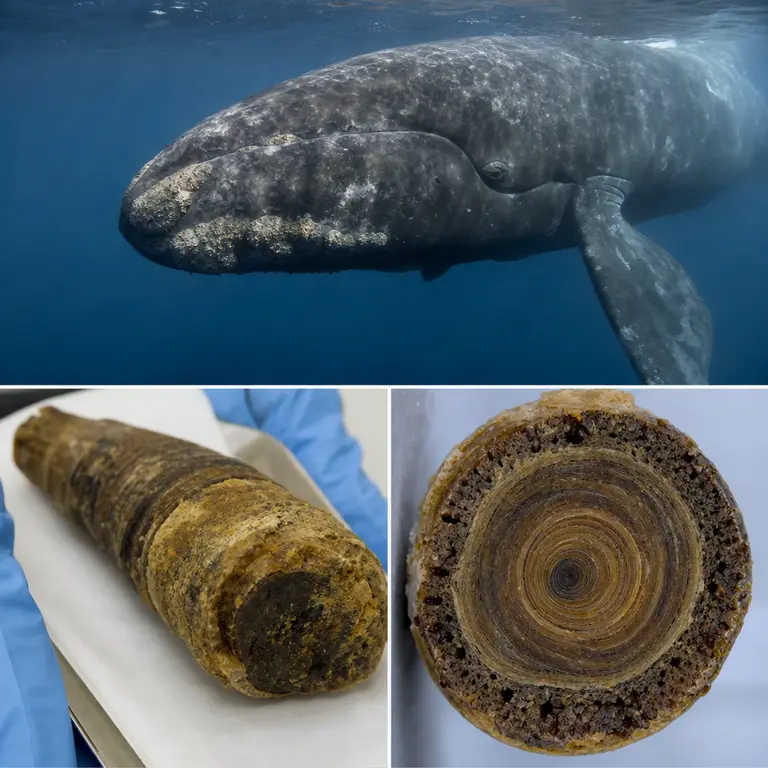
Whale earplugs — layered columns of earwax that accumulate over a lifetime — contain a chronological chemical archive of hormones, pollutants, and ocean history that scientists are only now learning to read.
 Watch on YouTube
 Watch on Rumble
Introduction: An Overlooked Archive
For most of the twentieth century, the earwax plugs of baleen whales were discarded along with the rest of the carcass during commercial whaling operations. Occasionally, a biologist would note their presence, record their length, and move on. The plugs were treated as anatomical curiosities at best — a peculiarity of whale biology with no obvious scientific utility. This dismissal was understandable given the tools and frameworks available at the time, but it meant that generations of researchers walked past one of the most detailed biological archives ever produced by any animal on Earth without recognizing what they were leaving behind.
It was not until 2013 that a team led by Sascha Usenko at Baylor University published a landmark paper in the Proceedings of the National Academy of Sciences demonstrating that these overlooked cylinders were, in fact, extraordinary records of individual animal life. A single plug from a blue whale, roughly 25 centimeters long, contained a layered chemical record spanning the animal’s entire existence — from its first months in the womb to the day it died. The publication prompted a quiet but significant reassessment across marine biology, conservation science, and environmental toxicology. Researchers began returning to museum storage rooms and specimen drawers with new urgency, wondering what had been sitting undisturbed on the shelves for a century.
The plugs form through a process analogous to tree ring deposition. Whales, like all mammals, continuously produce cerumen — the technical name for earwax — but unlike humans, they cannot clear it. The external auditory meatus, the canal leading to the whale’s inner ear, is sealed from the ocean environment, and the wax simply accumulates across the animal’s entire life. It does so in alternating light and dark laminae, each pair of layers representing approximately six months of growth. This means a researcher can count the bands, like rings in a cross-sectioned trunk, to determine the whale’s age with reasonable accuracy. But age estimation turned out to be the least remarkable thing these plugs could do. The chemistry preserved within each thin layer proved to be something far more valuable: a continuous, high-resolution record of what the animal experienced, absorbed, and survived across every season of its life.
A Lifetime of Hormones, Layer by Layer
Usenko’s team analyzed a 24-centimeter earwax plug recovered from a male blue whale that had died after a ship strike off the coast of California. By extracting and quantifying hormones from each successive lamina, they reconstructed the animal’s endocrine biography across its estimated 12-year lifespan. Testosterone levels were essentially undetectable in early layers corresponding to juvenile life, then surged dramatically around the layers associated with sexual maturity at roughly 10 years of age. Cortisol — the primary stress hormone in mammals — fluctuated throughout the record in patterns consistent with seasonal migration cycles and periods of nutritional stress. For the first time, researchers were not inferring a whale’s physiological history from population-level data or indirect behavioral observations. They were reading it directly from the animal itself.
What made the finding especially striking was the resolution. Because each lamina represents only six months of deposition, the team could detect hormonal spikes and valleys with a temporal precision that no other long-term wildlife monitoring method could match. Blood samples, blubber biopsies, and fecal analysis all provide snapshots of a single moment in an animal’s life. Hormone concentrations in a blood draw tell you something about the animal’s state on the day it was sampled, but nothing about what it experienced the previous spring or the winter before that. The earwax plug provides something fundamentally different: not a snapshot, but a continuous film running across the entire duration of an individual's life.
Subsequent studies expanded the hormonal panel to include progesterone, which allowed researchers to identify probable pregnancy events in female whales. A 2021 analysis published in Current Biology examined plugs from museum collections spanning decades and found that female right whales showed measurable progesterone elevations in laminae corresponding to years when calf sightings had been historically recorded in field surveys. This was a remarkable cross-validation between two entirely independent data sources separated by generations of scientists. The field observers who recorded calf sightings in the North Atlantic decades ago had no idea that the same reproductive events were being simultaneously inscribed in wax within the animals' skulls. The convergence of those two records, one behavioral and one biochemical, produced a level of confidence that neither dataset could have achieved alone.
The hormonal record also opens questions that have never previously been answerable in long-lived marine mammals. Researchers can now ask whether individual whales that experienced early-life cortisol elevations showed altered reproductive timing later in life, or whether testosterone surges at maturity varied between populations exposed to different levels of acoustic or chemical disturbance. These are the kinds of longitudinal questions that wildlife science has historically been unable to address in animals that live for decades and range across entire ocean basins. The earwax plug makes them tractable.
The Pollution Timeline Frozen in Fat
Because earwax is lipid-rich, it efficiently absorbs and retains fat-soluble compounds. This property, which makes wax useful biologically as a protective barrier, also makes it an unintentional accumulator of persistent organic pollutants. Organochlorine pesticides, including DDT and its metabolites, polychlorinated biphenyls, flame retardants, and various industrial byproducts, have all been detected in whale earwax plugs at concentrations that track historical patterns of industrial production and environmental regulation with striking fidelity.
In the original 2013 blue whale study, DDT contamination peaked in the laminae corresponding to the early years of the whale’s life — the 2000s — and then declined slightly in later layers, consistent with the gradual environmental dilution of DDT following its 1972 ban in the United States. Mercury, which is not fat-soluble but binds to proteins also present in earwax, showed a different pattern: a steady baseline with a sharp elevation in layers corresponding to the whale’s time spent feeding in certain Pacific regions known for elevated methylmercury concentrations in prey fish. The plug was not simply recording the whale’s chemical environment in aggregate. It was recording where the animal had been, season by season, and what it had eaten there.
This means that a single earwax plug does not merely record what a whale encountered during its lifetime. It records the geography of that lifetime, the timing of industrial contamination across different ocean basins, and the degree to which regulatory interventions translated into measurable biological outcomes in apex marine consumers. When DDT was banned, the policy decision was made in Washington. The biological consequence of that decision was written in the fat of a blue whale swimming in the Pacific, and it remained legible in that wax for decades after the animal died.
Researchers have proposed that museum collections of whaling-era earwax plugs — some dating to specimens collected in the early twentieth century — could provide a continuous environmental record of ocean pollution spanning more than a hundred years. This would predate satellite monitoring, systematic water sampling programs, and modern environmental toxicology by several decades. The prospect is significant because understanding the baseline state of ocean chemistry before industrialization accelerated is one of the central challenges in environmental science. Sediment cores and ice cores provide some of this information, but a biological record embedded in an apex predator offers a different kind of evidence — one that reflects not just what was present in the environment, but what was being absorbed by living organisms at the top of the food web.
Reading the Archive of a Changing Ocean
The implications for conservation biology and climate science extend well beyond any single study. Whale populations were dramatically reduced during the industrial whaling era, with some species losing more than 90 percent of their numbers between 1900 and 1970. Understanding how individual animals experienced stress during that period — whether through nutritional deprivation as prey populations collapsed, through elevated cortisol associated with acoustic disturbance from the rapid expansion of diesel-powered shipping traffic, or through toxic loading from industrial runoff entering coastal feeding grounds — has been nearly impossible because no direct physiological data exists from living whales of that era.
Museum earwax plugs change that calculation entirely. The Natural History Museum in London, the Smithsonian Institution, and several Scandinavian natural history collections hold hundreds of baleen whale specimens from the whaling era, many of which have intact earwax plugs that have never been chemically analyzed. A 2022 study in Science of the Total Environment examined plugs from fin whales collected between 1910 and 1969 and found a pattern of cortisol elevation in mid-century specimens, which the authors interpreted as consistent with chronic stress during the peak years of industrial whaling. This was a period when whale densities were collapsing across multiple ocean basins, and the acoustic environment of the deep ocean was being fundamentally transformed by the proliferation of large vessels. The cortisol record in those waxy laminae suggests that individual animals were registering this transformation physiologically, not merely demographically.
The technique is also being applied prospectively. Researchers working with stranded animals on both Atlantic and Pacific coasts now routinely collect earwax plugs as part of standard necropsy protocols. These samples are being archived with the explicit intention of creating a forward-looking biological record that future scientists can analyze against datasets that do not yet exist. Over time, these collections will allow researchers to correlate chemical signatures in the wax with ocean temperature anomalies, shifts in prey availability driven by changing current patterns, and specific anthropogenic disturbance events such as naval sonar exercises, seismic surveys, and major pollution incidents. The longitudinal depth this will eventually provide is something no other biological monitoring program in marine science can currently approach.
There is something quietly remarkable about the situation. In a field where individual animals are rarely observed for more than a few seasons, and where the interior lives of large, wide-ranging creatures remain almost entirely opaque, a plug of wax that records twelve unbroken years of physiology is an extraordinary gift. The whale that carried it was unaware of what it was preserving. It was simply living — migrating, feeding, maturing, responding to a changing world — and the chemistry of those experiences was being written, layer by layer, in a column of fat tucked inside its skull. That column is now one of the most powerful tools available for understanding what it means to be a large mammal navigating an ocean shaped by human activity, and scientists are only beginning to read it.
Conclusion: Rethinking What We Discard
The story of whale earwax is, among other things, a story about the costs of assumption. For decades, researchers assumed that a plug of biological wax had nothing meaningful to say. The assumption was reasonable given the analytical techniques of the time, but it meant that thousands of specimens passed through scientific hands without yielding the information they contained. The lesson is not simply that whale earwax is more interesting than it looks, though it certainly is. The lesson is that biological archives exist in unexpected forms, and that the decision about what to preserve and what to discard is always made against a background of incomplete knowledge.
The earwax plug joins a growing list of unconventional biological records — otoliths in fish, growth plates in teeth, annular rings in coral skeletons — that have revealed histories invisible to direct observation. What distinguishes the whale plug is the breadth of what it captures: hormonal biography, reproductive history, toxic exposure, geographic movement, and physiological stress, all encoded in a single object that fits in the palm of a hand. As analytical chemistry continues to advance and museum collections are systematically revisited, the record these plugs contain will only become richer and more detailed. The whales that died in the early twentieth century, their bodies processed and their carcasses rendered for oil, may yet contribute something lasting to the science of a living ocean.
Sources & Further Reading
- Usenko, S., et al. Blue whale earplug reveals lifetime contaminant exposure and hormone profiles. Proceedings of the National Academy of Sciences, 2013. https://doi.org/10.1073/pnas.1311418110
- Russo, M., et al. Lifetime hormonal and reproductive records of a North Atlantic right whale from earwax. Current Biology, 2021. https://doi.org/10.1016/j.cub.2021.04.067
- Travis, J. Reading a whale's life story in its earwax. Science News, 2013. https://www.sciencenews.org/article/reading-whales-life-story-its-earwax
- Aguilar, A., et al. Stress hormones in museum fin whale earwax plugs reflect industrial whaling pressure. Science of the Total Environment, 2022.