
Tektites: Earth's Violent Past Encoded in Cosmic Glass
Tektites — glassy minerals formed when meteorites vaporize terrestrial rock — carry an extraordinary internal clock that records not just ancient impacts, but the precise orientation of Earth's magnetic field at the moment of their birth, offering a window into planetary history no other material can provide.
 Watch on YouTube
 Watch on Rumble
Introduction
There is a category of objects sitting in museum drawers and private collections around the world that, at first glance, look like an unremarkable piece of dark or greenish glass. It might be thumb-sized, smoothly curved, and slightly translucent. To the untrained eye, it resembles nothing more than a decorative stone or a piece of old bottle glass worn smooth by time. But each of these objects is a frozen record of one of the most violent events the Earth can experience — a hypervelocity meteorite impact capable of vaporizing rock, reshaping landscapes, and leaving behind a chemical signature that persists for tens of millions of years. These objects are tektites, and the science embedded within them is far stranger and more consequential than their modest appearance suggests.
Glass Born from Catastrophe
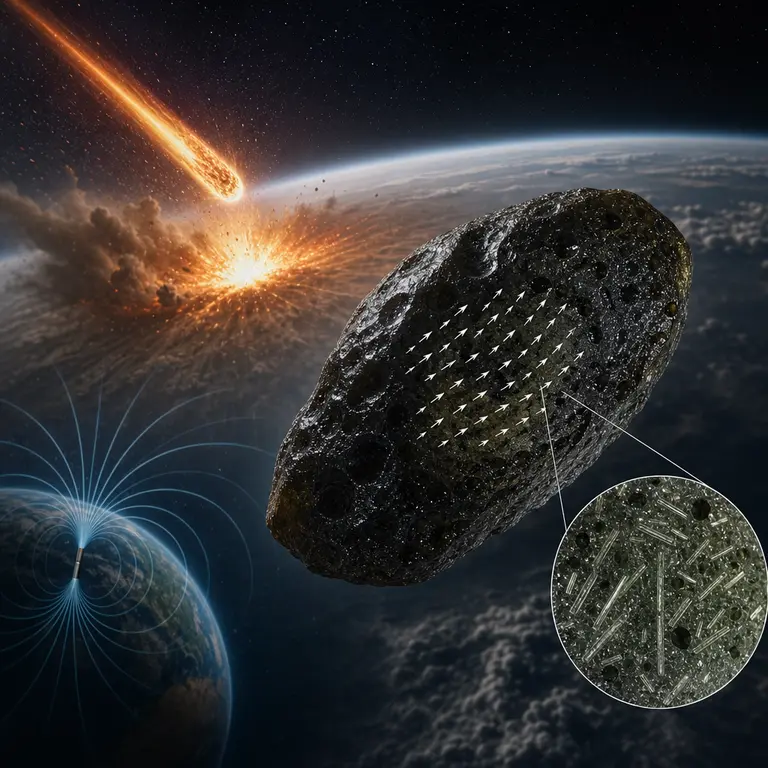
When a large meteorite strikes Earth with sufficient velocity, the energy released is so extreme that both the impactor and the uppermost layers of target rock are instantly vaporized and hurled into the atmosphere as superheated droplets of molten silica. These droplets cool rapidly as they arc through the air, solidifying into aerodynamically shaped glassy objects. Unlike volcanic glass such as obsidian, tektites form entirely outside any volcanic system. They are the product of hypervelocity impact events that generate temperatures exceeding 2,000 degrees Celsius in fractions of a second, and the aerodynamic shapes they acquire — teardrops, dumbbells, buttons, and discs — reflect the physics of their flight through the upper atmosphere rather than any geological process operating at the surface.
Tektites have been found on every continent except Antarctica in concentrated geographic zones called strewn fields. The four major strewn fields — the North American, Central European, Ivory Coast, and Australasian — each correspond to a specific ancient impact event. The Australasian strewn field, the youngest and largest, covers roughly ten percent of Earth’s surface and contains tektites dated to approximately 788,000 years ago. Curiously, despite decades of searching, the source crater for this event has never been definitively identified, making it one of geology’s most tantalizing open mysteries. The sheer geographic extent of the strewn field implies an impactor of considerable size, yet the landscape has so far refused to yield the scar that should, by all logic, still be visible somewhere on the planet’s surface.
What makes this mystery particularly compelling is that tektites from the Australasian field have been recovered from locations as far apart as southern Australia, Southeast Asia, and the Indian Ocean floor. The distribution pattern encodes information about the angle and direction of the original impact, and researchers have used these patterns to triangulate probable source regions in Southeast Asia or the South China Sea. The possibility that the crater lies beneath ocean sediment, or has been obscured by the dense vegetation and thick soils of tropical regions, remains the most widely accepted explanation for its absence, but no candidate site has achieved consensus.
The Paleomagnetic Signature Locked in Glass
What elevates tektites from geological curiosities to scientific instruments is their capacity to preserve a record of Earth’s magnetic field at the precise moment they solidified. As each molten droplet cooled below the Curie temperature — the threshold at which magnetic minerals lock into alignment with the ambient magnetic field — the tiny iron-bearing particles within the glass froze in place, recording the direction and intensity of Earth’s geomagnetic field at that instant. This is not a gradual process subject to the averaging effects that complicate other paleomagnetic archives. It happened in seconds, producing a snapshot of extraordinary fidelity.
This phenomenon, known as thermoremanent magnetization, is the same principle used to decode the history of seafloor spreading and continental drift. In those applications, the record is preserved in basaltic rock that cooled over years or centuries, and the signal represents an average of the field over that extended period. In tektites, cooling occurred in seconds rather than over geological timescales, preserving a record of the field as it existed at a single moment. Researchers analyzing Australasian tektites have used this frozen magnetic signature to confirm that the impact occurred during the Brunhes-Matuyama geomagnetic reversal boundary — a period when Earth’s magnetic poles were flipping. Some specimens even appear to record intermediate field orientations, suggesting they cooled at different moments during the reversal’s transitional phase, providing a resolution no sediment core could match.
The implications of this extend beyond the tektites themselves. Geomagnetic reversals are poorly understood in terms of their duration and the behavior of the field during the transition. Sediment cores and lava flows can bracket these events but cannot resolve them on timescales of individual years or decades. A collection of tektites from a single strewn field, each preserving its own instantaneous magnetic record, offers the theoretical possibility of sampling the reversal at multiple discrete moments, building a composite picture of how the field evolved during one of the most disorienting episodes in Earth’s magnetic history.
Fission Tracks and the Art of Counting Damage
Beyond paleomagnetism, tektites carry a second internal clock based on nuclear physics. Uranium atoms naturally present within the glass undergo spontaneous fission at a known, constant rate. Each fission event sends two nuclear fragments tearing through the surrounding crystal lattice, leaving a linear trail of atomic damage called a fission track. By etching a polished tektite surface with hydrofluoric acid — which preferentially attacks damaged zones, rendering the tracks visible under a microscope — researchers can count the accumulated damage and calculate how long ago the glass formed.
Fission track dating of tektites has confirmed ages consistent with radiometric methods using argon isotopes, but the technique offers something additional: spatial resolution. Because individual tracks are only a few microns long and can be counted across different zones of a single specimen, researchers can detect whether a tektite underwent any post-formation reheating. A tektite that was briefly reheated — perhaps by a secondary impact or atmospheric reentry — will show a zone of annealed, erased tracks surrounded by intact ones, revealing a two-stage thermal history invisible to bulk chemical analysis. This capacity to read thermal events written into the microstructure of a single specimen means that tektites can serve as detailed records not only of their formation but of everything that happened to them afterward.
The combination of fission track analysis with other dating methods has also helped resolve disagreements about the ages of certain strewn fields. When different techniques yield slightly different ages for the same material, the discrepancy often points to a real physical event rather than analytical error, and the spatial precision of fission track mapping has helped distinguish primary formation ages from secondary thermal overprints that had previously introduced noise into the chronological record.
Moldavites, Libyan Desert Glass, and the Rarest Specimens
Not all tektites are created equal. Moldavites, formed approximately 14.8 million years ago during the Nördlingen Ries impact in what is now southern Germany, are prized for their distinctive bottle-green color and deeply sculpted surfaces. The green coloration arises from the specific geochemical composition of the Bohemian sedimentary rocks that were vaporized and are rich in iron and magnesium silicates. They are found almost exclusively in a narrow corridor across the Czech Republic, Austria, and Germany, and the total estimated mass of all moldavites ever found is less than 275 metric tons — a vanishingly small quantity relative to the scale of the impact that created them. The Nördlingen Ries crater itself is 24 kilometers in diameter, and the medieval town of Nördlingen was built within it, its citizens unknowingly living inside one of the best-preserved impact structures on Earth.
Libyan Desert Glass occupies an even stranger niche. Found scattered across a roughly 6,500-square-kilometer area of the Sahara near the Libyan-Egyptian border, this pale yellow silica glass was formed approximately 29 million years ago. Unlike conventional tektites, it contains no meteoritic material and shows no clear impact crater association, leading some researchers to propose it was formed by a low-altitude airburst — an explosion of a large bolide in the atmosphere rather than a ground impact — that generated sufficient heat to melt the desert sand below without leaving a conventional crater. The glass contains tiny gas bubbles and inclusions of high-pressure mineral phases consistent with extreme transient heating, but the absence of a crater continues to spark debate among impact specialists.
A carved scarab made from Libyan Desert Glass was found in the tomb of Tutankhamun, suggesting ancient Egyptians collected and valued the material long before its cosmic origin was understood. The fact that craftspeople working more than three thousand years ago recognized this glass as something worth carving and placing among royal grave goods adds a peculiar human dimension to a story that is otherwise written entirely in the language of physics and geochemistry.
Implications for Planetary Science and Impact Hazard
The study of tektites has taken on renewed urgency as planetary scientists model the frequency and consequences of large impact events. Current estimates suggest that impactors capable of producing major tektite strewn fields — roughly one kilometer in diameter — strike Earth approximately once every million years. The four known major strewn fields span the last 35 million years, a frequency broadly consistent with this estimate, though the absence of the Australasian source crater has prompted debate about whether some impacts occurred in ocean basins where evidence would be rapidly obliterated by seafloor spreading.
Advances in isotope geochemistry are now allowing researchers to fingerprint the composition of the original impactors by analyzing trace-element ratios in tektites. Osmium and iridium isotopic signatures, enriched in meteoritic material relative to crustal rock, can distinguish between different classes of stony and metallic impactors, providing indirect information about the projectile even when no physical remnant of the meteorite survives. This approach, combined with the paleomagnetic and fission track records locked inside tektite glass, means that a single centimeter-sized specimen can simultaneously reveal the age of an impact, the state of Earth’s magnetic field at that moment, the thermal history of the ejecta, and the chemical identity of the object that triggered the entire event.
This density of information has broader implications for how planetary scientists think about impact hazard assessment. Historical frequency estimates have traditionally relied on crater counts, but craters are subject to erasure by erosion, volcanism, and tectonics. Tektites, being small and chemically stable, survive in environments where craters do not, and strewn fields preserved in deep-sea sediments may eventually reveal impact events for which no surface record remains. As ocean drilling programs recover more sediment cores from regions corresponding to known and suspected strewn fields, the tektite record may yet expand in ways that revise current estimates of how often the Earth has been struck by objects large enough to leave a global signature.
Conclusion
There is something philosophically striking about the fact that the most violent events in Earth’s surface history leave behind objects small enough to hold in one hand. A tektite is, in a sense, the distilled essence of a catastrophe — rock that was briefly converted into gas, then into liquid, then into glass, all within the span of a few minutes, and which has since preserved within its structure a precise record of the moment it froze. The science of reading that record draws on nuclear physics, geochemistry, paleomagnetism, and planetary science simultaneously, and it continues to yield surprises. From the unresolved mystery of the Australasian crater to the ancient Egyptian craftsman who shaped a piece of cosmic glass into a scarab, tektites connect the deepest processes of the solar system to the surface of human history in ways that few other objects can match.
Sources & Further Reading
- Koeberl, Christian. Tektite Research: A Review. Meteoritics and Planetary Science, 1994.
- Glass, Billy P. and Simonson, Bruce M. Distal Impact Ejecta Layers: A Record of Large Impacts in Sedimentary Deposits. Springer, 2012.
- Schmieder, Martin and Kring, David A. Earth's Impact Events Through Geologic Time: A List of Recommended Ages for Terrestrial Impact Structures and Deposits. Astrobiology, 2020. https://doi.org/10.1089/ast.2019.2085
- Haines, P.W. et al. Australasian Tektites: Outstanding Questions. Australian Journal of Earth Sciences, 2001.