
Ball's Pyramid: The Island That Hid a Living Ghost
How the world's tallest sea stack harbored a species of giant stick insect believed extinct for 80 years, and what its rediscovery reveals about island biogeography and conservation genetics.
 Watch on YouTube
 Watch on Rumble
The Needle in the Tasman Sea
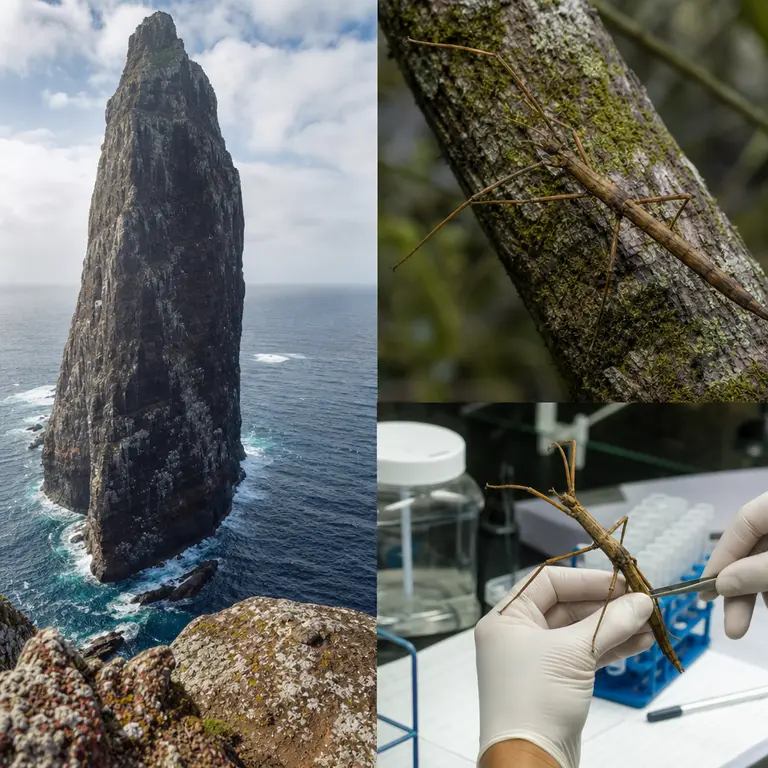
Rising 562 meters from the Tasman Sea roughly 23 kilometers southeast of Lord Howe Island, Ball’s Pyramid is the world’s tallest volcanic sea stack. It is a remnant of a shield volcano that collapsed into the ocean roughly 7 million years ago, leaving behind a near-vertical basaltic blade barely 300 meters wide at its base. No permanent human has ever lived there. Climbing it requires technical rope work, and Australian authorities severely restrict access. For most of recorded history, the pyramid was considered little more than a geological curiosity — an extreme landmark for sailors and a nesting site for seabirds.
What nobody suspected until 2001 was that this inhospitable pillar of rock was harboring one of the most dramatic zoological secrets of the twentieth century. The discovery that followed did not come from a targeted search or a sophisticated monitoring program. It came from rangers on an unrelated survey who noticed something small and biological that should not have been there. That accident of observation would eventually redirect millions of dollars in conservation funding, trigger one of the most complex reintroduction debates in modern ecology, and force scientists to reconsider what extinction actually means.
The Lord Howe Island Stick Insect and Its Presumed Death
The Lord Howe Island stick insect, Dryococelus australis, was once abundant on Lord Howe Island itself, a small crescent of land about 11 kilometers long lying in the Tasman Sea between Australia and New Zealand. Sailors and fishermen called it the land lobster, a nickname that captures its extraordinary size: females can reach 15 centimeters in length, making it one of the heaviest stick insects on Earth. Adults weigh up to 25 grams and possess thick, heavily armored bodies quite unlike the twig-like forms most people associate with the order Phasmatodea. The species is also notable for its behavior. Pairs form long-term bonds, unusual among insects, with males and females spending nights huddled together and males appearing to guard their partners. Whether this constitutes something resembling social attachment in any meaningful sense remains a subject of cautious scientific discussion, but the behavior is documented and consistent.
In 1918, the British supply ship SS Makambo ran aground near Lord Howe Island. Black rats escaped onto the island during the wreck. Within two years, the land lobster had vanished from Lord Howe Island entirely. By 1920, entomologists considered it functionally extinct. The speed of the collapse was typical of island extinctions driven by introduced rodents, which are among the most destructive invasive species ever to spread across oceanic ecosystems. Rats are generalist predators capable of consuming eggs, juveniles, and, in some cases, adults of large invertebrates. For a species like Dryococelus australis, which is slow-moving, flightless, and lays relatively few eggs by insect standards, there was no behavioral or reproductive mechanism available to outpace the predation pressure of that intensity.
For eight decades, the species existed only in museum drawers, preserved as pinned specimens collected before the rats arrived. It was listed as extinct in most authoritative catalogs of lost species, and few researchers had reason to question that designation. Then, in 2001, rangers investigating Ball’s Pyramid on an unrelated survey noticed fresh droppings and shed exoskeletons beneath a single Melaleuca shrub clinging to a narrow ledge approximately 100 meters above the waterline. The bush, barely two meters tall, was the only substantial vegetation on the entire pyramid. A follow-up night expedition confirmed what the physical evidence had suggested: a living population of Dryococelus australis, numbering somewhere between 20 and 30 individuals, was moving through the darkness on the face of a sea stack that most people assumed to be biologically inert.
Why Ball’s Pyramid and What It Reveals
The survival of the colony raises immediate questions about how the insects reached the pyramid in the first place, and how they managed to persist for so long without detection. One hypothesis holds that the insects were already present on Ball’s Pyramid before the rat catastrophe on Lord Howe Island, perhaps transported by seabirds carrying egg-laden plant material, or by floating debris during storms. Another possibility is that a small founding population survived the initial rat invasion on Lord Howe Island long enough to reach the pyramid on driftwood. The crossing distance of roughly 23 kilometers is not trivial for a flightless insect, but ocean currents in that region are capable of moving surface debris with some consistency, and stick insect eggs are notably resistant to desiccation and saltwater exposure compared to those of many other invertebrates. Either scenario speaks to the extraordinary resilience and capacity for accidental dispersal of insects, even large, flightless ones.
The colony’s confinement to a single Melaleuca bush also illustrates a principle ecologists call the Allee effect, the phenomenon in which very small populations become vulnerable to extinction not only from environmental pressures but also from reduced genetic diversity, failed mate-finding, and demographic stochasticity. That 20 to 30 insects sustained a viable breeding population for perhaps 80 years on a single bush on a vertical rock face is, by any measure, a statistical near-miracle. The Melaleuca itself was growing in a location that received minimal direct sunlight and was exposed to salt spray and oceanic winds. That it survived at all, and that the insects were able to exploit it as their sole resource base across multiple generations, suggests a degree of ecological flexibility that the species’ apparent specialization had not previously implied.
Genetic analysis subsequently confirmed that the Ball’s Pyramid population was genetically distinct from museum specimens collected on Lord Howe Island in the early twentieth century, suggesting that the island and pyramid populations had already been diverging for some time before the rats arrived. This finding significantly complicated the conservation picture. The animals being bred in captivity were not simply a backup copy of the original Lord Howe Island population but a subtly different lineage, one shaped by decades of isolation on a dramatically different substrate with different food plants, temperature profiles, and humidity levels. What that divergence means for the species’ fitness if reintroduced to Lord Howe Island is a question that conservation geneticists have not yet fully resolved.
The Captive Breeding Program and Its Complications
In 2003, two pairs of insects were carefully collected from Ball’s Pyramid and transported to Melbourne Zoo. The operation required extraordinary care: the animals are nocturnal, slow-moving, and sensitive to temperature fluctuations. Transporting living specimens of a newly rediscovered species across open water and into a controlled facility without losing them required protocols developed largely on the fly, as no established captive-husbandry literature existed for this species. One female, later named Renata by zookeepers, was found clinging to life when collected and required weeks of intensive hand-feeding before she stabilized. She went on to reproduce successfully, and her descendants form a significant portion of the current captive population. The detail is worth pausing on: a species that had been considered extinct for 80 years was brought back from the edge of a second extinction in part because a zookeeper spent weeks feeding a single sick insect by hand.
Melbourne Zoo’s program expanded over the following years, eventually producing hundreds of individuals. The San Diego Zoo joined the effort, establishing a parallel breeding colony on the other side of the Pacific. By 2012, the combined captive population exceeded 9,000 individuals, a number that sounds impressive but masks the narrow genetic bottleneck through which the entire effort passed. Every living land lobster in captivity descends from those original two pairs. The genetic consequences of that founding event will persist in the population for many generations, regardless of how many individuals are eventually produced, because the variation available to natural selection is fixed at the moment of the bottleneck. Captive breeding programs can expand population size, but they cannot manufacture genetic diversity that was not present in the founders.
The plan to reintroduce the species to Lord Howe Island has been repeatedly delayed by a separate, politically contentious project: the eradication of rats from the Island itself. A rodent eradication campaign using brodifacoum bait was finally executed in 2019 and declared successful in 2021, with no rat detections recorded since. The campaign was not without controversy. Brodifacoum is a second-generation anticoagulant rodenticide that can move through food chains, and some residents and environmental advocates raised concerns about its effects on native bird populations and other non-target species. The conservation community largely concluded that the risk of inaction outweighed the risks of the treatment, but the episode illustrated how complex even apparently straightforward interventions in island ecology can become. As of the mid-2020s, detailed ecological surveys are underway to determine whether the island’s vegetation and invertebrate community have recovered sufficiently to support a reintroduction of the land lobster. The genetic divergence between the Ball’s Pyramid lineage and the original Lord Howe Island population remains an active subject of debate among conservation geneticists, with some arguing that reintroducing a genetically altered lineage constitutes a form of ecological substitution rather than true restoration.
A Living Argument for the Unexpected
The story of Dryococelus australis carries implications far beyond those of a single unusual insect. It has reinvigorated scientific interest in what conservation biologists call Lazarus species, organisms declared extinct that are subsequently rediscovered alive in locations where nobody thought to look. The term is borrowed from theology, but the phenomenon is documented across taxonomic groups, from the coelacanth, a fish thought extinct for 65 million years before its rediscovery in 1938, to the black-footed ferret, declared extinct in 1979 and rediscovered in Wyoming in 1981. The Global Wildlife Conservation organization maintains a list of the 25 most wanted lost species, and the land lobster’s rediscovery has prompted researchers to take seriously the possibility that other presumed extinctions may be premature, particularly for invertebrates, which are monitored far less systematically than vertebrates and which can persist in small numbers in microhabitats that receive little scientific attention.
Ball’s Pyramid itself, precisely because of its inaccessibility and hostility to human habitation, functioned as an accidental nature reserve of the most extreme kind. The lesson is uncomfortable for conservation policy, which tends to focus resources on large, accessible, and politically visible landscapes. Sometimes the best protection a species can receive is to live somewhere humans cannot easily go. As climate change, invasive species, and habitat loss continue to accelerate extinctions globally, the pyramid’s accidental role as a refuge suggests that identifying and protecting similarly inaccessible microhabitats, sea stacks, cave systems, high-altitude cliff faces, and isolated offshore islets, may be an underutilized conservation strategy. These locations are difficult to survey, difficult to manage, and difficult to defend in budget discussions, but the land lobster’s survival suggests they deserve a more systematic place in extinction risk assessments.
The land lobster also challenges popular assumptions about what a fragile species looks like. It is large, slow, flightless, and dependent on a single plant species for food and shelter. By conventional metrics, it should have been among the first casualties of ecological disruption, and on Lord Howe Island, it was. That it survived at all, on a vertical rock in the open ocean, maintained by a population small enough to fit in a bathtub, across eight decades of complete scientific ignorance, is a reminder that biological resilience operates according to rules that human intuition consistently underestimates. The species did not survive because it was well-adapted to adversity in any obvious sense. It survived because chance placed a small number of individuals in a location that was simply too inconvenient for rats to reach. Survival, in ecology as in history, is often less a matter of fitness than of geography.
What Ball’s Pyramid ultimately offers is not comfort but recalibration. The natural world contains more persistence than our extinction lists acknowledge, and more fragility than our confidence in that persistence should allow. The land lobster survived on a needle of rock in the Tasman Sea for reasons that had nothing to do with human intention and everything to do with accident. The task now is to be less accidental about what we choose to protect and more honest about how little we know about what we have already lost.
Sources & Further Reading
- Priddel, D., Carlile, N., Humphrey, M., Fellenberg, S., and Hiscox, D. Rediscovery of the 'extinct' Lord Howe Island stick-insect (Dryococelus australis) and recommendations for its conservation. Biodiversity and Conservation, 2003. https://doi.org/10.1023/A:1021171singularity
- Zoo Victoria. Lord Howe Island Stick Insect Recovery Program. Melbourne Zoo, 2022. https://www.zoo.org.au/melbourne/whats-here/animals/lord-howe-island-stick-insect/
- Hassall, C. and Sherratt, T.N. Statistical analysis of skewed data in ecological studies. Oikos, 2011.
- Lord Howe Island Board. Rodent Eradication Project Final Report. New South Wales Government, 2021. https://www.lhib.nsw.gov.au