
The Hidden Radioactive Secret of Europe's Iconic Healing Spa
For centuries, Europeans drank from a spring in Belgium believed to have miraculous healing powers. Modern analysis reveals the water was genuinely therapeutic — and mildly radioactive — due to dissolved radon gas, making it one of history's most accidentally correct medical traditions.
The Spring That Worked for All the Wrong Reasons
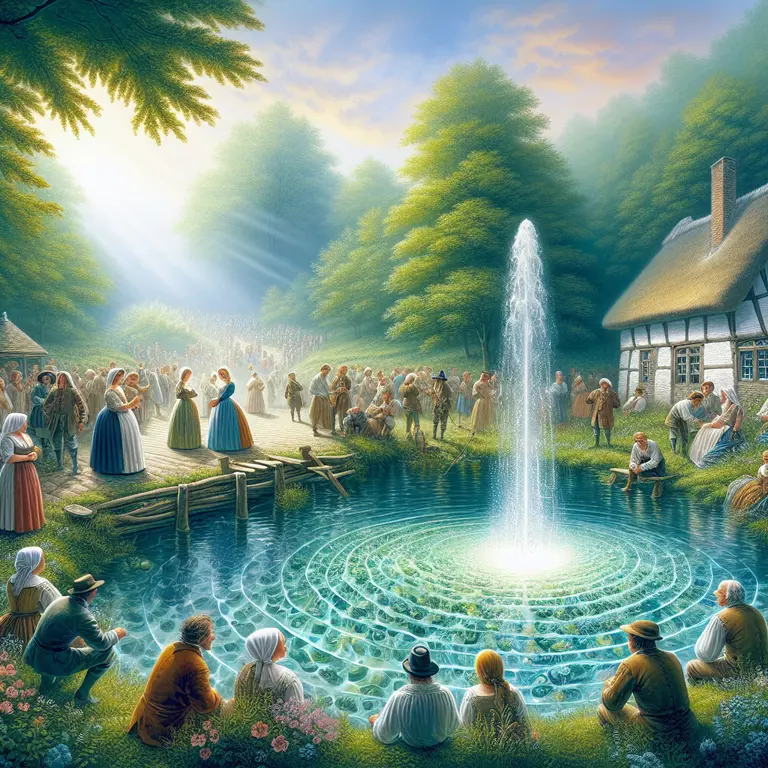
In 1326, a Belgian ironmaster named Collin le Loup discovered a cold spring bubbling up near the village of Spa, in the forested Ardennes hills. He drank from it, felt invigorated, and — as one does in the 14th century — declared it miraculous. Within two centuries, European royalty, including Holy Roman Emperor Charles V and England’s Henry VIII, were making pilgrimages to drink the waters. The town of Spa became so famous that its name entered virtually every modern European language as a common noun. We still use it today, casually and without a second thought, every time we book a weekend retreat or describe a hotel amenity.
The medical establishment of the time attributed the spring’s effects to chalybeate properties — iron-rich minerals — and wrote elaborate humoral explanations for why the waters balanced the body’s four essential fluids. Physicians produced learned treatises. Apothecaries bottled and sold the water across the continent. An entire theoretical architecture grew up around the phenomenon, none of which was correct. But here is the genuinely strange part: the water worked anyway. People returned from these springs feeling better, and not simply because they had rested in pleasant countryside surroundings. Something in the water was affecting their bodies. It just wasn’t what anyone thought.
What Was Actually in the Water
Modern geochemical analysis of the Spa springs and dozens of similar healing springs across Europe — including the famous waters of Bath in England and Bad Gastein in Austria — reveals something that would have horrified medieval physicians had they understood it. The water contains dissolved radon-222, a naturally occurring radioactive gas produced by the decay of uranium in surrounding granite and limestone rock formations.
Radon seeps into groundwater as it percolates slowly through these geological formations over decades or centuries. Cold, pressurized springs carry it to the surface before it can fully off-gas into the atmosphere, meaning that the water arriving at the surface retains measurable concentrations of radioactivity. Visitors who drank the water or simply bathed in the enclosed stone bathhouses that became fashionable across Europe from the 16th century onward received low-dose radiation exposure with every visit. They had no framework whatsoever for understanding this. The word radioactivity would not exist for another five centuries. Marie Curie would not isolate radium until 1898. And yet, generation after generation of European nobility and common people alike returned to these springs convinced that the waters had restored their vitality.
The geological conditions that produce radon-rich springs are not rare. They occur wherever surface water or groundwater interacts with uranium-bearing rock, which is common in granite-heavy regions across Europe, North America, and parts of Asia. Many of the world’s most historically celebrated healing springs share this geochemical profile, which raises an obvious and uncomfortable question: how much of the history of spa medicine, pilgrimage healing, and sacred water traditions worldwide was quietly mediated by low-level radioactive exposure?
The Hormesis Hypothesis
This is where the story crosses into genuinely contested scientific territory. A concept called radiation hormesis — the idea that very low doses of ionizing radiation can have stimulating or beneficial biological effects — has been debated in radiobiology since at least the 1980s, though its intellectual roots go back further. It remains controversial, and the scientific community is far from consensus. But a non-trivial body of research, including a widely cited 2009 review published in the journal Dose-Response, suggests that radon-rich thermal baths may reduce inflammatory markers and temporarily stimulate immune response in ways that are measurable and reproducible under controlled conditions.
The proposed mechanisms are several. At very low doses, ionizing radiation may trigger adaptive cellular responses, prompting cells to activate repair pathways, produce antioxidant enzymes, and modulate inflammatory signaling. This is distinct from the well-documented harm caused by high-dose radiation exposure, which overwhelms these same systems and causes the cellular damage associated with radiation sickness and cancer. The hormesis argument is essentially a dose-response argument: the same agent that kills at high concentrations may stimulate at low ones, a principle that applies to many substances in pharmacology and toxicology. Whether radiation genuinely follows this curve, or whether the apparent benefits at low doses are statistical artifacts or confounded by other variables, remains an active and unresolved debate.
What is not in dispute is that radon therapy is currently practiced as legitimate, licensed medicine in several European countries. Bad Gastein in Austria operates radon therapy tunnels today — medical facilities where patients with ankylosing spondylitis, rheumatoid arthritis, and related inflammatory conditions sit in warm, radon-saturated galleries carved into the mountain for therapeutic sessions lasting between one and two hours. Austrian national health insurance partially covers the treatment. Similar facilities operate in Germany, Poland, and the Czech Republic. These are not fringe institutions. They are staffed by physicians, regulated by health authorities, and used by patients who have often exhausted other options for managing chronic inflammatory conditions. Whether the underlying science fully supports them is a different question, but their existence is a fact.
The Accidental Precision of Pre-Scientific Medicine
What makes this story remarkable is not simply the radioactivity. It is the epistemological irony embedded in the whole sequence of events. Medieval physicians were right that the springs healed. They were wrong about every single mechanism they proposed to explain why. They invoked humoral balance, divine favor, mineral virtue, and astrological alignment, and none of it was the actual cause. Yet their empirical observation — that people who visited these springs tended to feel better — was accurate enough to sustain a medical tradition across five centuries and attract the patronage of emperors and kings. The observation outran the theory by an enormous margin, and the theory, despite being entirely wrong, did not prevent the observation from being useful.
This pattern recurs throughout the history of medicine and deserves more serious attention than it typically receives. Willow bark was used to treat fever and pain for thousands of years before anyone understood that it contained salicin, the compound that would eventually be synthesized as aspirin. Mold contamination was observed to inhibit bacterial growth in folk contexts long before Alexander Fleming formalized the observation into the discovery of penicillin. Foxglove was used by Welsh herbalists for heart conditions centuries before William Withering extracted digitalis and described its mechanism of action. In each of these cases, the empirical tradition was right, the theoretical explanation was wrong, and the gap between the two was eventually closed by scientific investigation rather than by discarding the original observation.
The spa tradition fits this pattern almost perfectly, with the additional twist that the closing of the gap has not yet fully occurred. We know the radon is there. We have plausible cellular mechanisms for why low-dose radiation might produce the observed effects. We have clinical facilities that operate on this basis. But we do not yet have the kind of large-scale, rigorously controlled evidence that would settle the question definitively. The medieval pilgrims were, in a sense, running an uncontrolled clinical trial for five hundred years, and the results were suggestive enough to keep the trial going.
A Wider Implication
Radiation hormesis sits at the intersection of radiobiology, toxicology, and evolutionary biology, and it is in the last field that some of the most speculative yet genuinely interesting ideas emerge. Several researchers have proposed that life on Earth evolved in a significantly more radioactive environment than exists today. The early Earth had higher concentrations of short-lived radioactive isotopes, and background radiation levels were meaningfully higher than at present. If cellular life spent billions of years in that environment, it is at least plausible that some cellular repair and stress-response mechanisms evolved in the presence of low-level radiation as a routine feature of the environment, rather than as a response to an exceptional hazard.
If that is true, it would suggest that the apparent stimulating effects of low-dose radiation are not paradoxical at all. They would be the normal operation of systems that evolved to expect a certain baseline of radiation stress and may function suboptimally in its complete absence. This is speculative and not the mainstream view in radiobiology. But it is a coherent hypothesis grounded in evolutionary reasoning, and it reframes the entire spa story in an unexpected light.
Collin le Loup drank from his spring in 1326 and felt invigorated. He had no way of knowing that the granite beneath the Ardennes hills was slowly releasing uranium decay products into the groundwater, or that those decay products might be interacting with his immune system in ways that modern science still cannot fully characterize. He called it miraculous, which was the only vocabulary available to him. He was wrong about the mechanism and right about the effect. That combination — correct observation, incorrect explanation, genuine phenomenon — is one of the most underappreciated patterns in the history of human knowledge, and the spring at Spa is one of its most quietly extraordinary examples.