
The Bioplastic Secret: Milk Protein Casein's Revival
Discover how an age-old method of making bioplastic from milk protein casein is seeing a modern revival.
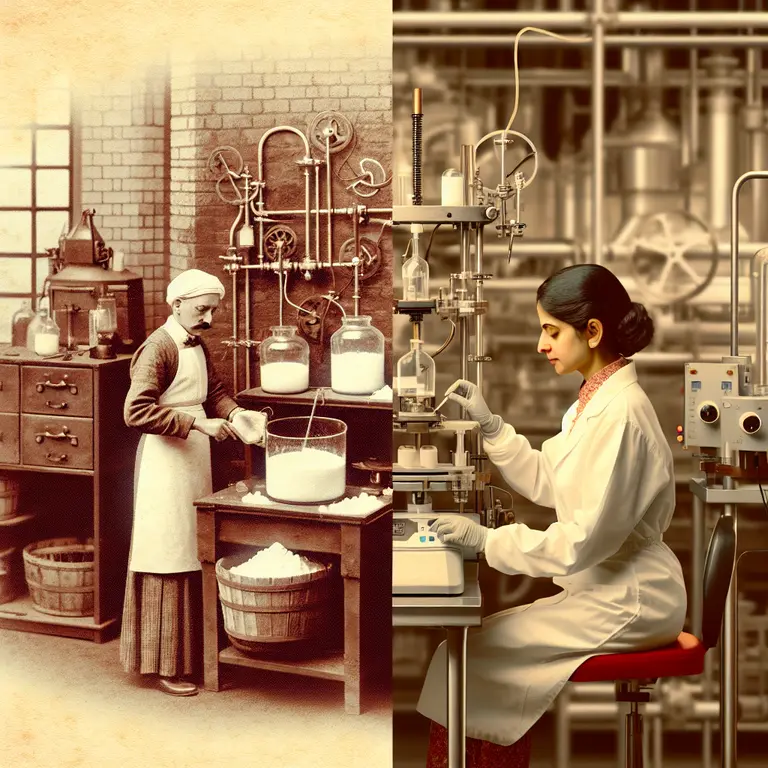
Introduction
In the quest for sustainable materials, researchers and innovators are turning back to old practices that predate the age of synthetic plastics. One remarkable example is the use of milk protein casein to create bioplastics — a method first popularized in the early 20th century but then largely forgotten as petroleum-based plastics took over. What makes this story particularly compelling is not just the ingenuity of its origins, but the way it illustrates a recurring pattern in the history of technology: promising innovations are often abandoned not because they fail, but because cheaper alternatives temporarily outcompete them. Today, as the environmental costs of those alternatives become impossible to ignore, the world is rediscovering what early chemists already knew — that one of the most versatile materials in history was hiding in an ordinary glass of milk.
Historical Background
The process of making plastic from milk can be traced back to ancient times, when people discovered that heated sour milk would coagulate into a hard, workable substance. Craftspeople in various cultures noticed that dried curds could be shaped and hardened, though the underlying chemistry remained entirely mysterious to them. This rudimentary plastic was not fully understood or systematically exploited until the late 1800s, when chemists began isolating casein, a protein that makes up roughly 80 percent of the protein content in cow’s milk. Once isolated, casein proved to be a remarkably effective precursor for making durable and moldable material.
The decisive breakthrough came in 1897, when German chemist Adolf Spitteler and Austrian chemist W. Krische patented the first industrial process for creating what they called “milk stone” — a plastic derived from casein that could be hardened through chemical treatment. Their discovery emerged almost by accident, reportedly when Spitteler noticed that a cat had knocked a bottle of formaldehyde onto a casein-coated surface, producing an unexpectedly hard and stable material. Whether or not this particular origin story is entirely accurate, the underlying chemistry it describes is real: casein proteins, when treated with formaldehyde under heat and pressure, undergo a cross-linking reaction that transforms a soft, crumbly material into something far more robust.
This early bioplastic was commercialized under the trade name Galalith, derived from the Greek words for milk and stone. It was widely used in manufacturing buttons, beads, knife handles, fountain pen reservoirs, and even elaborate jewelry pieces. The material could be dyed in vivid colors and polished to a high sheen, making it a popular substitute for ivory, tortoiseshell, and horn — materials that were increasingly difficult to source ethically or affordably. By the 1920s and 1930s, millions of items made from this milk plastic were flooding markets across Europe, and the fashion industry in particular embraced Galalith as a material that combined aesthetic appeal with relative affordability. France became one of the leading producers, and Galalith buttons remain collector’s items to this day, prized for their lustrous, semi-translucent appearance that synthetic plastics have never quite replicated.
The Rise and Fall of Galalith
Galalith’s popularity began to wane during World War II, when widespread disruptions to production and supply chains made consistent manufacturing difficult. The war redirected industrial resources and chemical supplies, and the fragile infrastructure that had grown around casein-based manufacturing could not easily survive those pressures. When peace returned, the industrial landscape had changed dramatically.
In the post-war decades, cheaper and more versatile petroleum-based plastics like polyethylene and polyvinyl chloride rapidly came to dominate commercial applications. These new materials offered advantages that Galalith could not match under the economic conditions of the time. They were faster to produce, easier to mold into complex shapes, more resistant to moisture — a significant weakness of casein-based materials — and considerably less expensive at scale. As fossil fuels remained cheap and their long-term environmental costs were not yet part of mainstream industrial calculations, synthetic plastics became the default choice across virtually every manufacturing sector. Galalith fell out of favor almost entirely, surviving only in niche applications and the memories of craftspeople old enough to have worked with it.
What is striking in retrospect is how thoroughly the transition happened. Within roughly two decades, an entire category of biodegradable, protein-based materials was effectively erased from industrial practice. The knowledge did not disappear entirely — it persisted in academic literature and among a small number of specialists — but it ceased to be economically relevant. This rapid displacement illustrates how powerfully economic incentives can shape material culture, sometimes in ways that take generations to reconsider.
The Modern Revival
The growing global concerns about environmental degradation driven by the excessive use of non-biodegradable plastics have rekindled serious interest in biodegradable alternatives, and casein-based bioplastics are once again attracting significant research attention. Every year, hundreds of millions of tons of synthetic plastic are produced worldwide, and a substantial fraction of that material ends up in landfills, waterways, and ocean ecosystems where it persists for centuries. Against this backdrop, materials that can degrade naturally without releasing toxic byproducts represent not just an ecological preference but an urgent practical necessity.
Researchers are now exploring improved methods for producing high-quality bioplastics from casein without relying on toxic chemicals such as formaldehyde, which was central to the original Galalith process but poses significant health and environmental risks. One of the most promising avenues involves the use of natural cross-linking agents — compounds that can bind casein proteins together in ways that enhance durability while remaining safe and environmentally benign. Tannins, which are naturally occurring polyphenolic compounds found in plant matter such as bark and fruit skins, have shown considerable promise in this role. Citric acid, derived from citrus fruits, is another candidate that researchers are investigating as a non-toxic alternative cross-linker.
Beyond chemistry, modern processing techniques are also opening new possibilities. Advances in nanotechnology have enabled researchers to incorporate nanoparticles into casein matrices, thereby improving mechanical properties such as tensile strength and flexibility. Some research groups are investigating hybrid materials that combine casein with other biopolymers such as starch or chitosan, creating composite materials with tailored properties suited to specific applications. There is even exploratory work underway on the use of casein-based films for biodegradable food packaging, a domain where the material’s natural origin and ability to form thin, transparent films make it particularly appealing.
It is worth noting that the casein used in these applications need not come exclusively from dairy farming. Researchers are investigating plant-based protein sources and even microbially produced casein analogs as the field of synthetic biology matures. This opens the possibility of producing casein-like proteins with reduced agricultural land use and lower carbon footprints, addressing one of the legitimate criticisms of dairy-derived materials at an industrial scale.
Conclusion
The story of casein bioplastics is ultimately a story about how human ingenuity, economic pressure, and environmental consequence interact across time. A material that was once innovative enough to transform entire industries was displaced not by a better solution in any ecological sense, but simply by a cheaper one. Now, as the true costs of that cheaper solution become apparent in the form of plastic pollution, climate change, and resource depletion, the older approach is returning — not as nostalgia, but as a genuinely competitive alternative backed by modern science.
What casein-based bioplastics represent is something broader than a single material innovation. They represent a model for how sustainable design can work: by drawing on biological systems, using renewable inputs, and producing outputs that the natural world already knows how to process. The challenge ahead lies in scaling these materials to meet modern demands without introducing new problems. But the foundation is solid, and it has been there, quietly waiting in every dairy farm and every glass of milk, for well over a century.
Sources & Further Reading
- Gupta A.P., Singh B., Biodegradable Polymers for Industrial Applications, Elsevier Science, February 2005.
- Klein M., Lavagnino N.J., “Casein-Based Materials Architectures Studied via Raman Spectroscopy,” Journal of Applied Polymer Science, Vol. 139, Issue 27, 2022.