
Antarctica’s Blood Falls: a Salty, Rust-Colored Phenomenon
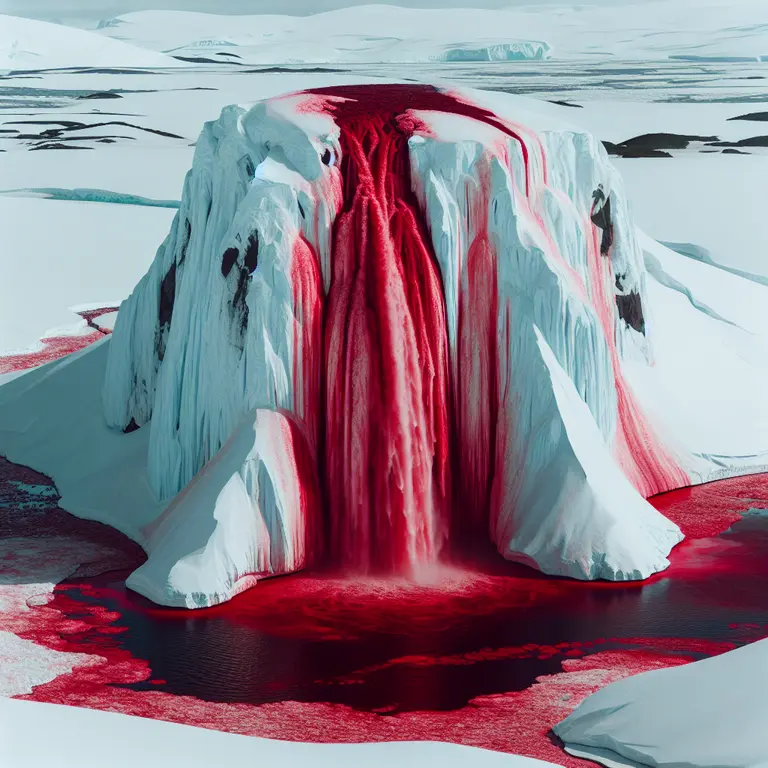
Blood Falls in Antarctica is a crimson-colored waterfall that attracts intrigue worldwide for its eerie appearance and unusual origin.
Introduction
Among the most visually arresting and scientifically significant natural phenomena on Earth, Blood Falls stands as a monument to the planet’s capacity for geological surprise. Located in the McMurdo Dry Valleys of Antarctica, one of the most inhospitable landscapes on the planet, this outflow from the Taylor Glacier pours a vivid, rust-red liquid into the frozen expanse of Lake Bonney. Against the blinding white of the surrounding ice and snow, the effect is deeply unsettling, as though the glacier itself has been wounded. Yet what appears to be a wound is, in fact, a window into a hidden world that has remained sealed for millions of years, and whose secrets are reshaping how scientists think about life, chemistry, and the possibility of biology beyond Earth.
The falls were first documented by Australian geologist Griffith Taylor during the 1911 British Antarctic Expedition, and for decades the red coloration was attributed to red algae, a reasonable first guess given the pigmentation. It was only through later geochemical investigation that the true explanation emerged, one far more extraordinary than algae. Beneath the Taylor Glacier lies an ancient, iron-rich saltwater reservoir, isolated from the surface world for an estimated five million years. When the brine from this subglacial lake seeps upward through cracks in the glacier and meets the oxygen-rich atmosphere at the surface, the dissolved iron oxidizes, producing the characteristic rust-red color that gives the falls their haunting name. This single process, oxidation, is the same chemical reaction that turns iron nails red-brown when left in the rain. At Blood Falls, it operates on a geological scale, with consequences that extend far beyond aesthetics.
The Origin Story: A Trapped Ocean Beneath the Ice
To understand Blood Falls, it is necessary to travel back approximately five million years to a period when Antarctica looked nothing like it does today. During this era, sea levels were substantially higher, and the eastern portions of the continent were periodically covered or bordered by shallow marine environments. As global temperatures dropped and ice sheets expanded across the continent, these ancient bodies of seawater became landlocked. Gradually, they were buried under successive layers of glacial ice, cut off from sunlight, from atmospheric exchange, and from any meaningful contact with the surface world.
The result was a series of subglacial brine reservoirs, essentially pockets of ancient ocean trapped in deep geological cold storage. The Taylor Glacier’s underlying lake is among the most well-studied of these. Over millions of years, the water within it became increasingly concentrated as pure water froze out of solution, leaving behind a liquid with a salt content several times greater than modern seawater. This hypersaline brine, rich in dissolved ferrous iron inherited from the surrounding bedrock, has remained liquid despite temperatures that would freeze ordinary water solid many times over. It is a chemical time capsule, preserving conditions that have not existed on Earth’s surface for geological ages.
The Science Behind the Color and Chemistry
The chemistry of Blood Falls is an elegant demonstration of what happens when ancient and modern worlds collide. The subglacial brine is laden with ferrous ions, which are iron atoms in a dissolved, reduced state. This form of iron is soluble in water and colorless. As the brine migrates upward through fractures in the Taylor Glacier and emerges at the surface, it encounters something it has not encountered in millions of years: oxygen. The ferrous iron reacts rapidly with atmospheric oxygen to produce ferric iron oxides and hydroxides, compounds that are insoluble and deeply pigmented. These precipitates are essentially rust, coating the outflowing water and surrounding ice with a reddish-brown stain that deepens over time as more iron is deposited.
What makes this process especially remarkable is the role that salinity plays in keeping the system active. The brine’s extreme salt concentration depresses its freezing point dramatically, allowing it to remain liquid at temperatures as low as negative ten degrees Celsius within the glacier. This is not a minor detail. Without this antifreeze effect, the water would freeze long before it could reach the surface, and Blood Falls would not exist. The same principle that keeps roads ice-free after a winter salting is operating here on a continental scale, driven not by human intervention but by millions of years of geological concentration.
The sulfur chemistry within the reservoir adds another layer of complexity. Microbial communities within the brine have been found to metabolize sulfate, a process known as sulfate reduction, in which microorganisms use sulfate as a terminal electron acceptor in the absence of oxygen. This is an ancient metabolic pathway, one that predates the oxygenation of Earth’s atmosphere, and it allows the organisms to extract energy from chemical reactions rather than sunlight. The byproducts of this metabolism cycle through the system, contributing to the overall geochemical character of the brine and sustaining the microbial community in a closed-loop biochemical economy.
Life in the Dark: Extremophiles and the Limits of Biology
Perhaps the most scientifically consequential aspect of Blood Falls is what lives inside it. The subglacial brine harbors a community of microorganisms that have adapted to conditions lethal to virtually all surface life. These extremophiles exist without sunlight, at near-freezing temperatures, under crushing pressure, in a highly saline, iron-rich chemical environment, and without access to atmospheric oxygen. They have not merely survived these conditions; they have evolved metabolic strategies specifically suited to exploit them.
Research published in Science in 2009 by Jill Mikucki and colleagues confirmed the presence of a diverse microbial community within the Blood Falls brine, including sulfate-reducing bacteria that had been metabolically active for an estimated 1.5 million years in isolation. These organisms are not dormant relics. They are alive, reproducing, and cycling nutrients through their environment in real time. The iron and sulfur compounds in the brine serve as both energy sources and metabolic products, creating a self-sustaining chemical ecosystem that requires no input from the surface world whatsoever.
This discovery has profound implications for the search for life beyond Earth. Two of the most promising candidates for extraterrestrial life in our solar system are Europa, a moon of Jupiter, and Enceladus, a moon of Saturn. Both are believed to harbor liquid water oceans beneath thick icy shells, kept liquid by tidal heating from their parent planets rather than by solar energy. The conditions in these subsurface oceans, cold, dark, and potentially rich in dissolved minerals and chemical gradients, bear a striking resemblance to the environment beneath the Taylor Glacier. Blood Falls does not prove that life exists on Europa or Enceladus, but it demonstrates that life as we know it is capable of persisting indefinitely in precisely the kinds of conditions those moons are thought to offer. It is, in the language of astrobiology, a proof of concept.
Conclusion
Blood Falls is not merely a striking visual anomaly in one of the world’s most remote landscapes. It is a convergence of geology, chemistry, microbiology, and planetary science, each discipline illuminating a different facet of this crimson outflow. The falls record the history of a vanished ocean, demonstrate the chemical consequences of isolation over geological timescales, and harbor a microbial community that challenges assumptions about the minimum requirements for life.
As climate change continues to alter Antarctic ice dynamics, there is legitimate scientific concern that features such as Blood Falls may eventually be disrupted, their ancient reservoirs destabilized by shifting glacial pressures and warming conditions. The urgency to study these systems before they are altered is real. Each brine sample collected from beneath the Taylor Glacier carries information encoded over millions of years, information about how life adapts, how chemistry evolves in isolation, and what conditions might be necessary to sustain biology in the coldest, darkest corners of a planet, or another world entirely. In that sense, Blood Falls is not just a window into Antarctica’s past. It is a preview of discoveries that may still await us far beyond Earth.