
The Titan Arum: Nature's Ingenious Deceptive Blooming
Amorphophallus titanum, the titan arum, produces one of the most chemically complex and biologically deceptive blooms on Earth — a stench engineered not to attract, but to briefly trap and manipulate the insects that serve it.
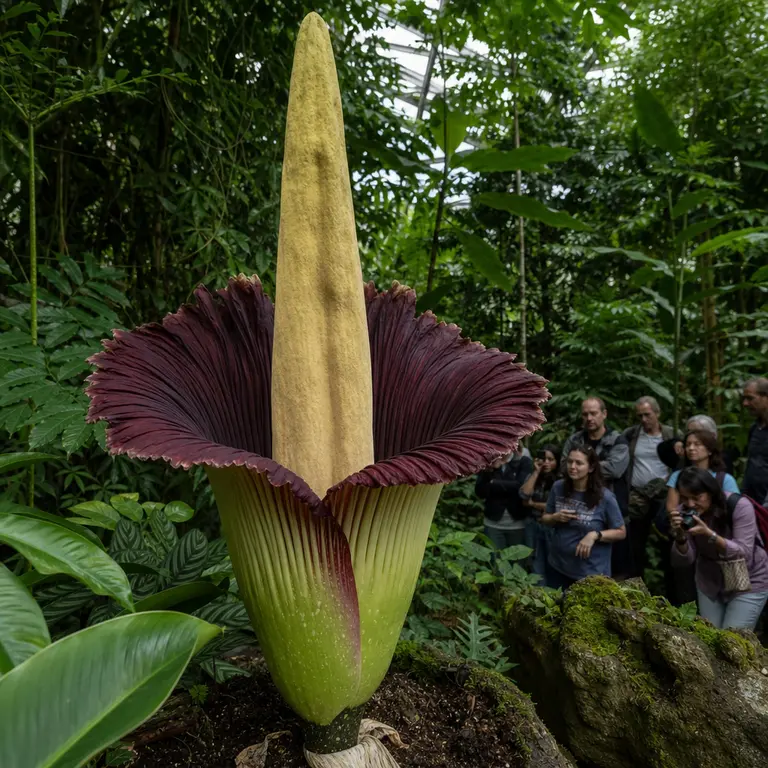
A Bloom That Smells Like Death
In 2024, botanical gardens from Chicago to Kew reported renewed public frenzy over rare titan arum blooms, drawing thousands of visitors willing to queue for hours to experience a smell most describe as rotting flesh mixed with sweaty socks. The spectacle is fleeting — the spathe opens for roughly 24 to 48 hours before collapsing — but the chemistry behind it is among the most sophisticated deception strategies in the plant kingdom. That such a spectacle exists at all, and that it has persisted through millions of years of evolution, raises a question that cuts to the heart of how life exploits perception: what does it mean for a living organism to construct a lie so convincing that it fools not just one species, but an entire ecological guild of insects shaped by millions of years of their own evolutionary pressure?
Amorphophallus titanum, native to the rainforests of Sumatra, produces what is technically not a single flower but a massive inflorescence: a central spike called a spadix surrounded by a frilled, petal-like spathe. The spadix can reach over three meters in height, making it the largest unbranched inflorescence of any plant on Earth. But size is only the beginning of its biological trickery. The plant has no roots in the conventional sense of a shallow, spreading system — instead, it anchors itself through a single massive underground corm that functions as both an anchor and an energy reservoir. Everything about its architecture is built around a single, explosive, temporary event, one that the plant may repeat only a handful of times across a lifespan stretching several decades.
The Chemistry of Manufactured Rot
The odor is generated by a cocktail of volatile organic compounds released in a carefully timed sequence. The primary offenders are dimethyl trisulfide and dimethyl disulfide — sulfur-containing compounds also produced by the decomposition of animal tissue — along with trimethylamine, which is associated with rotting fish, and isovaleric acid, the compound responsible for the smell of sweaty feet. These chemicals are not incidental byproducts of metabolism. They are precisely synthesized to mimic the chemical signature of a decaying large mammal, and the proportions in which they are released appear to be tuned to the olfactory sensitivities of the specific insect species the plant depends upon.
What makes the titan arum’s strategy particularly remarkable is thermogenesis: the spadix actively heats itself to temperatures approaching 36 degrees Celsius, nearly matching human body temperature. This is not passive warming from sunlight or ambient heat but a metabolically driven process that requires the rapid oxidation of stored carbohydrates, resembling the heat generation seen in warm-blooded animals. This heat volatilizes odor compounds, dispersing them over a wide area in the humid forest air. The warmth also mimics the body heat of a fresh carcass, reinforcing the illusion for carrion beetles and flesh flies — the plant’s primary pollinators — that a meal awaits.
The timing of the heat and odor release is not random. Emissions peak during the night hours, when carrion-associated insects are most active and when competing floral scents from other plants are least likely to interfere. This temporal precision suggests that the deception has been refined over evolutionary time not merely in its chemical composition but in its scheduling, coordinating the plant’s internal biochemistry with the behavioral rhythms of insects it has never, in any meaningful sense, encountered as individuals.
Entrapment Without Digestion
Unlike carnivorous plants such as Nepenthes pitcher plants, the titan arum does not digest its visitors. Instead, it operates a short-term trap built entirely around timing and surface texture. The spathe’s interior surface is coated with oils that make it difficult for insects to climb out once they have entered. The tiny flowers at the base of the spadix are arranged in two zones: female flowers open first, and male flowers open roughly 12 hours later. This sequential timing is a strategy to prevent self-pollination, a problem that becomes acute for a plant that blooms so rarely and whose nearest neighbor may be separated by considerable distance in the forest.
Insects arriving during the female phase, already dusted with pollen from a previously visited titan arum elsewhere in the forest, deposit that pollen on the sticky female flowers. They then become temporarily trapped overnight. By the time the male flowers release their pollen the following day, the spathe begins to wilt, and the insects escape — coated in fresh pollen and ready to be deceived again. The plant does not harm them. It feeds them nothing and offers no nectar, no nutritional reward of any kind. The entire transaction is extraction without compensation, and the insects are no worse for it physically, only biochemically manipulated into a service they did not choose.
The plant invests enormous energy in this single event: the underground corm, which can weigh over 70 kilograms, spends seven to ten years accumulating the resources needed for a single bloom cycle. In between blooms, the plant produces a single large leaf structure, sometimes reaching six meters in height, that photosynthesizes continuously and channels sugars back into the corm. When that leaf dies back, the plant enters dormancy before eventually deciding — through mechanisms that remain poorly understood — to commit its reserves to flowering. The decision, once made, cannot be reversed. If pollination fails, years of stored energy are lost.
Evolutionary Convergence and Conservation Stakes
The titan arum’s pollination strategy is an example of brood-site deception, a phenomenon documented in over 7,500 plant species worldwide. Plants in the genus Stapelia, the orchid Dracula, and certain Aristolochia species independently evolved similar chemical mimicry of decay or dung to exploit insects that associate those smells with food or egg-laying sites. None of these plants offer a reward. The entire interaction is a lie, and what makes it evolutionarily stable is the fact that individual insects rarely learn from the experience in ways that propagate through the population quickly enough to undermine the deception. The plant exploits a hardwired chemical response rather than a learned one, and hardwired responses are far slower to adapt.
This convergent evolution across unrelated plant lineages tells us something important about the landscape of biological possibility. When the same strategy evolves dozens or hundreds of times independently, it suggests that the underlying ecological opportunity — a large population of insects with predictable chemical triggers and limited capacity for rapid behavioral adaptation — is both stable and widely available. The titan arum did not stumble onto a unique trick. It found a door that evolution had opened in many places simultaneously.
This makes the titan arum’s survival precarious in ways beyond habitat loss. Because it depends on a relatively small population of carrion-associated insects within a specific geographic range, and because individual plants bloom so infrequently and unpredictably, successful pollination in the wild is rare. Sumatra has lost more than half its lowland rainforest since the 1980s, primarily to palm oil agriculture, and wild titan arum populations are considered vulnerable. The fragmentation of forest habitat does not merely reduce the number of plants — it disrupts the spatial network that makes the deception functional, separating individual blooms from the insect populations that serve them and from the other plants whose pollen those insects might carry.
Botanical garden cultivation has become a genuine conservation tool, with institutions maintaining corms and attempting hand-pollination during the narrow bloom window. In 2016, a synchronized bloom at the United States Botanic Garden and the Chicago Botanic Garden allowed researchers to transfer pollen between institutions — a cross-continental artificial pollination event for a plant that normally relies on a beetle stumbling through a Sumatran forest. The logistical coordination required to replicate what a single confused insect accomplishes in the wild speaks to how precisely calibrated the original system is, and how difficult it becomes to substitute human intention for ecological process.
What Deception Reveals About Complexity
The titan arum is often treated as a curiosity, a botanical spectacle that draws crowds through sheer sensory outrage. But the mechanisms behind that spectacle represent a level of biological integration that remains genuinely difficult to explain in simple terms. The plant synthesizes specific chemicals in specific ratios, generates metabolic heat on a precise schedule, constructs a physical trap with a timed release, and sequences its own reproductive organs to prevent self-fertilization — all without a nervous system, without sensory organs, and without any capacity for observation or real-time adjustment.
What the titan arum demonstrates is that complexity and coordination in living systems do not require centralized control. They require only that selection pressure be consistent and strong enough over sufficient time to reinforce every component of a system that only works when all components function together. The result is something that looks, from the outside, like planning — like a plant that knows what it is doing. It does not. But the distinction between knowing and having been shaped to behave as if you know may be less clear than it first appears, and the titan arum, standing three meters tall in a botanical garden atrium while thousands of people wait in line to be repelled by it, makes that ambiguity vivid in a way that few organisms can.
Sources & Further Reading
- Barthlott, W., Szabo, K., and Meve, U. 'The Titan Arum: Amorphophallus titanum.' In: Englera, Berlin-Dahlem Botanical Garden, 2002.
- Holmberg, N. and Bulow, L. 'Improving stress tolerance in plants by gene transfer.' Trends in Plant Science, 1998. (Background on plant thermogenesis mechanisms.)
- Kew Royal Botanic Gardens. 'Amorphophallus titanum.' Plants of the World Online, 2023. https://powo.science.kew.org/taxon/urn:lsid:ipni.org:names:84621-1
- Gibernau, M. 'Pollinators and visitors of aroid inflorescences.' Aroideana, Vol. 26, 2003.