
Indian Army Innovates with Chilly Balls for Wildlife Control
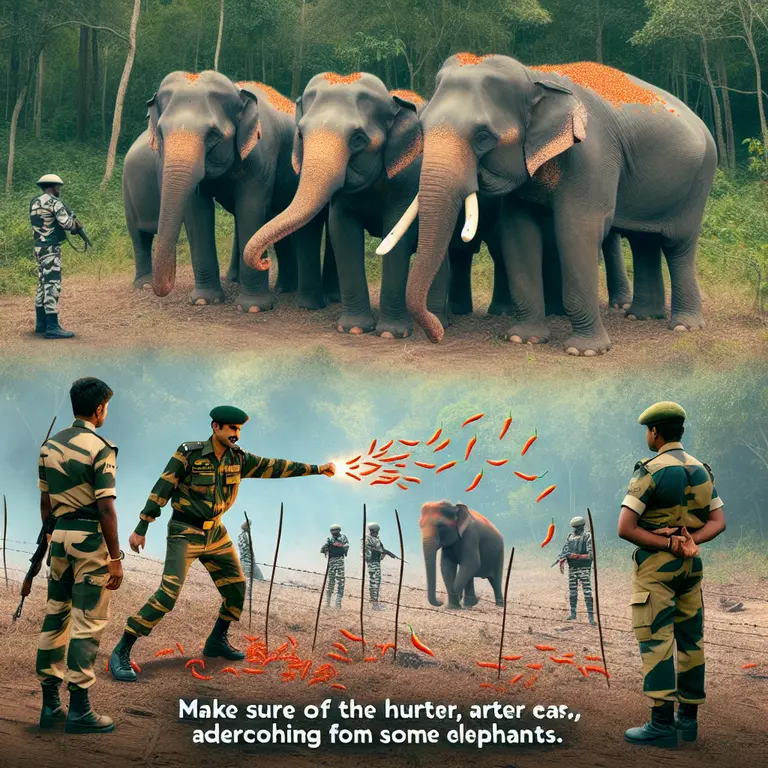
The Indian Army employs chilly balls as a non-lethal method to deter wild elephants from entering sensitive border areas.
Introduction
Military strategies often evoke images of cutting-edge technology: drones surveilling remote mountain passes, satellite-guided weapons systems, and encrypted communications networks humming across contested borders. Yet near the Indo-Bhutan border in the northeastern region of India, the Indian Army has adopted an approach that would seem more at home in a kitchen than a command center. Faced with a recurring and genuinely dangerous problem, soldiers turned to one of the oldest natural irritants known to humanity: the chili pepper. This is the story of how “chilly balls,” compact deterrent devices developed from capsaicin-rich chili powder, became a serious military tool in one of India’s most ecologically sensitive and geopolitically significant regions. The strategy is not merely a curiosity. It sits at the intersection of wildlife conservation, military innovation, indigenous ecological knowledge, and the broader global conversation about how human institutions can coexist responsibly with the natural world.
The Problem: Wildlife Intrusions in Strategic Areas
The northeastern Indian state of Sikkim occupies a position of extraordinary strategic sensitivity. Bordered by Nepal to the west, China to the north and east, and Bhutan to the east, it functions as a critical buffer zone and hosts significant Indian Army infrastructure. The terrain is mountainous, the forests are dense, and the biodiversity is remarkable. Sikkim sits within one of the world’s most important biodiversity hotspots, and among the animals that roam its lower forest corridors are wild Asian elephants, a species listed as endangered under the International Union for Conservation of Nature’s Red List.
These elephants do not recognize military perimeters. Driven by seasonal migration patterns, the search for food and water, and the gradual shrinkage of their natural habitat due to human encroachment, herds regularly move through areas that include army encampments, supply depots, and border outposts. The consequences of these encounters are serious on both sides. Elephants have destroyed equipment, damaged structures, and posed direct physical threats to personnel. In some cases, elephants have been injured or killed in confrontations with human settlements, outcomes that carry both moral weight and legal consequences under India’s Wildlife Protection Act of 1972, which affords significant protections to elephants as a Schedule I species.
Lethal deterrence was never a realistic option. Beyond the legal prohibitions, the Indian military operates within a country that has a deep cultural and religious relationship with elephants, animals venerated in Hindu tradition and embedded in the national consciousness. The challenge, then, was to find a method that was effective, humane, repeatable, and practical enough to deploy in remote, often difficult terrain.
The Chilly Ball Concept: Leveraging Capsaicin
The solution emerged from an understanding of elephant biology, specifically the animal’s extraordinary olfactory sensitivity. Elephants possess more olfactory receptor genes than any other species yet studied, including dogs. Their trunks, which function simultaneously as nose, hand, and sensory organ, are capable of detecting scents across remarkable distances. This sensitivity, which serves elephants so well in the wild for locating water and communicating with one another, also makes them acutely vulnerable to strong chemical irritants.
Capsaicin, the active compound in chili peppers, produces a burning sensation by binding to the TRPV1 receptor, a protein found in the sensory neurons of mammals. In humans, this manifests as the familiar heat of a spicy meal. In elephants, exposure to concentrated capsaicin, particularly through the sensitive mucous membranes of the trunk, produces a powerful aversive response. Crucially, this response causes no lasting physical harm. The discomfort is intense but temporary, making capsaicin an almost ideal candidate for non-lethal deterrence.
Researchers at India’s Defense Research and Development Organization worked to translate this biological reality into a deployable field tool. The result was the chilly ball: a compact, biodegradable sphere composed of chili powder, binding agents, and in some formulations, additional aromatic compounds designed to amplify the deterrent effect. These devices can be placed at perimeter points, along known elephant corridors, or at vulnerable entry points to installations. When an elephant approaches and investigates with its trunk, the capsaicin makes further advance deeply uncomfortable, and the animal retreats. The effect is consistent, the materials are inexpensive, and the environmental footprint is minimal. A deterrent made from chili powder leaves no toxic residue, poses no risk to other wildlife, and degrades naturally in the environment.
Historical Context and the Tradition of Non-Lethal Wildlife Management
The chilly ball strategy did not emerge in a vacuum. It belongs to a long and surprisingly rich tradition of non-lethal wildlife deterrence that stretches across cultures and centuries. African farmers have used chili-based deterrents along crop boundaries for decades, a practice that has been studied and promoted by conservation organizations, including the World Wildlife Fund. In Zimbabwe and Botswana, farmers hang cloth soaked in chili oil along fence lines or burn dried chilies in smoldering piles to create a scent barrier that elephants actively avoid. These community-level solutions informed and validated the more formalized approach taken by DRDO researchers.
Historically, the relationship between human communities and large mammals has always required creative management. Medieval European farmers used noise, fire, and strong-smelling substances to keep wolves and bears away from livestock. Indigenous communities across Asia and Africa developed sophisticated knowledge of which plants and smells repelled which animals, knowledge that modern conservation science is only beginning to document systematically. Ultrasonic deterrents are used today to prevent bats from roosting in buildings. Reflective tape and predator decoys are deployed to keep birds away from airfields. Netting and physical barriers have long been used to prevent giraffes, deer, and other large animals from damaging crops and infrastructure.
What distinguishes the chilly ball approach is its deployment within a formal military context and its development through an institutional research process. DRDO’s involvement brought scientific rigor to what had previously been a folk practice, validating the method through controlled trials and adapting it to the specific environmental and operational conditions of northeastern India. The development process was not rapid. It required extensive field observation, iterative testing, and careful study of elephant behavior patterns in the specific corridors where intrusions were most frequent.
Comparison with Other Deterrent Methods
Prior to the adoption of chilly balls, the Indian Army and local wildlife management authorities had attempted several alternative approaches, each of which proved inadequate in different ways. Electric fencing was among the first solutions considered. In principle, a properly maintained electric fence is an effective deterrent against elephants, and such fences are used successfully in various parts of India and Africa. In practice, however, the remote terrain of Sikkim and the surrounding northeastern region created serious logistical obstacles. Power supply in these areas is unreliable, and a fence that loses power becomes no barrier at all. Elephants, which are highly intelligent and capable of learning from experience, quickly identified inactive sections of the fence and exploited them. The cost of maintaining and repairing infrastructure that was repeatedly tested and breached by curious or persistent animals proved unsustainable.
Relocation was another approach that seemed promising on paper but failed in practice. Tranquilizing and relocating a wild elephant is an enormously complex operation requiring veterinary expertise, specialized equipment, and suitable release sites. The process is stressful for the animal, and stress-related complications during translocation have led to animal deaths in documented cases elsewhere in India. Furthermore, elephants have strong social bonds and well-established territorial memories. Relocated animals frequently attempt to return to their original ranges, sometimes traveling hundreds of kilometers to do so. The success rate of relocation as a long-term solution to human-elephant conflict is poor, and the resource demands make it impractical as a routine response.
Noise deterrents, including firecrackers and alarm systems, were also tried. These produced short-term results but suffered from habituation: elephants exposed repeatedly to the same stimuli learn to ignore them. Capsaicin, by contrast, works through a direct physiological mechanism that does not diminish with repeated exposure in the same way. The discomfort it causes is real and immediate each time, which prevents the habituation problem that undermines noise-based approaches.
The Significance of Innovation in Military and Conservation Contexts
The chilly ball strategy represents something more significant than a clever field improvisation. It reflects a deliberate institutional commitment to finding solutions that honor multiple, sometimes competing obligations simultaneously. The Indian Army operates in an environment where it must maintain security readiness while also complying with national wildlife law, respecting local ecological conditions, and managing public perception in communities where elephants hold cultural significance. The chilly ball approach satisfies all of these requirements at once.
There is also a broader lesson here about the value of cross-disciplinary thinking. The solution to a military problem was found not in military technology but in chemistry, zoology, and traditional agricultural practice. This kind of lateral thinking, drawing on knowledge from outside one’s own domain, is increasingly recognized as essential for addressing complex real-world challenges. Conservation organizations, urban planners, public health officials, and military strategists all face problems that resist purely technical solutions and require integrating ecological, social, and cultural knowledge.
Conclusion
The use of chilly balls as a non-lethal elephant deterrent along India’s northeastern military perimeters is a small story with large implications. It demonstrates that effective solutions to complex problems do not always require sophisticated technology or large budgets. Sometimes they require careful observation, scientific curiosity, and the willingness to look for answers in unexpected places, including the produce aisle. As human populations continue to expand into wildlife habitats and as climate change alters the migration and behavior patterns of large animals, the need for humane, effective, and ecologically sensitive deterrent strategies will only grow. The Indian Army’s experience in Sikkim offers a model worth studying carefully, not just by other militaries but by anyone working at the difficult boundary between human activity and the natural world.