
Discover the Stinging Defense of This Unique Parasitic Plant
Did you know there is a plant that stings and sucks the life out of its host? Its name is Cuscuta reflexa, also known as Amarbel.
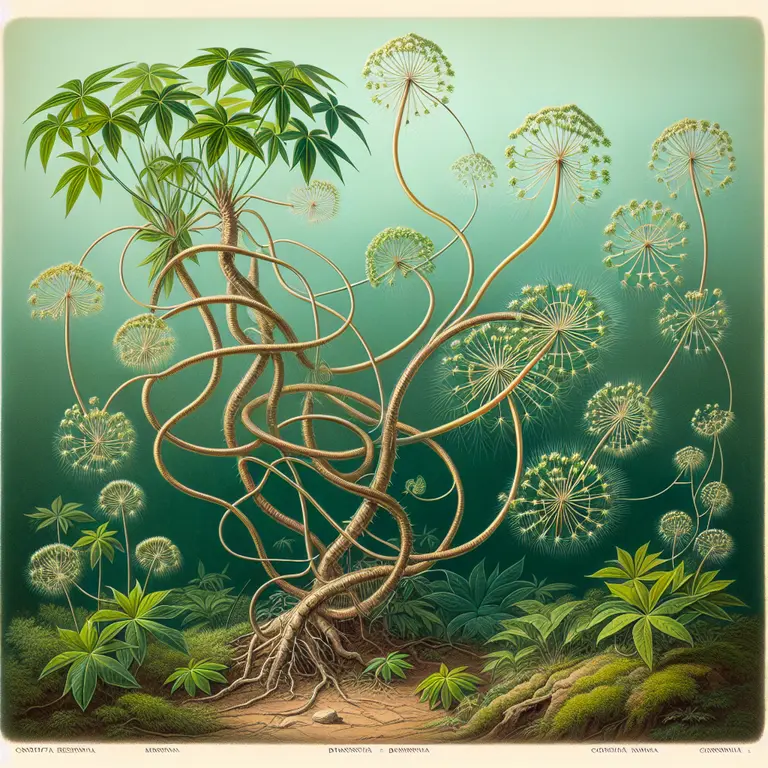
The Phantom Vine: How Cuscuta reflexa Survives Without Roots, Steals from Its Neighbors, and Still Heals the Sick
Among the myriad species of plants on Earth, only a minuscule fraction produces chemicals potent enough to harm humans or develops strategies radical enough to abandon the very foundations of plant biology. The Cuscuta reflexa, however, takes survival to another level entirely, with adaptations that are as deadly as they are scientifically fascinating. Commonly known across the Indian subcontinent as Amarbel or Akash Bel — meaning heaven’s vine — it has evolved an extraordinary method of surviving and propagating without roots, without leaves in any functional sense, and without the photosynthetic independence that defines almost every other plant on the planet. It is, in many ways, less a plant in the traditional sense and more a biological parasite masquerading as one, threading itself silently through gardens, forests, and farmlands with quiet, ruthless efficiency.
What makes this vine particularly compelling to scientists, historians of medicine, and ecologists alike is not just what it does, but how long it has been doing it, and what human civilizations have made of it in the meantime. A closer examination of Cuscuta reflexa reveals a species that challenges our assumptions about plants, parasitism, evolution, and even the boundaries between poison and cure.
Life Cycle and Parasitic Nature
Cuscuta reflexa begins its life cycle in a deceptively ordinary fashion. Like any other seed-bearing organism, it germinates in soil, pushing a small shoot upward into the light. For its first few inches of growth, it behaves as one might expect, drawing on the nutrients stored within its seed to fuel early development. But this phase of apparent normalcy is brief. Once the seedling reaches approximately three to four inches in height, something remarkable happens: it effectively abandons the soil. Its lower stem withers, severing its connection to the ground, and the plant pivots entirely to a different survival strategy — one built entirely on theft.
At this stage, Cuscuta reflexa begins actively seeking a host. It does this through a combination of chemical sensing and directional growth, responding to volatile compounds emitted by nearby plants. Research published in the journal Science in 2006 by researchers at Pennsylvania State University confirmed that Cuscuta can detect and orient itself toward the scent of tomato plants, demonstrating a level of sensory behavior that most people associate with animals rather than flora. Once a suitable host is found, the vine twines around the stem or branch with thread-like tendrils, coiling tightly to secure its grip.
The mechanism by which it then feeds is both elegant and brutal. Cuscuta reflexa develops specialized structures called haustoria, which are needle-like penetrative organs that bore through the host plant’s outer protective layer and embed themselves directly into the vascular tissue — the xylem and phloem — that carries water and nutrients throughout the plant. Through these haustoria, the parasite continuously draws out sugars, water, and minerals, often weakening or killing the host over time. Unlike many parasites that maintain a careful balance with their hosts to avoid killing them too quickly, Cuscuta reflexa can be aggressive enough to devastate entire crops, making it a serious agricultural concern in parts of South Asia, the Middle East, and beyond.
Unique Adaptations and Biological Weaponry
Beyond its parasitic feeding strategy, Cuscuta reflexa possesses additional adaptations that set it apart even among parasitic plants. Certain strains of the vine have developed stinging hairs along their surface, structurally similar to those found on the common nettle, Urtica dioica. These are not passive structures. When touched, the cells that form these hairs respond to mechanical pressure by rupturing, releasing a cocktail of irritants directly onto the skin or mucous membranes of whatever creature makes contact. The result for humans can range from mild itching and redness to more pronounced inflammation, depending on the duration of exposure and individual sensitivity.
This dual-layered defense — the ability to drain a host plant while simultaneously deterring animals from disturbing it — suggests a level of evolutionary sophistication that is rarely discussed in mainstream accounts of the plant. It is worth noting that not all Cuscuta reflexa populations exhibit the stinging-hair trait equally, suggesting ongoing evolutionary divergence among geographic populations. Some researchers have speculated that the development of these irritant structures may have been driven by pressure from herbivores that learned to consume the vine before it could complete its parasitic cycle on a host, essentially cutting off its food supply before it could become established.
The vine’s coloration is itself an adaptation worth noting. Cuscuta reflexa ranges from pale yellow to vivid orange, colors that result from its near-total lack of chlorophyll. Without the green pigment that most plants use to capture sunlight for photosynthesis, the vine has no need for the green coloration that typically characterizes plant tissue. This yellow-orange hue gives it a distinctly alien appearance as it drapes itself across hedgerows and trees, and it is partly responsible for the poetic name heaven’s vine — the golden threads appear almost luminous against the green of the host plants it colonizes.
Evolutionary Perspective and Ancient Origins
From an evolutionary standpoint, Cuscuta reflexa occupies a fascinating position in the history of plant life on Earth. Botanical and fossil evidence suggests that the ancestors of modern Cuscuta species were conventional photosynthesizing plants, not unlike many flowering plants today. The transition to full parasitism represents one of the more dramatic evolutionary pivots recorded in the plant kingdom, and scientists estimate it occurred over tens of millions of years, with the lineage beginning its shift in the early Cretaceous, more than 100 million years ago.
The selective pressures that drove this transition are still debated, but one prominent hypothesis links it to the explosion of herbivorous dinosaurs and other large plant-eating creatures during that geological period. Under intense predation pressure, plants that could reduce their above-ground, visible tissue while still obtaining nutrients from alternative sources would have had a significant survival advantage. Parasitism may have emerged as a solution to a world where standing tall and green made a plant a target. Over successive generations, ancestral plants that invested less in photosynthetic machinery and more in penetrative haustoria produced more offspring, gradually giving rise to the highly specialized parasite we recognize today.
Modern genomic studies have added another dimension to this story. Research has shown that Cuscuta species have undergone significant gene loss over their evolutionary history, shedding many of the genes responsible for photosynthesis that are conserved across virtually all other plant lineages. This genetic streamlining is itself evidence of the depth of commitment to parasitism — Cuscuta has not merely supplemented photosynthesis with parasitism, it has replaced one with the other at the molecular level.
Medicinal Uses and the Paradox of the Healing Parasite
Perhaps the most counterintuitive aspect of Cuscuta reflexa is that, despite its reputation as an agricultural pest and a skin irritant, it has been used for centuries as a medicinal plant in traditional healing systems across South Asia and the Middle East. In Ayurveda, the ancient Indian system of medicine whose foundational texts date back over two thousand years, Amarbel is listed as a therapeutic herb with applications ranging from treating chronic coughs and bronchial inflammation to skin diseases and swelling. Its use in these contexts is attributed to documented anti-inflammatory and antibacterial properties that modern pharmacological research is only beginning to validate.
Studies conducted in recent decades have identified several bioactive compounds in Cuscuta reflexa, including flavonoids, alkaloids, and phenolic acids, that demonstrate measurable biological activity in laboratory settings. Some of these compounds have shown potential to inhibit the growth of certain bacteria and to reduce inflammatory markers in cell-based studies. Interestingly, the same chemical profile that makes certain strains of the plant irritating to the skin may, in controlled and processed forms, contribute to its therapeutic effects — a reminder that the line between medicine and poison has always been primarily a matter of dose and context.
Traditional practitioners in India have historically used preparations of the vine to treat hair loss, jaundice, and nervous disorders, though the scientific basis for many of these applications remains incompletely understood. This gap between traditional knowledge and formal scientific validation represents both a challenge and an opportunity for researchers interested in ethnobotany and drug discovery.
Conclusion
Cuscuta reflexa stands as one of the more remarkable organisms in the botanical world, a plant that has traded the independence of photosynthesis for the efficiency of parasitism, developed chemical defenses that protect it from the very animals that might disrupt its feeding, and managed to embed itself in both the agricultural fears and the healing traditions of human civilization. Its evolutionary history stretches back to a world dominated by dinosaurs, and its genetic architecture tells the story of a lineage willing to abandon ancient biological machinery in pursuit of a more efficient survival strategy.
Further research into this vine holds genuine promise on multiple fronts. A deeper understanding of its bioactive compounds could contribute to the development of new anti-inflammatory or antimicrobial agents. A better understanding of its sensory mechanisms could inform strategies to manage its spread in agricultural settings without resorting to broad-spectrum herbicides that damage surrounding ecosystems. And a fuller appreciation of its evolutionary history could shed light on the broader question of how and why parasitism repeatedly emerges across the tree of life. For a plant without roots, Cuscuta reflexa has managed to establish itself very deeply in the world.