
Moonflower: Captivating Blooms That Light up the Night Sky
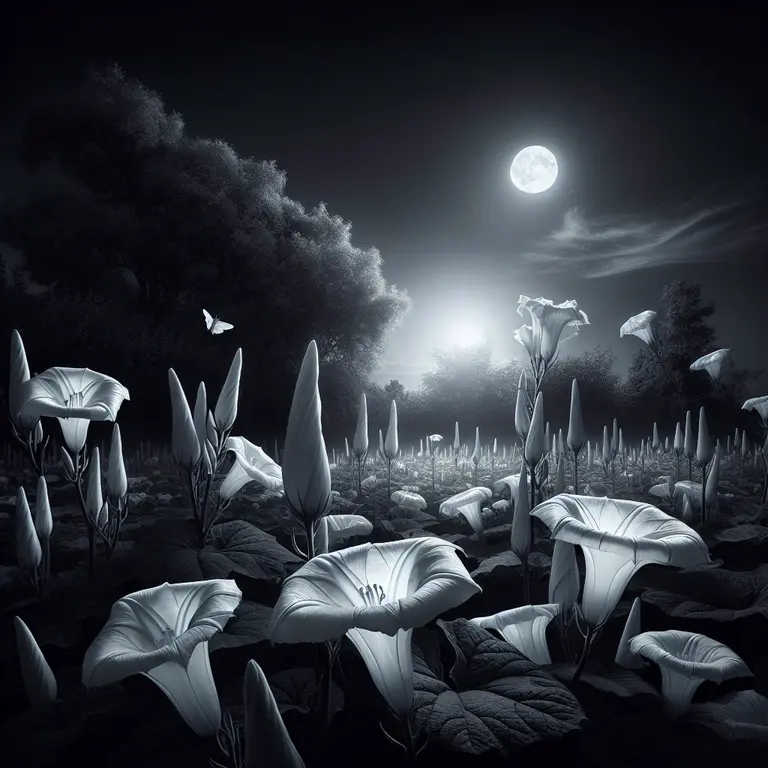
While most plants bloom during the daytime, the Moonflower plant (ipomoea alba) opens its blossoms only at night.
Introduction
Plant behavior is often predictable and straightforward. Most flowering species follow a reliable rhythm dictated by sunlight, opening their petals to greet the morning sun, photosynthesizing throughout the day, and closing up as dusk falls. This pattern is so consistent that we rarely stop to question it. Yet certain varieties defy this norm entirely, operating on a schedule that most of the natural world has abandoned. One of the most striking examples is the Moonflower. Ipomoea alba, commonly known as Moonflower or moon vine due to its nocturnal blooming habits, has long intrigued botanists, naturalists, and plant enthusiasts alike. Far from being a simple ornamental curiosity, the Moonflower represents a sophisticated evolutionary strategy, one that reveals just how inventive nature can be in survival and reproduction. To understand the Moonflower fully is to appreciate the hidden complexity that operates in gardens and wild landscapes every night, largely unseen by human eyes.
A Blooming Habit Unlike Any Other
Unlike its daylight-oriented counterparts, this unique member of the morning glory family waits until evening to unfurl its white, fragrant blooms. As if on cue with the rising moon, hence its evocative name, floral buds that remain green and tightly shut during daytime hours begin to open into large, luminous blossoms right after sunset. The transformation is remarkably swift. What appears to be an unremarkable closed bud during the afternoon hours can open fully within a few minutes once light levels drop sufficiently. Observers who have witnessed this in real time often describe it as one of the more quietly dramatic spectacles that a home garden can offer.
This nocturnal behavior contrasts sharply with most flowering plants, which bloom during daylight hours to attract pollinators like bees and butterflies. The timing of a flower’s bloom is not arbitrary. It is the result of millions of years of co-evolution between plants and the animals that pollinate them. For the Moonflower to diverge so completely from this daytime pattern suggests that something very specific drove its evolution in a different direction. The plant essentially carved out its own ecological niche, one defined not by competition with thousands of other daytime bloomers, but by exclusivity in a quieter, darker world.
What makes this behavior even more remarkable is its precision. The Moonflower does not simply bloom at some point during the night. It responds to specific environmental cues, primarily the fading of light and the corresponding drop in temperature that accompanies evening. This sensitivity to environmental signals reflects a level of biological sophistication that challenges the common perception of plants as passive organisms simply reacting to the sun.
The Science of Nocturnal Pollination
The reason behind this unusual blooming behavior lies in pollination strategies that are as elegant as they are effective. Many flowers attract their pollinators, primarily bees and butterflies, using visually appealing blooms during the daytime. Color, symmetry, and ultraviolet patterns invisible to the human eye all play roles in guiding these insects toward pollen and nectar. However, as conventional daytime pollinators retire for the evening, nighttime opens an entirely different ecological opportunity for other species, most notably moths and certain nocturnal beetles.
By timing their bloom to coincide with nightfall, when these nocturnal creatures become active, Moonflowers have essentially tapped into an underutilized pollination network. This is not simply a matter of convenience. It is a deeply strategic adaptation that reduces competition. A Moonflower does not need to compete with thousands of other plant species for the attention of a honeybee. Instead, it has cultivated a relationship with an entirely different set of pollinators, ones that are far less distracted by the abundance of daytime floral options.
Sphinx moths, also known as hawk moths, are among the most important pollinators for Ipomoea alba. These insects are remarkably efficient, capable of hovering in front of flowers, much like hummingbirds, while feeding on nectar. Their long proboscises allow them to reach deep into tubular flowers, inadvertently collecting and transferring pollen. The relationship between the Moonflower and the sphinx moth is considered a textbook example of co-evolutionary mutualism, where both species benefit from and have shaped each other’s development over time.
How the Moonflower Attracts Its Pollinators
Understanding why the Moonflower blooms at night is only part of the story. Equally fascinating is how it manages to attract pollinators in low-visibility conditions. The answer lies in a combination of color, structure, and scent that together create an irresistible signal for nocturnal insects.
Like many creatures that prefer darkness over light, moths navigate by moonlight and are strongly attracted to pale-colored objects that reflect it well. The Moonflower’s petals are a brilliant, almost luminous white, a color that stands out dramatically against dark foliage in low-light conditions. The large, flat surface of the bloom, which can reach up to six inches in diameter, acts almost like a reflective dish, maximizing the amount of moonlight and ambient light that bounces back toward any approaching insect. In this way, the flower’s color is not merely aesthetic. It is functional, serving as a beacon in the dark.
Alongside this visual strategy comes fragrance, and here the Moonflower truly excels. The intensely sweet, almost tropical scent it releases at night is far more powerful than that of most daytime flowers. This is no coincidence. In conditions where vision is limited, scent becomes the primary navigational tool for nocturnal pollinators. The Moonflower’s fragrance can carry considerable distances on the night air, drawing moths toward it from well beyond the range at which the flower itself would be visible. Once a moth detects the scent and follows it to the source, the white bloom's visual cue takes over, guiding the insect to the nectar within.
This dual-signal strategy, combining visual and olfactory attraction, ensures the Moonflower is effectively pollinated even when the more common daytime pollinators are entirely inactive. It is a reminder that nature rarely relies on a single mechanism when two or more work in concert to be more reliable.
Historical Spread, Cultivation, and a Word of Caution
Originating in tropical America, the Moonflower was introduced to other parts of the world by explorers and botanists curious about its unusual qualities. Its ability to bloom exclusively at night made it a novelty in European and Asian gardens, where it was cultivated as much for conversation as for aesthetics. Over time, it became a staple of moon gardens, a garden design concept built entirely around plants that are most visible and most fragrant after dark. These gardens, intended to be experienced during evening strolls, rely heavily on white-flowered and silver-leafed plants, and the Moonflower remains one of their most celebrated residents.
From a horticultural standpoint, the Moonflower is remarkably accommodating. It thrives in well-drained soil, tolerates a range of growing conditions, and can be cultivated in garden beds, along trellises, or in large containers. It is a vigorous climber, capable of reaching impressive heights in a single growing season, making it useful for quickly covering fences or pergolas. Both novice and experienced gardeners tend to find it rewarding, as it requires minimal intervention once established and produces blooms reliably throughout the warmer months.
However, the plant’s beauty comes with an important caveat. All parts of Ipomoea alba contain compounds that are mildly toxic to humans and animals if ingested. The seeds in particular contain alkaloids that can cause gastrointestinal distress and, in larger quantities, more serious symptoms. Gardeners with young children or pets should be mindful of where the plant is positioned and ensure that fallen seeds are collected promptly. This toxicity is itself an evolutionary adaptation, a chemical defense that discourages herbivores from consuming the plant and thereby protects its reproductive capacity.
Conclusion
The Moonflower is a fascinating and instructive example of nature’s diversity and ingenuity. It showcases how plants can evolve highly specific traits in response to ecological pressures, developing solutions that are simultaneously practical, beautiful, and surprising. Its nocturnal blooming schedule, its precisely calibrated attraction mechanisms, and its co-evolutionary relationship with sphinx moths all highlight the intricate and often invisible relationships that sustain ecosystems after dark. In a world that tends to celebrate the obvious and the visible, the Moonflower is a quiet reminder that some of nature’s most sophisticated work happens in the dark, noticed only by those willing to step outside and look up at the night.
Sources & Further Reading
- Smithsonian Gardens. (n.d.). Moonflower. Retrieved from Smithsonian Gardens.
- University of Illinois Extension. (n.d.). Moonflower: Ipomoea alba. Retrieved from University of Illinois Extension.
- Lady Bird Johnson Wildflower Center. (n.d.). Ipomoea alba. Retrieved from Lady Bird Johnson Wildflower Center.