
Unveiling the Camel’s Hump Secret: Fat Storage, Not Water
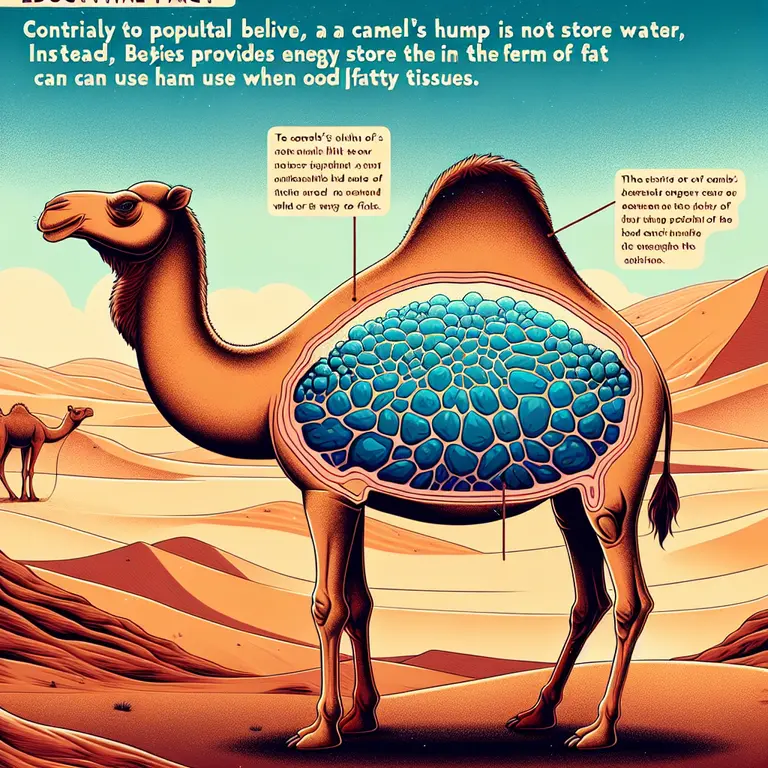
Contrary to popular belief, a camel's hump does not store water. Instead, it is a fatty deposit that provides energy when food is scarce.
Introduction
Few animals have captured the human imagination quite like the camel. For centuries, travelers crossing the Sahara, the Arabian Peninsula, and the Gobi Desert have depended on these creatures for transportation, milk, and companionship in some of the most unforgiving terrain on earth. In that long history of coexistence, a persistent myth took root and spread across cultures and classrooms alike: that the camel’s distinctive hump is a reservoir of water, a biological canteen carried on the animal’s back. It is a logical enough assumption. After all, what else would a desert animal need most? But the truth is considerably more interesting than the myth, and understanding it opens a window into one of the most sophisticated survival systems that evolution has ever produced.
The Function of Camel Humps
A camel’s hump stores not water but fat. This distinction matters enormously because it reframes the hump from a simple storage container into something far more elegant: a mobile energy reserve that fuels the animal through prolonged periods of scarcity. Camels inhabit environments where food sources are unpredictable, sparse, and often nutritionally poor. Desert vegetation is tough, dry, and available only in scattered patches. An animal that could not endure long gaps between meals would not survive long in such a landscape. The hump is the camel’s answer to that problem.
There are two species of camel commonly referenced. The dromedary, or Arabian camel, carries a single hump and is the species most associated with the Middle East and North Africa. The Bactrian camel, native to Central Asia, carries two humps. Despite this structural difference, both humps serve the same purpose in both species. When food is plentiful, camels eat voraciously and store the excess energy as fat concentrated within the hump. When food becomes scarce, that fat is metabolized to sustain the animal. As the reserves are depleted, the hump visibly shrinks and may even flop to one side, a reliable external indicator of the animal’s nutritional state.
Composition and Utility
The humps are composed almost entirely of fatty tissue, and the scale of this reserve is impressive. A well-nourished camel can carry close to 36 kilograms, or roughly 80 pounds, of fat in its hump. That is not distributed across the body in a general layer of insulation, as in many cold-climate mammals, but concentrated into a single distinct structure. This concentration is itself an adaptation, and an important one.
Fat is the most energy-dense macronutrient available to a living organism. Each gram of fat yields more than nine kilocalories of energy when metabolized, which is more than double the caloric return from an equivalent gram of carbohydrate or protein. This makes fat an extraordinarily efficient fuel source for long-distance endurance under conditions of scarcity. But the benefits do not stop at calories. When fat is broken down through oxidative metabolism, one of the byproducts is water. This is known as metabolic water, produced when hydrogen atoms in fat molecules combine with oxygen during cellular respiration. A camel metabolizing its hump fat therefore generates a meaningful internal water supply as a secondary consequence of energy production.
This production of metabolic water is almost certainly the origin of the popular misconception. The connection between the hump and water is real, but it is indirect and chemical rather than anatomical. The hump does not hold water the way a flask holds water. It produces water as a consequence of the biochemical work it performs. The distinction is subtle enough that it likely escaped casual observation for generations, and the simpler story of a built-in water tank proved too intuitive to resist.
Adaptations Beyond the Hump
Concentrating fat in the hump rather than distributing it beneath the skin across the whole body has a thermal advantage that is easy to overlook. A thick layer of subcutaneous fat covering an animal’s entire body would act as insulation, trapping heat inside during the scorching midday hours of a desert summer. By keeping the fat localized in the hump, the camel leaves the rest of its skin relatively uninsulated, allowing excess body heat to radiate outward more freely. This is a small but meaningful contribution to the animal’s overall thermal management strategy.
That strategy involves several other remarkable mechanisms. Camels possess oval red blood cells rather than the circular or biconcave disc shape found in most other mammals. This unusual morphology allows the cells to continue flowing through narrowed blood vessels even when the blood thickens and becomes more viscous due to dehydration. In a severely dehydrated human, the blood thickens to the point where the heart struggles to pump it efficiently, accelerating the crisis. A camel’s oval red blood cells resist this problem, buying the animal additional time under extreme water deficit.
Camels also regulate their body temperature in a way that most mammals cannot. Rather than maintaining a strict internal temperature and sweating continuously to achieve it, camels allow their core temperature to rise several degrees during the day and fall again at night. This behavioral and physiological flexibility reduces the need to sweat, thereby conserving water. A camel can tolerate a body temperature swing of roughly six degrees Celsius across a single day without experiencing the kind of cellular damage that would be catastrophic in a human being. The animal’s kidneys are also highly efficient at concentrating urine, and its nasal passages are structured to recapture moisture from exhaled air before it escapes into the dry atmosphere.
Together, these systems form an integrated survival architecture. No single adaptation alone would be sufficient to sustain life in the deep desert. It is the combination of fat storage, metabolic water production, flexible thermoregulation, specialized blood cells, and water-conserving kidneys that makes the camel genuinely extraordinary.
Evolutionary Significance
The camel’s physiology is a case study in what biologists call extreme adaptation, the process by which evolutionary pressure over vast stretches of time shapes organisms into highly specialized forms suited to particular environments. Camels did not always live in deserts. Their ancestors originated in North America during the Eocene epoch, roughly 45 million years ago, and the lineage spread across the globe over millions of years before the North American branch went extinct. The desert-dwelling forms we recognize today are the product of millions of years of selection pressure favoring individuals best equipped to handle heat, drought, and nutritional scarcity.
Understanding this evolutionary history adds depth to what might otherwise seem like a collection of biological curiosities. Each of the camel’s remarkable traits was not designed by intention but selected by survival. Animals that could not tolerate dehydration, that could not sustain themselves on sparse vegetation, that could not manage heat without exhausting their water supply, left fewer offspring. Over time, the traits that conferred survival advantages became dominant in the population. The hump, the oval blood cells, the flexible body temperature, the efficient kidneys: all of these are the accumulated legacy of countless generations living and dying in harsh landscapes.
Conclusion
The camel’s hump is not a water tank. It is something more sophisticated: a concentrated energy reserve that sustains the animal through periods of scarcity while simultaneously generating metabolic water as a byproduct of fat oxidation. That indirect connection to water is real, but it is a chemical process, not a storage mechanism, and conflating the two has produced one of the most durable misconceptions in popular natural history.
Correcting this misunderstanding is not merely a matter of pedantry. It invites a deeper appreciation for how evolution actually works, through incremental, interlocking adaptations that solve multiple problems at once. The camel survives the desert because of one impressive trick. It survives because its entire body has been shaped, over millions of years, into a coherent system for enduring extremes. That is a far more compelling story than a hump full of water, and it is entirely true.