
Unveiling the Waggle Dance: Inside the Secret Life of Bees
Bees communicate with each other through a unique dance known as the 'waggle dance', enabling them to relay precise information about the location of food sources.
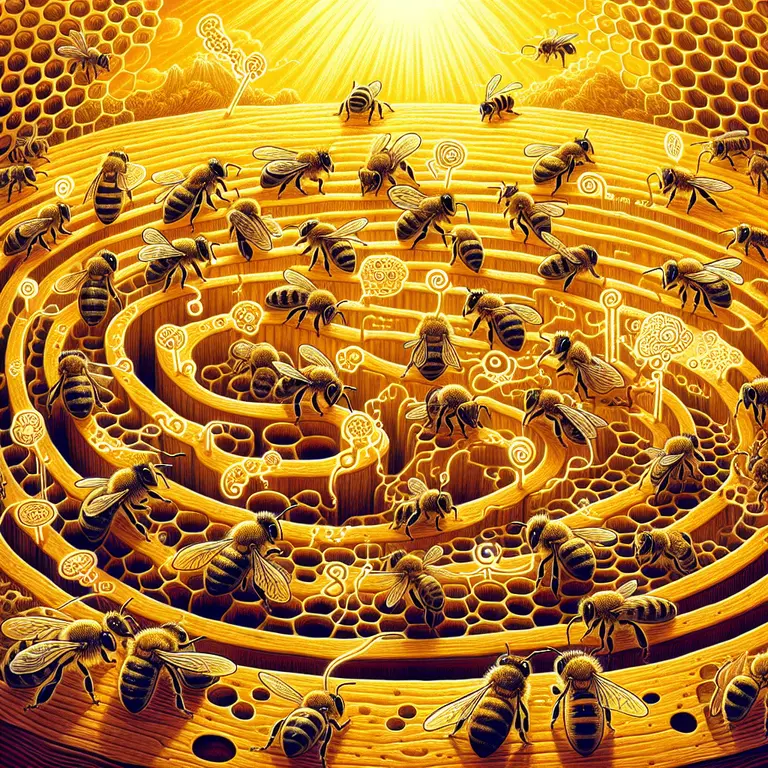
The Waggle Dance: How Bees Speak in Movement
Among the countless wonders of the natural world, few are as elegant and surprising as the communication system employed by honeybees. While most people know that bees produce honey and pollinate flowers, far fewer are aware that these small insects have developed one of the most sophisticated non-human languages on Earth. Bees communicate the precise location of food sources to their hive mates through a choreographed series of movements known as the waggle dance. This behavior, first formally described by Austrian biologist Karl von Frisch in the mid-twentieth century, represents a level of informational complexity that scientists once believed was exclusive to higher-order animals. Von Frisch’s work was so groundbreaking that it earned him a share of the Nobel Prize in Physiology or Medicine in 1973, a recognition he shared with Nikolaas Tinbergen and Konrad Lorenz. Understanding the waggle dance not only deepens our appreciation for bees but also reshapes how we think about animal cognition, navigation, and collective intelligence.
The Mechanism of the Waggle Dance
The waggle dance is a finely tuned performance that combines movement, vibration, and timing to transmit navigational data with remarkable accuracy. When a forager bee discovers a worthwhile source of nectar, pollen, water, or propolis, a resinous substance bees collect from tree buds and use to seal their hives, it returns to the colony and begins its dance on the vertical surface of the honeycomb. The routine is not random. Every element of the performance carries encoded meaning that other bees are biologically prepared to interpret.
The dance itself consists of two distinct phases that repeat in a continuous loop. In the first phase, the bee moves in a straight line while rapidly shaking, or waggling, its abdomen from side to side. This is the informational core of the dance, the segment that carries the most critical data about the food source. In the second phase, the bee curves around in a semicircle to return to its starting point, alternating the direction of the curve with each repetition so that the overall path traces a figure-eight pattern. The straight waggling run is the key communicative element, while the return loops simply reset the dancer for the next repetition.
What makes this behavior particularly astonishing is that the dance takes place in near-total darkness inside the hive. The observing bees do not watch the dance so much as feel it. They crowd around the dancer, making physical contact with their antennae and legs, sensing the vibrations transmitted through the comb and through the air. Sound also plays a role. The waggling bee produces a buzzing pulse during the straight run that other researchers have shown to be part of the signal. The dance, in other words, is a multisensory broadcast.
Navigational Precision and Solar Geometry
Perhaps the most intellectually astonishing aspect of the waggle dance is how it encodes direction. Bees navigate using the sun as a reference point, and they translate that solar geometry into the angle of the waggle run on the vertical comb inside the hive. If the food source lies directly in line with the sun from the hive, the bee performs its waggle run straight up the comb. If the food source is located 60 degrees to the left of the sun, the waggle run is performed 60 degrees to the left of vertical. The comb effectively becomes a map, with straight up representing the direction of the sun, and every other angle representing a deviation from that reference point.
This system requires the bee to perform a continuous mental translation. Outside, direction is measured relative to the sun in the sky. Inside the dark hive, it is represented as an angle relative to gravity on the comb. The bee must convert one coordinate system into another every time it dances, and it must do so with enough consistency that other bees can follow the instructions and locate a target that may be several kilometers away.
What makes this even more remarkable is that bees track the sun's movement across the sky. The sun’s position changes throughout the day, and a dance performed in the morning would give incorrect directions if the same angle were used in the afternoon. Researchers have found that bees update the angle of their waggle run over time to compensate for this shift, even when they have been kept in the dark and cannot directly observe the sun. They appear to have an internal circadian clock that tracks the sun’s movement and adjusts their navigational calculations accordingly.
Distance, Quality, and the Economics of Foraging
Direction is only half of the message. The waggle dance also communicates how far away the food source is and how valuable it is, giving the colony the information it needs to allocate its foraging workforce efficiently.
Distance is encoded in the duration of the waggle run. A longer straight run indicates a more distant food source, while a shorter run signals something nearby. Researchers have measured this relationship with considerable precision. Roughly speaking, each additional second of waggle run duration corresponds to an additional kilometer of flight distance, though the exact ratio varies somewhat between species and populations. Bees observing the dance can extract this timing information and use it to calibrate their own flight expectations before leaving the hive.
The vigor and enthusiasm of the dance communicate quality. A bee that has found an exceptionally rich patch of flowers, one with abundant nectar at a high sugar concentration, will dance with greater energy and repeat its performance more times than a bee that has found a mediocre source. This means that better resources attract more recruits. The colony does not simply send bees toward any available food; it preferentially dispatches foragers toward the most rewarding options. This is a form of collective decision-making that emerges not from any central authority but from the aggregated signals of individual dancers competing for the attention of their hive mates.
This economic logic extends to the colony’s broader behavior. When multiple dancers are performing simultaneously for different food sources, the bees observing them effectively compare options and distribute their attention accordingly. The result is a decentralized yet surprisingly efficient allocation of labor, one that allows the colony to respond flexibly to changing environmental conditions without any single bee directing the process.
Conclusion
The waggle dance stands as one of the most remarkable communication systems ever discovered in the animal kingdom, and its full significance is still being explored by researchers around the world. It is a language built not from words or symbols in the conventional sense, but from angles, durations, and vibrations that carry precise and actionable information across the darkness of the hive. It challenges the assumption that complex communication is the exclusive domain of large-brained vertebrates, and it suggests that intelligence, in some meaningful sense, can be distributed across a colony rather than concentrated in any individual mind.
For most of human history, bees were admired for their honey and their industry, but their inner communicative lives went entirely unrecognized. Karl von Frisch gave us the tools to listen, and what we heard was extraordinary. In a world that increasingly values data, efficiency, and collective problem-solving, the honeybee has been practicing all three for millions of years, encoded in a dance performed in the dark.