
Exploring Water's Optical Properties and Light Refraction
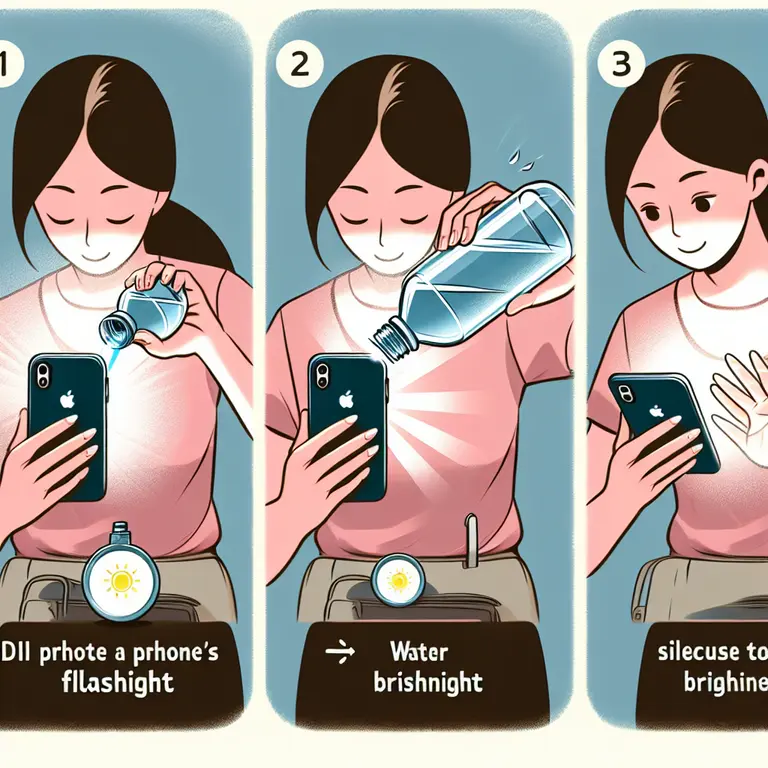
Here's a DIY trick to increase the brightness of your phone's flashlight using water.
 Watch on YouTube
 Watch on Rumble
Introduction
Water’s ability to refract light is a fascinating natural property that can be used creatively to enhance everyday tools. One practical application of this principle is using water to amplify the flashlight on your smartphone, turning a small light source into a much broader, brighter beam. This simple trick can be a handy solution in emergencies or situations where you need a more powerful light source but only have your phone available.
What makes this technique remarkable is not just its simplicity, but the depth of physics underlying it. The same optical principles that govern how telescopes, microscopes, camera lenses, and eyeglasses function are at work when you place a water-filled bottle over your phone’s LED. Understanding why this works can give you a greater appreciation for the natural world and help you apply similar thinking to other everyday problems. This article explores the science, method, practical applications, and broader context of light manipulation using water.
Understanding Refraction and Light Magnification
Before diving into the practical steps, it helps to understand the science behind this trick. Refraction occurs when light passes through a medium, such as water, causing its rays to bend. This bending of light can spread out and magnify the beam from your smartphone’s flashlight, making it appear larger and brighter. The water acts as a lens, dispersing the light over a wider area.
This phenomenon is similar to how eyeglasses or magnifying glasses work: light enters through a curved surface, is bent, and spreads to create a magnified image. When using water, the bottle’s shape, combined with light refraction, significantly increases the illuminated area compared to the bare LED alone.
The physics here traces back to a property called the index of refraction, which measures how much a given material slows down light relative to its speed in a vacuum. Water has an index of refraction of approximately 1.33, meaning light travels about 33 percent slower through water than through empty space. Air, by contrast, has an index very close to 1.0. When light crosses the boundary between these two media at an angle, it bends according to a mathematical relationship known as Snell’s Law, named after the Dutch astronomer Willebrord Snellius, who formalized it in the early 17th century.
This principle has been understood and exploited for centuries. Ancient Romans reportedly used glass spheres filled with water as primitive magnifying lenses. Glassblowers in medieval Europe discovered that rounded glass vessels could concentrate sunlight intensely enough to start fires. The water-bottle flashlight trick is, in essence, a modern continuation of a long history of humans bending light to their advantage with simple, readily available materials.
Step-by-Step Guide to Magnify Your Smartphone Flashlight
You do not need special tools to try this technique, and everything required is likely already within reach. Begin by activating the flashlight function on your smartphone. On most devices, this can be done through the quick-access control center or with a dedicated flashlight app. Ensure the flashlight is fully functioning before proceeding, since it will serve as the primary light source throughout the process.
Next, find a clear glass or plastic bottle. The container should be as transparent as possible and free of labels, significant texture, or tinting, since any of these can interfere with clean light refraction. A standard water bottle or a smooth drinking glass will work perfectly. The rounder and more uniform the container, the more even the resulting light dispersion will be.
Fill the bottle or glass with clean water. The water is the refractive medium doing the optical work, so a full container will generally produce better results than a partially filled one. Round or cylindrical containers tend to work best because their curved walls bend light consistently in all directions, producing a wide, relatively even spread.
Once the bottle is filled, carefully place it directly over your smartphone’s flashlight lens. The base of the bottle should be in firm, direct contact with the light source for the best refraction effect. As light passes upward through the water, it spreads out, illuminating a substantially larger area than the bare flashlight would on its own. Depending on the bottle’s size and shape, you may need to make minor adjustments to its position. Tilting the bottle slightly or experimenting with different container shapes can further enhance light projection in specific directions.
Practical Uses for This Technique
This trick proves useful across a surprisingly wide range of situations where a broader, more diffuse light source is needed but conventional tools are unavailable. During a power outage, placing a water-filled bottle over a phone flashlight and setting it on a table can illuminate a significant portion of a room, providing enough light to move safely, locate supplies, or keep children calm during an unexpected blackout.
For campers and outdoor enthusiasts, the technique offers a lightweight, cost-free way to extend a smartphone's utility. Rather than packing a separate lantern, a simple water bottle already carried for hydration can double as a light-diffusing tool at night. Pointed upward, the setup creates a makeshift lantern that casts ambient light in all directions, which is far more practical for illuminating a campsite than a focused beam.
In emergency roadside situations, such as changing a tire in the dark or inspecting a vehicle problem, having a wider spread of light can be the difference between a manageable task and a dangerous one. A focused phone flashlight requires one hand to hold and still only illuminates a small area at a time. The water-bottle method frees up both hands by allowing the light to be placed on the ground or a nearby surface while casting a broader glow over the work area.
The technique also serves well as an improvised reading or task light in low-light indoor environments. Placed beside a book, a map, or a workbench, the diffused light is easier on the eyes than a direct LED beam and covers a larger surface area, making detailed work more manageable.
The Broader Science of Light and Water in Nature and Technology
The interaction between light and water extends far beyond this simple trick and appears throughout both the natural world and advanced technology. Rainbows are perhaps the most universally recognized example of water refracting and dispersing sunlight. Each raindrop acts as a tiny prism, separating white light into its component wavelengths and projecting them at slightly different angles, producing the arc of colors visible in the sky after rainfall.
Fiber optic cables, which carry the majority of the world’s internet traffic, rely on a related principle called total internal reflection. Light traveling through a glass or plastic fiber bounces off the interior walls at angles that prevent it from escaping, allowing data encoded as light pulses to travel vast distances with minimal loss. The same physics that bends light at the air-water interface in your bottle enables long-distance digital communication.
In medicine, endoscopes use bundles of optical fibers to transmit light and images through the curved passages of the human body, allowing doctors to examine internal organs without surgery. Underwater cameras and diving masks are designed with the refractive index of water in mind, compensating for the way water distorts apparent distances and sizes. Even the human eye itself functions as a refractive optical system, with the cornea and lens bending incoming light to focus it precisely on the retina.
Understanding refraction also helps explain some common visual illusions. A spoon placed in a glass of water appears bent at the surface because the light rays coming from the submerged portion change direction as they exit the water. Swimming pools appear shallower than they actually are for the same reason. These everyday distortions are not errors in perception but accurate responses to the physics of light traveling between media of different densities.
Conclusion
Using water to magnify the flashlight on your smartphone is a clever, practical solution that demonstrates the power of basic scientific principles in everyday life. Whether facing an emergency, spending time outdoors, or simply needing a quick fix for a dimly lit situation, this method effectively expands your light source using nothing more than items already at hand.
Beyond its immediate utility, this trick serves as a reminder that scientific literacy has tangible, real-world value. Knowing why light bends through water connects a simple survival hack to centuries of optical science, from Snell’s Law to fiber optics to the biology of human vision. With just a water-filled bottle and a smartphone, you can significantly brighten your surroundings, and in doing so, participate in a tradition of human ingenuity that stretches back to the earliest experimenters who first noticed that water could bend, focus, and transform light.