
Fog-Collecting Beetles Inspire Innovations in Fluid Science
The Namib Desert's fog-basking beetle has inspired a generation of biomimetic engineers designing surfaces that harvest water from air, with applications from architecture to medicine.
 Watch on YouTube
 Watch on Rumble
A Desert That Rains Upward
The Namib Desert along southern Africa’s Atlantic coast is one of the oldest and driest places on Earth, receiving less than 25 millimeters of rainfall annually in most areas. Yet it supports a surprisingly dense community of life, much of it sustained not by rain but by fog. Each morning, Atlantic sea fog rolls inland from the cold Benguela Current, blanketing the dunes in a thin, ephemeral mist. For most organisms, this fog is too diffuse to collect directly. For Stenocara gracilipes, a small darkling beetle native to the Namib, it is a lifeline.
The Namib itself is estimated to be between 55 and 80 million years old, making it one of the oldest desert systems on the planet. This extreme antiquity has given its inhabitants an enormous span of evolutionary time to develop specialized adaptations. The Benguela Current, a cold upwelling of deep ocean water running along the southwestern African coast, chills the air above it and generates fog that penetrates up to 100 kilometers inland on some mornings. This fog belt is not a marginal resource. For dozens of species of beetles, lizards, plants, and invertebrates, it is the primary source of fresh water available to them for most of the year.
In 2001, zoologist Andrew Parker of the Natural History Museum in London and engineer Chris Lawrence published a landmark paper in Nature describing exactly how the beetle harvests this fog. Their findings launched a field of engineering research that continues to produce commercial and scientific results more than two decades later. What began as a study of a two-centimeter insect in a remote coastal desert became one of the most cited examples of biomimicry in modern materials science.
Bumps, Wax, and the Physics of a Droplet
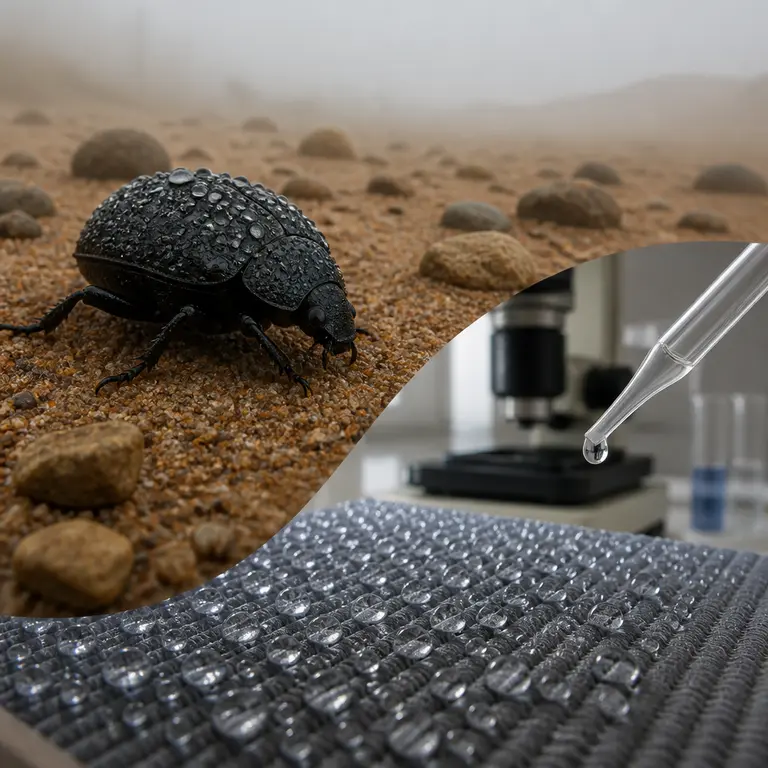
Stenocara gracilipes is roughly 2 centimeters long and unremarkable in appearance. Its survival strategy, however, is a masterclass in surface physics. When fog arrives, the beetle climbs to the top of a dune and tilts its body at roughly 45 degrees into the wind, a behavior called fog-basking. Its back is covered in a pattern of microscopic bumps, each about 0.5 millimeters apart. The peaks of these bumps are hydrophilic, meaning they attract water molecules. The troughs between the bumps are coated in a waxy, hydrophobic material that repels water.
As fog drifts across the beetle’s back, tiny water droplets nucleate preferentially on the hydrophilic peaks. Once a droplet grows large enough, gravity and the hydrophobic channels between bumps work together to roll the droplet toward the beetle’s mouth, where it is consumed. The beetle can collect up to 40 percent of its body weight in water during a single fog event. Parker and Lawrence demonstrated that this dual-surface chemistry, combining attraction and repulsion at the microscale, was the key mechanism, rather than any single surface property.
This finding was counterintuitive. Earlier assumptions held that a uniformly water-attracting surface would be most efficient at capturing moisture. The beetle’s heterogeneous surface proved far superior, because a droplet that sticks everywhere never moves anywhere useful. The insight reframed how engineers thought about surface design for fluid management. Rather than optimizing a single property in isolation, the beetle demonstrated that productive tension between opposing surface chemistries, carefully arranged in space, could outperform any uniform solution.
The physics underlying this process involves contact-angle dynamics and droplet-pinning forces that materials scientists had studied theoretically for years before the beetle provided a working biological demonstration. When a water droplet sits on a hydrophilic surface, it spreads out and wets the surface broadly. When it sits on a hydrophobic surface, it beads up and maintains a high contact angle. The beetle’s genius is in using the hydrophilic zone to nucleate and grow the droplet, and the hydrophobic zone to ensure that once the droplet reaches a critical size, it detaches and travels rather than remaining fixed in place.
From Beetle Back to Building Material
The 2001 Nature paper prompted immediate interest from materials scientists and engineers. The challenge was replicating the beetle’s nanoscale surface chemistry using manufacturable processes. Early attempts used photolithography and chemical vapor deposition to create patterned surfaces on glass and polymer substrates, but these methods were expensive and difficult to scale.
By the early 2010s, researchers at MIT, including groups led by Kripa Varanasi, had developed fog-collection meshes inspired by the beetle that outperformed conventional designs by factors of three to five. In 2012, Varanasi’s team reported in ACS Nano that surfaces combining hydrophilic bumps on hydrophobic backgrounds could collect fog at rates approaching 10 liters per square meter per hour under favorable conditions. The key advance was learning to control not just the chemistry but the geometry of the bumps, since droplet size, spacing, and slope angle all affect how quickly water moves toward collection channels.
Fog harvesting as a technology is not new. Mesh fog collectors have been deployed in the Atacama Desert of Chile, the mountains of Morocco, and the highlands of Eritrea since at least the 1980s. The Chilean project at El Tofo, begun in 1987, supplied roughly 11,000 liters of water per day to the village of Chungungo using simple polypropylene mesh panels. What the beetle research added was a principled understanding of surface design that could dramatically improve the efficiency of these systems. Prior to Parker and Lawrence’s paper, fog collection engineering was largely empirical, guided by trial and error rather than a mechanistic understanding of why some surfaces worked better than others.
By 2023, several startups had commercialized beetle-inspired fog nets for agricultural use in water-scarce regions. One notable example is Warka Water, an Italian-Ethiopian design project that uses tower structures with biomimetic mesh to collect both fog and dew in sub-Saharan Africa. While results from field deployments remain variable depending on local fog frequency and mesh maintenance, the underlying physics from Parker and Lawrence’s beetle study remains the foundation of their design logic. The promise of these technologies is substantial. The World Health Organization estimates that over two billion people currently live in countries experiencing high water stress, and coastal fog represents an underutilized freshwater resource in dozens of those regions.
Medical, Aerospace, and Anti-Icing Applications
The beetle’s surface principles have migrated far beyond water collection. Researchers at Harvard’s Wyss Institute have applied heterogeneous wettability surfaces to medical tubing and catheters, where controlling fluid flow reduces clotting and bacterial adhesion. The same logic that moves a water droplet efficiently across a beetle’s back can be used to prevent blood from pooling in surgical tubing or to guide therapeutic fluids along a defined path inside a medical device. In 2019, a team at Penn State demonstrated that beetle-inspired micropatterned surfaces could reduce ice accumulation on aircraft wings by directing supercooled water droplets away from critical zones before freezing. This is significant because conventional de-icing fluids are both expensive and environmentally problematic, with many formulations containing glycol compounds that contaminate groundwater near airports.
In architecture, fog-harvesting principles are being incorporated into building facade designs in coastal cities where humidity is high, but freshwater access is limited. A 2022 pilot project in Lima, Peru, one of the world’s most populous cities without a river running through it, tested beetle-inspired facade panels on a public building to supplement the municipal water supply during dry months. Lima receives less than 10 millimeters of rain per year but sits in near-constant coastal fog called garua, making it a logical test environment. The project represented a convergence of urban infrastructure design and biological inspiration that would have been difficult to imagine before the beetle’s mechanism was understood in detail.
The textile industry has also taken note. Outdoor gear manufacturers have explored fabrics that mimic the beetle’s surface to wick sweat away from the skin while resisting external moisture, though most commercial implementations remain crude approximations of the biological original. The challenge in textiles is that fabric must be flexible, washable, and durable under conditions that would quickly degrade a precisely patterned hydrophobic coating. Nonetheless, the directional fluid transport principles the beetle demonstrated have informed the design of moisture-wicking athletic wear, surgical drapes, and filtration membranes used in industrial water treatment.
What the Beetle Still Knows That We Do Not
Despite two decades of research, scientists have not fully replicated the beetle’s efficiency. One reason is that the biological surface is dynamic in ways that engineered materials are not. The beetle’s waxy coating is continuously renewed by metabolic processes, maintaining its hydrophobic properties even as the surface is abraded by sand. Engineered hydrophobic coatings degrade over time, particularly under ultraviolet exposure and mechanical wear, reducing their fog-collection performance. Developing self-renewing or self-healing hydrophobic surfaces remains an active area of materials research, with some groups exploring polymer coatings that migrate to the surface of a substrate as the outer layer degrades, effectively restoring hydrophobicity without external intervention.
A second unresolved question concerns the beetle’s behavior. The fog-basking posture is well documented, but the sensory mechanisms that trigger it are not fully understood. How does Stenocara gracilipes detect incoming fog before it is visible? Some researchers have proposed that the beetle responds to subtle changes in air humidity or temperature at the dune crest, but the specific receptor pathways have not been identified. Understanding this sensory system could have implications for the design of autonomous fog-harvesting devices that deploy or orient themselves in response to atmospheric conditions, much as a weather vane responds to wind direction.
The Namib’s fog-basking beetles are also not the only animals to exploit fog chemistry. Researchers studying the coastal redwood forests of California have documented that the trees themselves harvest fog through their needles using surface tension principles, accounting for up to 40 percent of their annual water intake during summer dry seasons. The coastal redwood, Sequoia sempervirens, can intercept fog droplets across its enormous canopy surface area and channel the resulting water to the soil below, effectively creating a localized rainfall event from air that would otherwise carry its moisture back out to sea. The convergent evolution of fog-harvesting strategies across beetles, trees, and other desert organisms suggests that the physics Parker and Lawrence described in 2001 represents a near-optimal solution to a universal problem, one that engineers are still learning to match.
The deeper lesson of Stenocara gracilipes may be epistemological as much as technological. The beetle had solved a problem that human engineers had not clearly defined. Before Parker and Lawrence’s paper, the relevant question in fog collection was simply how to attract more water. The beetle reframed the question: how do you attract water in exactly the right place, and then make it leave? That distinction, between capture and transport, between adhesion and directed motion, turns out to be fundamental not just to water harvesting but to a wide range of fluid management challenges across medicine, aerospace, and materials science. A small insect tilting into the morning fog on a Namibian dune had been answering that question for millions of years before anyone thought to ask it.
Sources & Further Reading
- Parker, A.R. and Lawrence, C.R. Water capture by a desert beetle. Nature, 2001. https://doi.org/10.1038/414033a
- Varanasi, K.K. et al. Fog Harvesting with Hierarchical Surfaces. ACS Nano, 2012. https://doi.org/10.1021/nn302390w
- Klemm, O. et al. Fog as a Fresh-Water Resource: Overview and Perspectives. AMBIO, 2012. https://doi.org/10.1007/s13280-012-0247-8
- National Geographic. How a Desert Beetle Inspired Engineers to Harvest Water from Fog. National Geographic, 2020. https://www.nationalgeographic.com/environment/article/fog-harvesting-beetles