
Leafcutter Ants: The Ancient Pioneers of Fungus Farming
Leafcutter ants did not merely discover fungus farming — the fungus may have shaped the ants' evolution as profoundly as the ants shaped the fungus, in one of biology's most sophisticated and ancient mutual dependencies.
Introduction
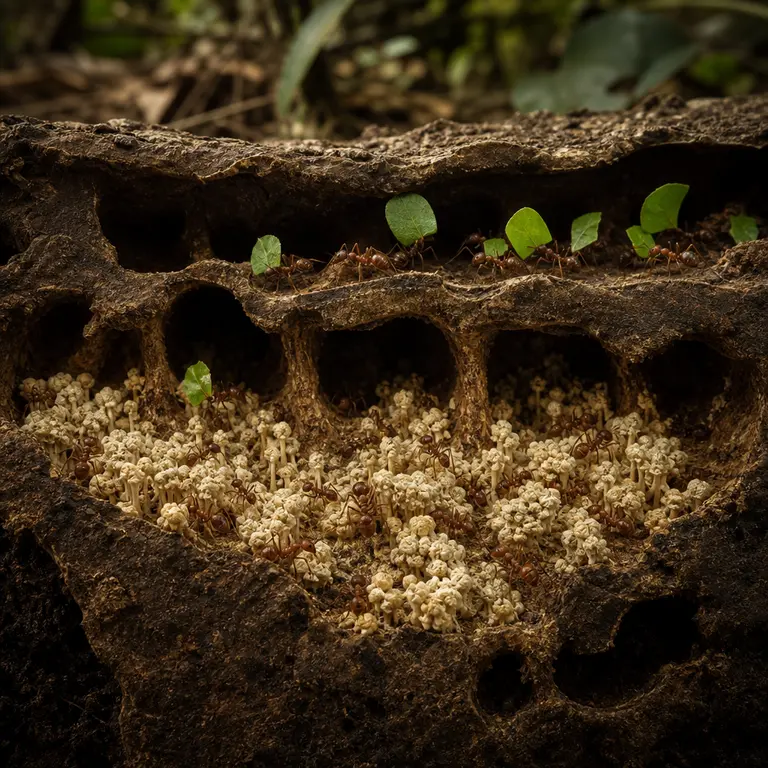
When most people think of agriculture, they imagine human hands and plowed soil, a plow cutting furrows into earth that has been deliberately cleared and prepared. But leafcutter ants of the genus Atta and Acromyrmex have been farming a specialized fungus for approximately 50 million years, predating human agriculture by an almost incomprehensible margin. The partnership is so ancient and so tightly interwoven that neither partner can survive without the other. The fungus, belonging to the genus Leucoagaricus, no longer produces the spores it would need to reproduce independently in the wild. The ants, in turn, have lost the digestive enzymes required to directly process plant cellulose. Each has become, in a very real biological sense, a hostage to the other.
This mutual dependency is not merely a curiosity of natural history. It is one of the most sophisticated and durable examples of coevolution ever documented, a system that challenges our assumptions about agriculture, intelligence, domestication, and the nature of biological control. The more closely scientists examine the relationship between leafcutter ants and their fungal cultivar, the more unsettling its implications become. What appears at first glance to be a colony of insects carrying leaves is, on closer inspection, a fully operational agricultural civilization governed by chemistry, shaped by millions of years of reciprocal evolutionary pressure, and capable of producing pharmacological innovations that human researchers are only beginning to understand.
The Structural Bond Between Ant and Fungus
What makes this relationship unusual, even among examples of mutualism, is the degree to which the fungus appears to have exerted selective pressure on ant behavior and anatomy over geological time. Researchers at the Smithsonian Tropical Research Institute and the University of Copenhagen have documented that leafcutter queens carry a small pellet of fungal mycelium in a specialized pouch beneath their mouth, called the infrabuccal pocket, when they leave to found new colonies. This is not a learned behavior passed down through observation or social instruction. It is hardwired into the ant's developmental biology. The queen’s body has been structurally modified over millions of years to transport a specific organism across the gap between one colony’s existence and the next.
The implications of this are worth pausing over. The fungus, which has no nervous system and no capacity for intentional action, has nonetheless managed to engineer its own dispersal mechanism using an insect's body. Natural selection, acting on variation within the fungal population over enormous spans of time, favored strains that produced chemical signals or nutritional rewards compelling enough to ensure that ants would carry them. The result is an organism that has effectively outsourced its reproduction to another species, not through passive luck but through a slow accumulation of traits that have made it indispensable. The ant did not choose the fungus. The fungus, in a meaningful evolutionary sense, chose the ant.
This structural codependency extends to the colony founding process itself. A newly mated queen that fails to carry viable fungal material when she departs her birth colony will almost certainly fail to establish a new one. The survival of the next generation of ants depends entirely on the successful transport of a living organism across what may be considerable distances. The fungus has made itself the keystone of an entire reproductive strategy.
The Chemistry of Control
The relationship goes deeper than logistics and anatomy. Research published in 2015 in the journal BMC Evolutionary Biology revealed that the Leucoagaricus fungus produces a suite of chemical compounds that appear to suppress the ants’ immune systems in targeted ways, reducing inflammatory responses that might otherwise cause the ants to treat the fungus as a pathogen. This is not passive coexistence between two organisms that happen to benefit from proximity. The fungus is actively managing its host’s biology, tuning the ant's immune environment to ensure its continued cultivation and protection.
This kind of immunological manipulation is known from other host-parasite relationships, but finding it within a mutualistic partnership adds a layer of complexity that complicates easy definitions. The fungus is simultaneously a food source, a dependent cultivar, and a biochemical agent operating within the bodies of the ants that tend it. The line between symbiosis and manipulation, between partnership and control, becomes difficult to draw with confidence.
The fungal gardens themselves are pharmacological environments of considerable sophistication. Leafcutter colonies host at least one additional fungal species, Escovopsis, a devastating garden parasite that can collapse an entire colony’s food supply within days if left unchecked. To combat this threat, the ants cultivate bacteria of the genus Pseudonocardia on specialized patches of their cuticle. These bacteria produce antifungal compounds that suppress Escovopsis. The system is effectively a three-way chemical war, mediated by bacterial antibiotics, occurring on the surface of an insect’s exoskeleton. Scientists, including Cameron Currie at the University of Wisconsin-Madison, have spent decades mapping this chemical arms race, and the work has already yielded insights relevant to the development of new antifungal drugs for human medicine. The ants, it turns out, solved a version of the antibiotic resistance problem long before we recognized it as a problem at all.
The Overlooked Complexity of Ant Agriculture
The popular image of leafcutter ants as simple leaf-collectors misrepresents a genuinely sophisticated agricultural system operating across multiple scales simultaneously. The ants do not eat the leaves. They chew them into a pulp, inoculate the pulp with fungal mycelium, and harvest the swollen hyphal tips called gongylidia that the fungus produces specifically as a food reward. This is not an incidental outcome of the relationship. Gongylidia are structures that exist nowhere in nature outside of ant-cultivated Leucoagaricus. The fungus evolved them as a deliberate nutritional offering, a kind of edible currency paid in exchange for cultivation, protection, and dispersal. No wild relative of the cultivated fungus produces them. They are an artifact of domestication as surely as a domesticated wheat grain is an artifact of human agriculture.
Division of labor within leafcutter colonies is equally remarkable and has revealed surprises even to experienced researchers. Colonies of Atta cephalotes can contain up to eight million individuals, organized into at least four distinct worker castes differentiated primarily by head width. The smallest workers, called minims, ride atop cut leaf fragments during the return journey to the colony. For a long time, this behavior puzzled observers, since the minima are too small to contribute meaningfully to carrying the leaf. The explanation, only formally documented in 1996 by researchers Hermogenes Fernandez-Marin and William Wcislo, is that the minims are guards. A parasitic phorid fly attempts to lay eggs in the necks of larger workers while they are burdened with leaf fragments and unable to defend themselves. The minim rides the leaf as a living deterrent. This behavioral adaptation had gone unrecognized despite leafcutter ants having been studied by Western science for well over a century, a reminder of how much complexity can remain hidden in plain sight.
What Ant Fungus Farming Reveals About Evolution
The leafcutter system has become one of the most important models in the scientific literature for understanding coevolution, the process by which two species shape each other’s evolutionary trajectories simultaneously across geological time. Genetic analysis has shown that the Leucoagaricus cultivated by different ant lineages across Central and South America is not a single species but a complex of closely related strains, each adapted to the particular ant colony or lineage that cultivates it. In some cases, ant colonies separated by only a few kilometers maintain genetically distinct fungal strains, suggesting that horizontal transfer of fungal material between unrelated colonies is far rarer than previously assumed. Each colony, in effect, tends its own private cultivar, shaped by its own local history.
This finding carries implications well beyond entomology. The leafcutter system demonstrates that domestication, typically discussed as something that conscious, tool-using humans do to other species, is a process that evolution can independently achieve through purely non-conscious mechanisms, producing outcomes of comparable complexity and stability. The ants weed their gardens, remove diseased material, regulate temperature and humidity within underground chambers, and apply chemical treatments derived from bacteria they themselves cultivate. They do all of this without any individual ant understanding the system it maintains. The intelligence of the colony, if it can be called that, is distributed across millions of bodies and encoded in chemical signals rather than in any individual nervous system.
Recent work using metagenomic sequencing has begun to reveal that the fungal gardens also harbor hundreds of bacterial species beyond Pseudonocardia, forming a microbiome as complex as any found in a mammalian gut. Several of these bacteria produce novel enzymes capable of breaking down plant polymers with unusual efficiency, a discovery that has attracted significant interest from biotechnology companies seeking more sustainable methods for converting agricultural waste into biofuels. The ants have been running an enzyme discovery program for 50 million years, and we are only now beginning to read the results.
Conclusion
The leafcutter ant and its fungal partner represent something more than a biological curiosity. They represent a proof of concept, a demonstration that agriculture, pharmacology, division of labor, and even something resembling biotechnology can emerge from evolutionary processes operating without foresight or intention. The system is older than the Himalayas, more stable than any human civilization, and more chemically sophisticated than most of what we have deliberately engineered. Studying it carefully is not merely an exercise in natural history. It is an encounter with a form of accumulated knowledge encoded not in books or institutions but in the bodies, behaviors, and biochemistry of millions of small animals going about their ancient work beneath the forest floor.
Sources & Further Reading
- Currie, Cameron R., et al. Fungus-Growing Ants Use Antibiotic-Producing Bacteria to Control Garden Parasites. Nature, 1999. https://www.nature.com/articles/22919
- Mueller, Ulrich G., et al. The Evolution of Agriculture in Insects. Annual Review of Ecology, Evolution, and Systematics, 2005.
- Fernandez-Marin, H., and Wcislo, W.T. Minima Workers in Leafcutter Ant Colonies. Behavioral Ecology, 1996.
- Bass, M., and Cherrett, J.M. Leaf-cutter Ants: Functional and Applied Aspects. Blackwell Scientific, 1994.