
The Diatom That Builds Glass Skeletons from the Sea
Diatoms are single-celled algae that construct intricate silica shells with nanoscale precision, influencing ocean chemistry, climate, and now nanotechnology and medicine.
Introduction
In every liter of ocean water, thousands of organisms are quietly manufacturing glass. Diatoms — single-celled photosynthetic algae belonging to the class Bacillariophyceae — build elaborately patterned shells called frustules entirely from amorphous silica, the same fundamental material as window glass and optical fiber. There are an estimated 100,000 to 200,000 species of diatoms, making them one of the most species-rich groups of organisms on Earth, yet most people have never heard of them. They range in size from 2 micrometers to 2 millimeters and inhabit oceans, freshwater lakes, soils, and even the surfaces of arctic ice.
What makes diatoms so remarkable is not merely their abundance or diversity, but the fact that they have been performing this feat of biological engineering for approximately 200 million years, long before the first dinosaurs disappeared and long before the first flowering plant spread its petals toward the sun. They predate human civilization by an almost incomprehensible margin, and yet the structures they build at the microscopic scale have begun to inform some of the most cutting-edge research in materials science, nanotechnology, and climate modeling. To understand diatoms is to understand something fundamental about how life shapes the physical world, and how the physical world, in turn, shapes life.
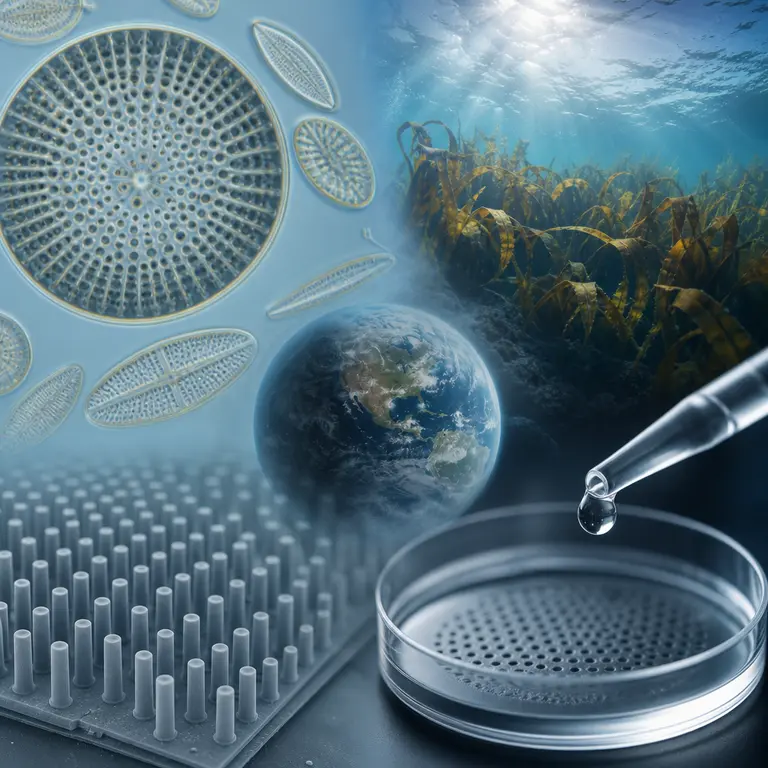
The frustule is not a simple container. It consists of two interlocking halves, the epitheca and hypotheca, that fit together like a Petri dish and its lid. Each half is perforated by a species-specific pattern of pores, channels, ribs, and chambers so geometrically precise that they can only be resolved under electron microscopy. These patterns are not decorative accidents — they are functional architectures that regulate the exchange of nutrients and gases while providing structural rigidity with minimal material. Engineers studying diatom shells have found that their hierarchical porosity yields strength-to-weight ratios that rival those of engineered ceramics. The sheer variety of frustule geometries across species is staggering: some are radially symmetric, like snowflakes; others are elongated, like needles; and still others are shaped like stars, crescents, or interlocking chains. Each design reflects millions of years of evolutionary pressure operating on a canvas made of glass.
How Diatoms Changed Earth’s Atmosphere
Diatoms are responsible for roughly 20 to 25 percent of all photosynthesis on Earth — more than all the world’s tropical rainforests combined. This statistic is difficult to absorb. The Amazon basin, which spans more than five million square kilometers and is commonly described as the lungs of the planet, contributes less to global primary productivity than a group of microscopic organisms invisible to the naked eye. This extraordinary productivity has deep consequences for the planet’s carbon cycle, operating across timescales that range from seasonal blooms to geological epochs.
When diatoms photosynthesize, they draw carbon dioxide from surface waters, which in turn draws more CO2 from the atmosphere. When they die, their silica shells act as ballast, carrying organic carbon to the ocean floor at rates far exceeding those of other phytoplankton. This process, known as the biological pump, has sequestered billions of tonnes of carbon in marine sediments over geological time. The silica shell is the critical difference between a diatom and a soft-bodied phytoplankton cell: where other organisms decompose near the surface and return their carbon to the water column, diatoms sink rapidly and efficiently, locking carbon away in sediments for millions of years.
During the Cretaceous and early Cenozoic periods, expanding diatom populations are thought to have contributed significantly to the long-term cooling of Earth’s climate. Vast sedimentary deposits called diatomite or diatomaceous earth — formed from compressed frustule layers hundreds of meters thick — exist on every continent. The White Cliffs of Lompoc in California, for example, represent ancient diatom blooms preserved over millions of years. These deposits are not merely geological curiosities. Alfred Nobel used diatomaceous earth in the 1860s to stabilize nitroglycerin, creating dynamite — an entirely accidental application of diatom geology that changed the history of warfare and mining. The porous structure of frustule debris, which makes it so useful for absorbing volatile liquids, is the same property that makes it valuable in swimming pool filters, pest-control powders, and industrial polishing compounds today. A creature that has never been seen by the vast majority of humans has, nonetheless, shaped the material conditions of modern civilization in ways both subtle and explosive.
The Molecular Mystery of Silica Synthesis
Perhaps the most scientifically remarkable aspect of diatoms is that they build their glass shells at room temperature, in seawater, using a biochemical process that materials scientists still cannot fully replicate in the laboratory. Industrial glass manufacturing requires temperatures above 1,400 degrees Celsius. Diatoms accomplish equivalent silica polymerization through a family of proteins called silaffins and long-chain polyamines, which were first isolated and characterized by Nils Kroger and colleagues at the Max Planck Institute in the late 1990s and early 2000s.
Silaffins are unusual proteins densely modified with polyamine chains and phosphate groups. When mixed with silicic acid in vitro, they precipitate silica within seconds into nanosphere structures that partially mimic frustule components. The precise molecular choreography by which living diatoms assemble these nanospheres into species-specific macroscopic patterns within a membrane-bound compartment called the silica deposition vesicle remains an open question in cell biology. Research published in Nature in 2002 by Kroger’s group demonstrated that different silaffin variants produce silica with different morphologies, suggesting the cell controls shell architecture through protein composition rather than physical templating alone. This was a conceptually important finding because it implied that the geometry of the final structure is encoded not in a rigid mold but in the chemistry of the molecules that assemble — a principle that resonates deeply with broader questions in developmental biology about how complex forms arise from molecular instructions.
The silica deposition vesicle itself is a fascinating organelle. It is essentially a membrane-enclosed reaction chamber within which the entire shell is built before being extruded to the cell surface. The cell must regulate the concentration of silicic acid inside this vesicle with extraordinary precision because silica polymerization is irreversible — once the glass sets, it cannot be remodeled. The fact that diatoms have been doing this reliably, producing geometrically consistent shells generation after generation, for 200 million years, suggests a degree of molecular control that we are only beginning to understand. Several research groups are now attempting to harness silaffin chemistry to produce nanostructured silica materials under ambient conditions, which would represent a significant advance in green manufacturing. The diatom solved this problem before the end of the Jurassic period. Human engineers are still working on it.
From Ocean Floors to Nanotechnology Labs
The unique properties of diatom frustules have attracted serious attention from materials scientists, biomedical engineers, and nanotechnologists since the early 2000s. The shells are naturally porous at the nanoscale, chemically stable, optically active in ways that depend on pore geometry, and biodegradable — a combination of properties that is extremely difficult to engineer synthetically. Each of these characteristics, unremarkable in isolation, becomes powerful in combination, and researchers have found applications across a surprisingly wide range of fields.
Researchers at Oregon State University demonstrated in 2009 that diatom frustules could be chemically converted into nanostructured silicon through a magnesiothermic reduction process, producing battery anode materials with significantly higher energy storage capacity than conventional graphite anodes. The frustule’s three-dimensional pore network allows lithium ions to diffuse efficiently while accommodating the volume expansion that typically degrades silicon anodes — a problem that has long blocked silicon battery technology. The fact that the template for this advance was a biological structure refined over evolutionary time, rather than an engineered design, reflects a broader trend in materials science toward what researchers call bioinspiration, or the direct use of biological structures as starting points for technological development.
In drug delivery, diatom frustules have been loaded with chemotherapy agents and antibiotics, with the pore geometry controlling release rates. A 2015 study published in Small demonstrated that frustules functionalized with cancer-targeting antibodies could deliver doxorubicin to tumor cells in vitro with reduced off-target toxicity. The frustule dissolves harmlessly into silicic acid — a compound already present in human blood plasma — after releasing its payload, eliminating the toxicity concerns associated with synthetic nanoparticle carriers. This biocompatibility is not incidental. It reflects that silica has been cycling through living systems for hundreds of millions of years, and that biological chemistry has had ample time to accommodate it.
Diatom optics represent another frontier. The frustule’s periodic pore arrays function as natural photonic crystals, diffracting and concentrating light in wavelength-specific ways. Several research groups have demonstrated that intact frustules can enhance the efficiency of dye-sensitized solar cells by trapping light within the photoanode layer. The German physicist Ernst Abbe, who in the 19th century was trying to determine the resolution limits of optical microscopes, famously used diatom frustules as test specimens precisely because their pore spacings approached the diffraction limit of visible light — an accidental benchmark that helped define modern optical theory. The fact that the same organisms are now being used to improve solar energy collection suggests that diatoms occupy a peculiar position in the history of science: they have served as instruments of discovery and as objects of application across centuries and disciplines, without ever being aware of either role.
A Climate Indicator in Peril
Diatom assemblages preserved in lake sediments and ocean cores have become one of the most powerful tools in paleoclimatology. Because different species thrive under different temperature, salinity, and nutrient conditions, the relative proportions of diatom species in a sediment layer encode the environmental conditions of the water at the time of deposition with remarkable fidelity. Ice cores from Antarctica and Greenland, lake sediments from the Tibetan Plateau, and deep-sea cores from the North Atlantic have all been interpreted using diatom transfer functions — statistical models that translate species assemblages into quantitative estimates of temperature and salinity. In this sense, diatom frustules are not merely biological structures or engineering templates; they are archives. Every layer of diatomaceous sediment is a page in a record of Earth’s climate history, written in glass.
Yet the organisms doing this recording are themselves under threat. Ocean acidification, driven by rising atmospheric CO2, does not dissolve silica directly as it does calcium carbonate, but it alters the availability of silicic acid and changes the competitive dynamics between diatoms and other phytoplankton. Warming surface waters increase stratification, reducing the upwelling of silica-rich deep water that diatoms depend on. Studies published in Global Change Biology and Nature Climate Change between 2015 and 2023 document declines in diatom abundance and shifts in community composition in the Southern Ocean, the Arctic, and the North Pacific. These are not marginal changes at the edges of the system. They represent alterations to one of the foundational processes by which the ocean absorbs and stores atmospheric carbon, with potential consequences that cascade through the entire Earth system.
The irony is precise and uncomfortable. The biological pump that diatoms drive has, over geological time, helped regulate the very atmospheric CO2 concentrations that industrial civilization is now elevating. As those concentrations rise, they alter the conditions under which diatoms live and reproduce, potentially weakening the pump and accelerating the accumulation of atmospheric carbon in a feedback loop that climate models are only beginning to capture with adequate resolution. The organisms that built glass in the dark for 200 million years, that fed the ocean, cooled the planet, and accidentally gave Alfred Nobel his invention, are now registering the consequences of industrial civilization in the chemistry of their own shells. Reading those shells carefully and understanding what they are telling us may be among the most important scientific tasks of the coming century.
Sources & Further Reading
- Kroger, N., Deutzmann, R., and Sumper, M. Polycationic Peptides from Diatom Biosilica That Direct Silica Nanosphere Formation. Science, 1999. https://doi.org/10.1126/science.286.5442.1129
- Field, C.B., et al. Primary Production of the Biosphere: Integrating Terrestrial and Oceanic Components. Science, 1998. https://doi.org/10.1126/science.281.5374.237
- Treguer, P., et al. Influence of diatom diversity on the ocean biological carbon pump. Nature Geoscience, 2018. https://doi.org/10.1038/s41561-017-0028-x
- Santos, H.A., et al. Porous silicon nanoparticles for nanomedicine: preparation and biomedical applications. Nanomedicine, 2011. https://doi.org/10.2217/nnm.11.156