
The Poison That Powered the Victorian Perfume Trade
Before synthetic musks existed, the fragrance industry relied on secretions from endangered animals — including a compound chemically identical to a known carcinogen — to create the world's most coveted scents.
Introduction: A Thousand Years of Animal Extraction
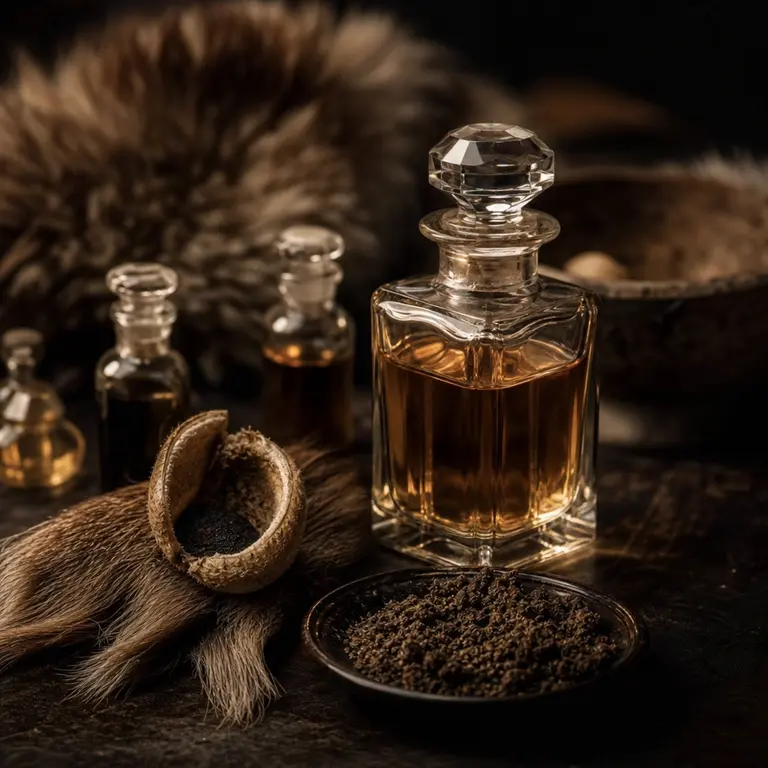
Before the late nineteenth century, the most prized perfumes in the world were built on a foundation of animal suffering and biochemical accident. The fixatives and base notes that gave fine fragrances their lasting, skin-warming depth came almost entirely from four animal sources: musk from the Siberian musk deer, civet paste from the African civet cat, castoreum from North American beavers, and ambergris from the sperm whale. These were not minor ingredients. They were the architectural skeleton of every serious perfume produced in Europe and the Islamic world for over a thousand years.
To understand why these substances were so prized, it helps to understand what a fixative does. A fragrance is not a single smell but a timed sequence of evaporating molecules. The top notes — the first impression of citrus or green or spice — vanish within minutes. The heart notes follow, lasting perhaps an hour. The base notes are what remain on skin after several hours, and without a fixative to bind and slow the evaporation of those base molecules, even the finest composition would disappear before noon. Animal secretions, with their complex fatty acid and steroid profiles, performed this function with an effectiveness that no plant-derived material could match. They also contributed something harder to define: a warmth, an animalic resonance, a quality perfumers described as making a fragrance smell alive. Understanding this is essential to understanding why the industry pursued these materials so relentlessly, and why their eventual loss was experienced not merely as an ethical correction but as a genuine creative crisis.
The Musk Deer and the Economics of Scarcity
The musk deer, Moschus moschiferus, is a small, fang-bearing ungulate found across the Himalayan and Siberian highlands. It is an unusual creature in several respects. Unlike most deer, it lacks antlers, and the males bear a pair of elongated canine teeth that protrude visibly below the jaw, giving the animal an appearance quite unlike the graceful herbivores most people associate with the family. The musk itself is produced in a glandular pod near the male deer’s abdomen, apparently as a sexual attractant during breeding season. A single pod yields roughly 25 to 30 grams of raw musk, and obtaining it almost invariably required killing the animal. Extraction from a living animal was technically possible but rarely practiced, as the trapping-and-slaughter method was simply more economical at scale.
By the mid-twentieth century, demand had driven the species to near-collapse. Estimates suggest that for every gram of musk reaching the European market, three to five deer died in the harvest and transport process, a figure that accounts not only for deliberate kills but for the extraordinarily high mortality rates among animals caught in crude snare traps and transported long distances under poor conditions. The perfume trade was not the only pressure on the species — traditional Chinese and Tibetan medicine also consumed significant quantities of musk pod — but European demand amplified the crisis considerably. At the height of the trade in the early twentieth century, hundreds of thousands of deer were being killed annually across Central Asia, and local populations in accessible highland regions had been effectively extirpated.
What makes this history particularly striking is that musk was simultaneously one of the most expensive raw materials in perfumery and one of the most adulterated. Because genuine musk pods commanded extraordinary prices, the supply chain was riddled with fraud. Pods were weighted with lead shot. Dried blood and animal tissue were pressed into counterfeit pods and sold to European importers who lacked the expertise to distinguish them from authentic material. The perfume houses of Grasse and Paris employed specialist buyers whose sole function was to authenticate incoming musk shipments, and even they were routinely deceived. The entire supply chain, from Himalayan trapper to Parisian perfumer, operated in a fog of uncertainty about what was actually being traded.
Civet, Castoreum, and the Chemistry of Animal Secretions
Civet paste, extracted from the perineal scent glands of Civettictis civetta, presents one of perfumery’s more unsettling paradoxes. In its raw state, civet smells overwhelmingly fecal, a consequence of its high concentration of skatole and indole, compounds produced by bacterial decomposition of tryptophan. At extreme dilution, however, these same molecules transform into something warm, animalic, and deeply compelling to the human nose. Perfumers in the seventeenth and eighteenth centuries discovered this threshold effect empirically, long before organic chemistry could explain it. The transformation is not merely a matter of intensity. At high concentrations, skatole activates olfactory receptors in a pattern the brain interprets as waste and danger. At low concentrations, the same molecule activates a partially overlapping but distinct receptor pattern that reads as intimate, warm, and animal. This is one of the more counterintuitive facts in the science of olfaction, and it helps explain why so many classical perfumes contain trace quantities of materials that would be deeply unpleasant in isolation.
Ethiopian civet farms, which kept animals in small cages and extracted the paste every nine to fourteen days through a process that caused significant stress and injury to the animals, supplied much of Europe’s demand through the 1980s. The farming operation was not a modern development. Civets had been kept and harvested in Ethiopia for centuries, and the trade was well established by the time Portuguese traders encountered it in the sixteenth century. What changed in the twentieth century was scale. Industrial demand from the fragrance industry transformed what had been a cottage trade into an intensive operation involving thousands of animals kept in conditions that animal welfare investigators described as severely inhumane.
Castoreum, the yellowish secretion from beaver castor sacs, occupies a somewhat different position in the history of animal-derived materials. Its chemical composition is remarkably complex, containing phenols, salicylaldehyde, castoramine, and dozens of additional compounds whose individual contributions to the overall odor profile remain incompletely characterized. It was used not only in perfumery but in eighteenth-century medicine as an alleged treatment for hysteria and headache, a use that persisted in European pharmacopeias well into the 1800s. The medicinal rationale was largely speculative, rooted in humoral theory rather than empirical observation, but castoreum’s presence in the pharmacopeia gave it a dual-market legitimacy that sustained demand even as its perfumery applications began to decline. The FDA still lists castoreum as generally recognized as safe for use as a food flavoring, where it appears under the euphemistic designation natural flavoring. It is occasionally used today in vanilla and raspberry flavor compounds, though in vanishingly small quantities, making its practical contribution to the modern food supply essentially negligible.
Ambergris occupies a different category entirely. Formed in the intestines of sperm whales around indigestible squid beaks, it is expelled into the ocean and undergoes years of oxidation and solar exposure before washing ashore. Fresh ambergris smells of feces. Aged ambergris, after years or even decades of weathering, develops a complex, marine, slightly sweet odor that perfumers describe as uniquely capable of extending and blending other scents. The transformation is driven primarily by oxidation of ambrein, a triterpene alcohol, into a suite of secondary compounds including ambroxide, the molecule most responsible for the characteristic aged ambergris odor. A single piece found on a New Zealand beach in 2021 was estimated to be worth over NZD 100,000. The key active molecule, ambroxide, was eventually synthesized in the 1950s and is now produced industrially, though natural ambergris retains a legal and commercial status that the synthetic version cannot match.
The Synthetic Revolution and Its Unexpected Toxicology
The first synthetic musk was discovered accidentally in 1888 by Albert Baur, a German chemist attempting to improve upon the explosive properties of trinitrotoluene. He noticed that one of his nitroaromatic byproducts had a powerful musk-like odor, and within a decade, nitromusks including musk ambrette, musk tibetene, and musk moskene were flooding the fragrance industry. They were cheap, stable, and did not require killing anything. The industry embraced them with enthusiasm, and for several decades the synthetic musk revolution appeared to be an uncomplicated success story: a case where chemistry had cleanly solved a problem that ethics and ecology had made urgent.
The toxicological consequences took nearly a century to fully materialize. Musk ambrette was found to be a potent photoallergen, causing severe skin reactions in sunlight, and was banned by the International Fragrance Association in 1985. More troublingly, several polycyclic musks developed in the 1950s as replacements, particularly musk xylene and musk tibetene, were later identified as persistent bioaccumulative toxicants. They concentrate in human fatty tissue, breast milk, and river sediment. Studies published in the early 2000s detected musk xylene in the blood of over 90 percent of tested individuals in industrialized nations who had never knowingly been exposed to it as an isolated compound. The ubiquity of the contamination was itself a measure of how thoroughly synthetic musks had penetrated the consumer product supply chain, appearing not only in fine fragrance but in laundry detergents, fabric softeners, shampoos, and cleaning products.
Galaxolide and Tonalide, the two most widely used synthetic musks today, are now classified as endocrine-disrupting compounds at environmentally relevant concentrations. They pass largely untreated through conventional wastewater facilities and have been detected in Arctic marine mammals and freshwater fish thousands of kilometers from any point source of contamination. The irony is considerable. The synthetic musks were developed in part to protect wildlife from the consequences of natural musk extraction. They have instead introduced a different and, in some respects, more pervasive form of environmental harm, one that is distributed across entire ecosystems rather than concentrated in the highland habitats of a single ungulate species.
The Present State: Regulation, Revival, and Bioengineering
The CITES appendices now protect the Siberian musk deer, the African civet, and the sperm whale, effectively banning commercial trade in their secretions across most of the world. Yet the regulatory landscape for synthetic replacements remains fragmented and inconsistent. The International Fragrance Association’s IFRA standards are voluntary, and enforcement varies enormously by jurisdiction. Some of the most problematic synthetic musks remain widely used in markets where regulatory pressure is limited. The European Chemicals Agency added several polycyclic musks to its substances of very high concern list in 2023, accelerating pressure on manufacturers to find alternatives, but the timeline from regulatory designation to actual phase-out in consumer products has historically been measured in decades rather than years.
The most promising direction is biotechnology. Companies including Ginkgo Bioworks and Givaudan have invested in fermentation-based production of ambroxide and muscone, the key odorant molecule in natural musk, using engineered yeast strains. Ambroxide produced through microbial fermentation was commercially available by 2022, carrying a significantly lower environmental footprint than petrochemical synthesis. A 2023 paper in the journal ACS Synthetic Biology demonstrated successful muscone production in Saccharomyces cerevisiae at yields approaching industrial viability. The appeal of this approach extends beyond environmental credentials. Fermentation-derived molecules can, in principle, be produced with greater purity and consistency than either natural extracts or petrochemical synthetics, and the production process can be scaled or modified without the geographic and ecological constraints that have limited natural sourcing.
Conclusion: A Recurring Pattern
The history of perfumery’s raw materials is, in miniature, the history of industrial modernity’s relationship with the natural world: extraction followed by crisis, crisis followed by synthetic substitution, substitution followed by the slow discovery of unforeseen harms, and finally the tentative arrival of biotechnology as a potential escape from the cycle. Each transition was presented at the time as a solution. Each solution carried consequences that were not apparent until years or decades later, by which point the industry had built new dependencies that made rapid change difficult.
Whether engineered microbes represent a genuine departure from this pattern or merely its next iteration remains an open question. The history surveyed here offers reasons for both cautious optimism and structural skepticism. What it does not offer is any basis for the assumption that the problem has been solved, or that the elegance of a fragrance on skin has ever been, or is now, a simple thing.
Sources & Further Reading
- Donkin, R.A. Dragon's Brain Perfume: An Historical Geography of Camphor. Brill, 1999.
- Tucker, Arthur O. and Thomas DeBaggio. The Encyclopedia of Herbs: A Comprehensive Reference to Herbs of Flavor and Fragrance. Timber Press, 2009.
- Berenstein, Nadia. 'Flavor Added: The Sciences of Flavor and the Industrialization of Taste in America.' University of Pennsylvania Dissertation, 2018. https://repository.upenn.edu/dissertations/AAI10683365
- ACS Synthetic Biology. 'Microbial Production of Muscone and Macrocyclic Musks.' American Chemical Society, 2023. https://pubs.acs.org/journal/asbcd6