
Redefining Parasitism: The Evolutionary Tale of Sacculina
Sacculina carcini, a barnacle-derived parasite, hijacks crabs so completely it erases their biological sex and turns males into surrogate mothers — a feat of evolutionary manipulation unlike almost anything else on Earth.
Introduction
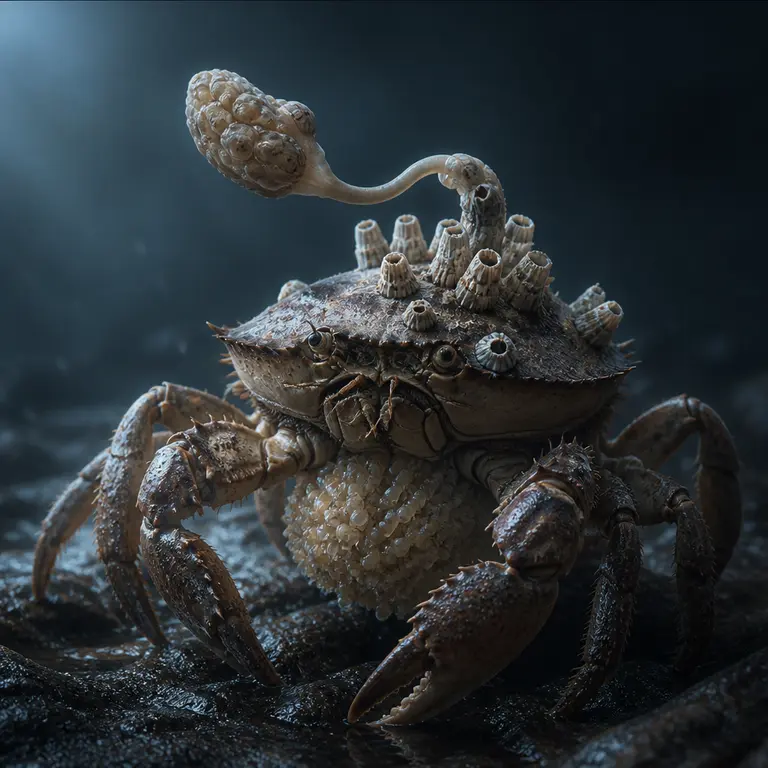
At first glance, Sacculina carcini looks nothing like a barnacle. It produces no shell, no feeding appendages, no recognizable body plan. What it does produce is a network of root-like tendrils that infiltrate every organ of a living crab, and a small external sac dangling beneath the host’s tail — the only visible sign that something has gone catastrophically wrong inside. Yet Sacculina belongs to the class Cirripedia, the same group as the familiar barnacles cemented to harbor pilings worldwide. Its ancestors were filter-feeders with recognizable limbs, shells, and the basic body architecture shared by shrimp, lobsters, and crabs. Somewhere across roughly 300 million years of evolution, an ancestral barnacle lineage abandoned free-living existence entirely and became one of the most sophisticated biological parasites ever documented.
The transformation is so complete that 19th-century naturalists who first encountered Sacculina had no idea what they were looking at. It was not until 1836 that the Danish zoologist Johannes Japetus Steenstrup began piecing together the developmental evidence suggesting that these strange, rootlike organisms were crustaceans at all. The larvae, it turned out, were unmistakably barnacle-like in their early stages, before the parasite’s life cycle takes its extraordinary turn. That larval window is the only moment in which Sacculina resembles anything like its evolutionary heritage. Everything that follows is a study in biological reinvention so thorough it borders on the unrecognizable.
The lifecycle begins when a free-swimming Sacculina larva, called a kentrogon, lands on a crab and injects a mass of cells through a joint in the host’s exoskeleton using a hollow stylet. This cellular injection — smaller than a grain of sand — is the entire future parasite. It migrates through the crab’s bloodstream, eventually anchoring near the digestive gland and erupting outward through the abdomen wall to form the externa, the external reproductive sac. From there, the parasite extends its interna, a branching root system that permeates the crab’s tissues like mycelium through soil, drawing nutrients and simultaneously issuing chemical signals that begin rewriting the host’s biology from the inside out. The crab does not die from this process, at least not immediately. Instead, it is transformed into something that serves Sacculina’s purposes more completely than any external predator or environmental pressure could manage.
Erasing Sex: The Feminization of Male Crabs
What Sacculina does to male crabs is among the most radical examples of parasitic host manipulation in the animal kingdom. Within weeks of successful infection, male crabs begin exhibiting physiological and behavioral changes associated with females of their species. The parasite chemically suppresses the androgenic gland responsible for male hormone production, causing the host’s body to feminize along a trajectory that mirrors normal female development. The male’s narrow abdomen — a trait that distinguishes him from the broader-tailed female — begins to widen over successive weeks. The small pleopods, the swimming legs on the underside of the abdomen that are vestigial in males, begin to grow larger and eventually resemble those of a gravid female ready to carry eggs.
The anatomical changes are striking enough on their own, but the behavioral transformation is what has made Sacculina so fascinating to researchers in parasitology and behavioral ecology. When Sacculina releases its own eggs into the externa sac, the infected male crab performs precisely the same grooming and fanning behaviors a healthy female would use to aerate a clutch of her own eggs. He waves his pleopods rhythmically over the parasite’s reproductive sac, oxygenating Sacculina’s offspring as if they were his own genetic investment. He defends the sac against disturbance. He orients his body in the water column to maximize current flow over the eggs, exactly as uninfected females do during brooding.
Researchers at institutions including the Station Biologique de Roscoff in France have documented that these males respond to Sacculina’s egg release with the same hormonal cascade that triggers maternal behavior in uninfected females. The parasite has not merely hijacked a body — it has reprogrammed a mind. The crab’s own neurological hardware executes these behaviors, but the instructions are chemical, and they originate entirely from the organism that wraps around its organs. In this sense, the male crab becomes a foster parent to a parasite’s offspring, devoting the remainder of its life to a clutch of eggs that shares none of its DNA and will eventually go on to infect other crabs in the same manner.
Reproductive Castration and the Evolutionary Logic of Control
Sacculina does not kill its host, at least not quickly. That restraint is deliberate in an evolutionary sense, even if evolution operates through selection rather than intention. A dead crab provides nothing; a living crab provides a perpetual nutrient stream and a behavioral servant capable of performing complex tasks on the parasite’s behalf. To maintain this arrangement indefinitely, Sacculina first renders the crab reproductively sterile — a process called parasitic castration — by destroying or suppressing the host’s own gonads. In females, the ovaries are absorbed entirely into the parasite’s nutrient supply. In males, the testes atrophy until they are functionally inert. Neither sex will ever reproduce again. All energy that would have gone into the crab’s own offspring is redirected toward feeding and protecting Sacculina’s reproductive output.
The suppression of molting is equally strategic. Crustaceans grow by periodically shedding their exoskeleton, a process called ecdysis that requires enormous metabolic investment and leaves the animal temporarily vulnerable. Sacculina suppresses this process entirely, because a new exoskeleton would physically dislodge the externa and sever the parasite’s connection to the host. By halting molting, Sacculina locks itself permanently into place and simultaneously frees the crab from one of the most energetically demanding aspects of crustacean biology. The crab’s physiology stabilizes. Its metabolic demands decrease. Its lifespan, paradoxically, may extend.
This strategy is so effective that infected crabs actually live longer than many uninfected individuals under certain conditions. Studies published in the Journal of Experimental Marine Biology and Ecology have found that Sacculina-infected shore crabs (Carcinus maenas) show measurably reduced mortality from environmental stressors compared to uninfected crabs, not because they are healthier in any meaningful sense, but because their physiology has been simplified and stabilized under the parasite’s chemical governance. The crab has been converted from a reproducing individual into a biological platform optimized for long-term parasite support. From Sacculina’s perspective, this is an elegant solution. From the crab’s perspective, there is no longer a meaningful perspective to speak of.
What Sacculina Reveals About Parasitism as an Evolutionary Strategy
The case of Sacculina has become a touchstone in the field of evolutionary parasitology because it illustrates how far natural selection can push an organism away from its ancestral form when a sufficiently exploitable host is available. The parasite has lost eyes, limbs, a digestive system, and virtually all morphological complexity over its evolutionary history. It retains only the machinery needed to locate a host, penetrate it, extract nutrients, and reproduce. This reductive evolution — sometimes called degenerative evolution, though the term carries an unfair connotation, since the organism is extraordinarily well adapted to its niche — is not unique to Sacculina. Tapeworms have lost their digestive systems. Certain parasitic plants have lost photosynthesis. Endoparasitic fungi have reduced themselves to little more than reproductive structures embedded in host tissue. But few organisms demonstrate the process as dramatically or as completely as Sacculina, which has essentially become a living abstraction of parasitism itself.
More broadly, Sacculina raises genuinely uncomfortable questions about the concept of individuality in biology. When a crab is infected, which organism is in control of the crab’s behavior? The crab’s own nervous system executes the fanning movements, but the chemical instructions originate from the parasite. The crab’s muscles perform the brooding behaviors, but the signals that trigger them are foreign. The crab is, in a meaningful sense, both itself and not itself simultaneously. Philosopher of biology Kim Sterelny and others working on extended phenotype theory — a framework developed by Richard Dawkins in 1982 — have used examples such as Sacculina to argue that an organism’s phenotype can extend into and through other organisms entirely. The crab’s body becomes, in this framing, part of Sacculina’s phenotype as much as its own. The crab’s behavior is Sacculina’s adaptation, expressed through borrowed tissue.
This has implications that reach beyond the philosophical. If parasites can evolve to control host behavior with such precision, then the chemical mechanisms they use to do so represent millions of years of biochemical refinement targeting specific hormonal and neural pathways. Current research is exploring whether the compounds Sacculina uses to suppress molting and reprogram reproductive behavior could offer insights into crustacean endocrinology with practical applications in aquaculture. Shrimp and lobster farming suffer significant yield losses due to molting-related mortality and stress responses. Understanding the molecular signals a parasite evolved over hundreds of millions of years to control these processes may, in an ironic turn, help humans manipulate the same pathways for commercial benefit.
Conclusion
Sacculina carcini began its evolutionary journey as a barnacle — a filter-feeder clinging to rocks and ship hulls, unremarkable in the vast catalogue of marine invertebrates. What it became is something that challenges basic assumptions about what an organism is, where one body ends and another begins, and how far natural selection can drive biological transformation when the conditions are right. It is a parasite that feminizes males, suppresses reproduction, halts development, and commandeers the behavioral repertoire of its host so thoroughly that the host spends its remaining life caring for another species’ offspring. It has shed nearly everything that made its ancestors recognizable and retained only what was necessary to exploit a single ecological relationship with devastating efficiency.
There is something instructive in this, beyond the immediate strangeness of the biology. Evolution does not preserve complexity for its own sake. It preserves what works and discards what does not, regardless of how elaborate or simple the result may be. Sacculina is not a lesser barnacle. It is a barnacle that found a different way to survive, one that required abandoning almost everything its lineage had built over hundreds of millions of years. That it succeeded so completely — that it can be found today in tidal zones across Europe, the Americas, and beyond, quietly converting crabs into unwitting nursemaids — is a reminder that the most successful strategies in nature are not always the most intuitive ones, and that the line between organism and environment, between self and other, is far more negotiable than it appears.
Sources & Further Reading
- Høeg, J.T. and Lützen, J. 'Life Cycle and Reproduction of the Cirripedia Rhizocephala.' Oceanography and Marine Biology: An Annual Review, 1993.
- Glenner, H., Høeg, J.T., Stenderup, J., and Rybakov, A.V. 'The Monophyletic Origin of a Remarkable Sexually Dimorphic Cirripede Parasite, Sacculina.' Experimental Parasitology, 2010. https://doi.org/10.1016/j.exppara.2010.01.011
- Smith, G. 'Rhizocephala.' Fauna und Flora des Golfes von Neapel, 1906. (Historical foundational monograph on Sacculina biology)
- Dawkins, R. The Extended Phenotype. Oxford University Press, 1982.