
The Egg Mountain Discovery: Transforming Dinosaur Science
Discoveries at Egg Mountain in Montana have revealed that some dinosaurs brooded their nests communally and showed prolonged parental care — overturning decades of assumptions about reptilian indifference to offspring.
Introduction
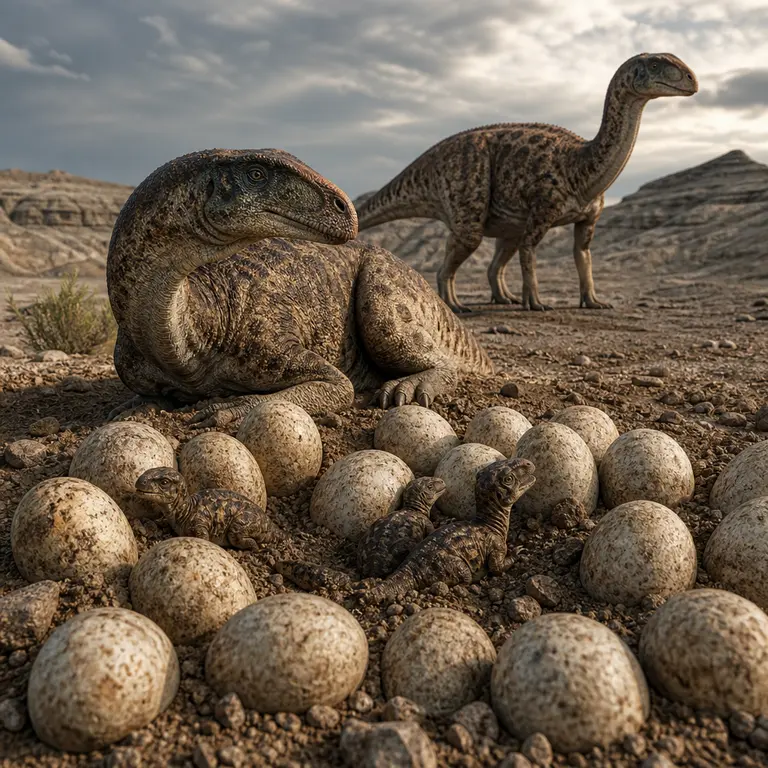
In 1978, a fossil hunter named Marion Brandvold walked into a rock shop in Bynum, Montana, carrying fragments of tiny dinosaur bones. She brought them to paleontologist Jack Horner, who recognized something extraordinary: these were baby dinosaurs, too underdeveloped to have left the nest on their own. The site she had found, later named Egg Mountain, would become one of the most consequential paleontological discoveries of the twentieth century. For the first time, scientists had physical evidence that at least some dinosaurs did not simply lay eggs and abandon them. They stayed. They fed their young. They lived in structured social groups organized around reproduction.
The species responsible was Maiasaura peeblesorum, a hadrosaur whose name Horner coined from the Greek for “good mother lizard.” But the implications stretched far beyond one species. Egg Mountain contained not just nests but entire nesting colonies, with clutches spaced roughly an adult body width apart, suggesting deliberate communal organization. Some hatchlings showed worn tooth surfaces, indicating they had been eating solid food while still in the nest — food that had to have been brought to them by adults. In a single field season, the image of the dinosaur as a cold, instinct-driven creature that reproduced and moved on began to crack apart.
What followed was decades of excavation, laboratory analysis, and theoretical debate that collectively transformed paleontology’s understanding of dinosaur behavior, physiology, and social complexity. The story of Egg Mountain is not simply a story about one nesting site. It is a story about how a single discovery can force an entire scientific discipline to reconsider assumptions it did not even know it was making.
What the Bones Actually Reveal
The evidence at Egg Mountain is unusually granular, and its value lies precisely in the specificity of what the fossils preserve. Embryonic Maiasaura bones show that hatchlings were born with poorly ossified joints, meaning their limbs were not yet hardened enough to support sustained locomotion. This is a key diagnostic marker in reconstructing post-hatching behavior. Modern reptiles that abandon their eggs tend to produce hatchlings with fully formed, load-bearing limbs almost immediately after birth, because survival depends on independent mobility from the first moments of life. The underdeveloped state of the Maiasaura young implies something very different: a period of nest-bound dependency lasting weeks to months, analogous in some respects to altricial birds such as songbirds, whose helpless hatchlings require continuous parental feeding before they are capable of independent movement.
The nests themselves measured roughly two meters in diameter and were constructed in shallow depressions, with eggs arranged in circular layers. This geometry was not accidental. The deliberate arrangement of eggs suggests active nest construction rather than opportunistic egg deposition, and the spacing between nests across the colony — consistently maintained at approximately one adult body length — points to a level of spatial awareness and social coordination that researchers had not previously attributed to ornithischian dinosaurs.
Perhaps the most telling physical detail is the condition of the eggshell material found within the nests. Rather than intact shells concentrated at the edges of the nest where they might have rolled after hatching, researchers found crushed and distributed shell fragments throughout the nesting substrate. Hatchlings moving around inside the nest over days and weeks would produce exactly this pattern of dispersed debris. Intact shells at the periphery would suggest rapid abandonment; what Egg Mountain shows instead is evidence of extended occupation. Sedimentary analysis reinforces this interpretation by indicating that the site was revisited across multiple seasons, pointing toward site fidelity — a behavior seen today in colonial nesting birds like herons and penguins, which return to the same nesting grounds year after year and often to the same individual nest locations.
Hypacrosaurus and the Disturbing Side of Dinosaur Development
More recent work at a separate site in Alberta has added a stranger and more troubling dimension to the picture of dinosaur parenting. Hypacrosaurus stebingeri, another hadrosaur closely related to Maiasaura, left behind bonebeds containing embryos at various developmental stages. A 2020 study published in Nature Communications examined neural tissue preserved in these embryos using synchrotron imaging — a technique that uses high-intensity X-ray beams to produce three-dimensional maps of internal structure without destroying the specimen — and found that the brain and inner ear structures were already partially developed before hatching. More significantly, the study revealed that growth rates during late incubation were extraordinarily fast, comparable to those seen in modern birds.
Hypacrosaurus embryos appear to have doubled in size every few weeks during the final stages of development. This rapid pace came with a measurable biological cost. The cartilage in the embryos showed early signs of a condition resembling osteochondrosis, a developmental joint disease in which tissue outpaces its own blood supply during periods of accelerated growth. In other words, some dinosaur embryos were growing so fast they were effectively injuring themselves before they had even hatched. The joints were forming faster than the vascular network could support them, leaving regions of cartilage without adequate nutrition.
Whether adults compensated for this fragility through extended post-hatching care remains an open question, but the finding reframes dinosaur development in a significant way. Rather than a passive biological process governed by environmental incubation conditions, dinosaur embryonic development now appears to have been a high-stakes physiological gamble — one that maximized growth speed at the expense of structural integrity, and that may have created hatchlings even more dependent on parental care than the Maiasaura evidence alone suggested. The parallel to certain fast-growing modern bird species, which also show developmental vulnerabilities linked to rapid growth, is striking and continues to attract research attention.
Rethinking the Reptile-Bird Divide
The parenting behaviors inferred from these sites sit at the center of a broader and still unresolved debate about where non-avian dinosaurs fall on the physiological spectrum between ectothermic reptiles and endothermic birds. The question matters because metabolism and behavior are not independent variables. An animal’s capacity for sustained parental investment is constrained by its energy budget, and its energy budget is shaped by whether it generates heat internally or depends on external sources.
Modern crocodilians — the closest living reptilian relatives of dinosaurs — do exhibit nest guarding and even assist hatchlings in reaching water after hatching, but they do not provision food to young after the nest stage. Their parental investment ends at the threshold of independent mobility. Modern birds, which are themselves descended from theropod dinosaurs, show the full range of parental investment, including active feeding, brooding for warmth, and in some species extended periods of behavioral instruction. The Maiasaura evidence suggests that at least some ornithischian dinosaurs, despite being on a separate evolutionary branch from the theropods that gave rise to birds, had independently evolved a level of parental investment closer to the avian end of the spectrum.
This convergence has implications for understanding dinosaur thermoregulation that go beyond the nesting evidence itself. Sustained parental provisioning requires significant caloric expenditure and implies a metabolism capable of supporting that cost over extended periods. Some researchers have argued that the nesting colony evidence at Egg Mountain constitutes one of the strongest behavioral arguments for at least partial endothermy in large hadrosaurs — not derived from bone chemistry, growth ring analysis, or isotopic studies, but from the simpler and more direct logic of what the fossils show these animals were actually doing. Behavior, in this view, becomes a window into physiology.
Egg Mountain Today and the Ongoing Excavation
Excavations at Egg Mountain have continued intermittently for over four decades, and the site continues to produce new findings that complicate and enrich the original picture. A 2022 field season led by researchers from the Museum of the Rockies uncovered new nesting horizons below the original discovery layer, suggesting the site was used across multiple geological time intervals, potentially spanning thousands of years. The vertical depth of nesting activity implies that Egg Mountain was not a one-time congregation but a persistent feature of the Late Cretaceous landscape — a place that generations of Maiasaura returned to for reasons that were likely embedded in learned behavior passed from adults to offspring over time.
Microvertebrate screening of sediment from the site has also recovered the remains of small mammals, lizards, and early birds that shared the nesting environment, offering a rare and detailed snapshot of an entire Late Cretaceous ecosystem organized around a single behavioral phenomenon. The presence of these smaller animals raises additional questions about the ecological dynamics of the nesting colony. Were they scavengers exploiting abandoned eggs or shell debris? Predators drawn by the concentration of vulnerable hatchlings? Incidental inhabitants of the same habitat? The answers remain incomplete, but the questions themselves illustrate how much information a single well-preserved site can generate across multiple fields of inquiry.
Conclusion
Egg Mountain remains one of only a handful of locations worldwide where dinosaur nesting behavior can be studied at a population level rather than reconstructed from isolated specimens. The site has driven revisions not only in how scientists understand dinosaur parenting but in how they think about dinosaur metabolism, social organization, and the evolutionary continuity between non-avian dinosaurs and modern birds. What began as a rock shop curiosity in rural Montana — a handful of small bones that a fossil hunter thought might be worth something — became the foundation for an entirely revised understanding of how some of the largest animals that ever walked the Earth raised their young. That revision is still ongoing, and Egg Mountain is still giving up its secrets one field season at a time.
Sources & Further Reading
- Horner, J.R. and Makela, R. Nest of juveniles provides evidence of family structure among dinosaurs. Nature, 1979. https://www.nature.com/articles/282296a0
- Woods, A.D. et al. Rapid growth and developmental anomalies in Hypacrosaurus embryos. Nature Communications, 2020. https://www.nature.com/articles/s41467-020-15030-4
- Horner, J.R. and Gorman, J. Digging Dinosaurs. Workman Publishing, 1988.
- Museum of the Rockies. Egg Mountain Research Updates. Montana State University. https://www.museumoftherockies.org