
Ikaite: The Fragile Crystal Shaping Climate Science
Ikaite, a rare hydrated calcium carbonate mineral that only forms in near-freezing water, is dissolving across polar regions as temperatures rise — and the chemical ghost it leaves behind is rewriting how scientists read ancient climate records.
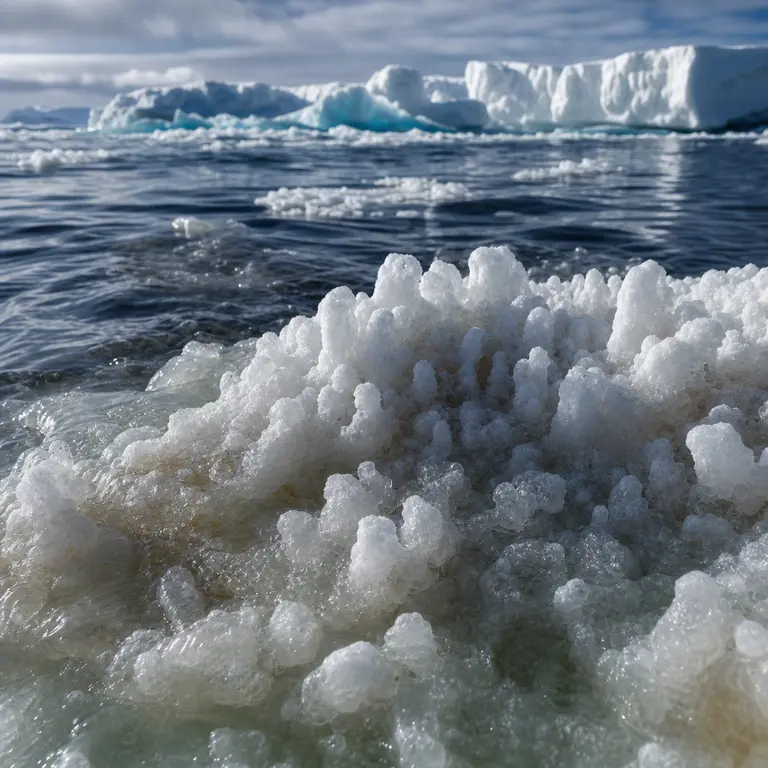
 Watch on YouTube
 Watch on Rumble
The Crystal That Cannot Survive Room Temperature
Most minerals are defined by their permanence. Granite endures for billions of years. Diamonds survive the pressures of deep planetary interiors. But ikaite — a hydrated form of calcium carbonate with the chemical formula CaCO3·6H2O — exists in a perpetual state of near-dissolution. Discovered in 1963 in the sediments of the Ika Fjord in Greenland, from which it takes its name, ikaite forms only in water temperatures hovering near 0°C. Bring a sample above roughly 4°C, and it begins to irreversibly decompose into calcite or vaterite and liquid water within minutes. Scientists studying it in the field have watched specimens crumble to powder on the walk back from a collection site.
This fragility is not merely a logistical inconvenience for researchers. It represents something philosophically unusual in the world of mineralogy: a naturally occurring solid that cannot exist under the conditions most humans experience as ordinary. The vast majority of minerals we encounter — from the quartz in beach sand to the feldspar in kitchen countertops — are thermodynamically stable across an enormous range of temperatures and pressures. Ikaite occupies a vanishingly narrow environmental niche, one that happens to overlap with some of the most climatically significant regions on Earth. Its instability, rather than disqualifying it from scientific interest, has made it one of the more consequential minerals in contemporary Earth science research.
A Crystal Perpetually on the Edge
The chemical structure of ikaite places it in the category of hydrated minerals, compounds in which water molecules are incorporated directly into the crystal lattice. In ikaite, six water molecules bond to each unit of calcium carbonate, and it is precisely this water that makes the mineral so sensitive to temperature. When heat is applied, those water molecules gain enough energy to escape the lattice, and the entire crystalline architecture collapses. The process is irreversible under ambient conditions, meaning there is no way to reconstitute the original ikaite once it has decomposed. What remains is either calcite or vaterite, both anhydrous forms of calcium carbonate that are stable at room temperature, along with a small puddle of released water.
This fragility made ikaite almost impossible to study for decades. Early researchers could observe it only through indirect chemical signatures in sediment cores, never holding a stable sample long enough to characterize it fully. Attempts to transport specimens from Arctic collection sites to laboratories consistently failed. The mineral would begin decomposing before it could be sealed into a cold container, leaving scientists with a wet residue and a mineralogical mystery. It was not until the development of cold-stage X-ray diffraction equipment in the 1990s that crystallographers could finally confirm its full atomic structure without triggering its collapse. These instruments enable diffraction analysis while the sample is held at near-freezing temperatures, providing scientists with a window into the crystal’s architecture without disturbing the thermal conditions that keep it intact. The mineral exists at the very edge of thermodynamic stability — a crystal perpetually on the verge of ceasing to be a crystal at all.
Polar Seas and the Unexpected Climate Archive
Ikaite does not merely exist in cold environments. It is actively produced in them, and at scales that matter enormously to Earth’s carbon cycle. Sea ice is one of its primary birthplaces. As seawater freezes, brine is expelled downward through tiny channels in the ice matrix. This concentrated, alkaline, cold brine creates ideal chemical conditions for ikaite to precipitate from solution as small rosette-shaped crystals embedded within the ice itself. Research published in Nature Geoscience in 2011 by Søren Rysgaard and colleagues at the Greenland Climate Research Center revealed that this process is far more widespread than previously recognized, occurring on a massive scale across Arctic and Antarctic sea ice.
The significance extends beyond mineralogy. When ikaite forms inside sea ice, it sequesters carbon dioxide from seawater. When the ice melts and the ikaite dissolves, that CO2 is released. The mineral, therefore, acts as a seasonal pump in the polar carbon cycle — one that had been almost entirely invisible to climate models because no one knew it existed at such a scale. Current estimates suggest that ikaite formation and dissolution in polar sea ice may influence the exchange of millions of tonnes of CO2 between ocean and atmosphere each year, though precise figures remain an active area of research.
What makes this discovery particularly striking is how recently it entered mainstream scientific awareness. The polar carbon cycle has been studied intensively for decades, yet a potentially significant component of it was hiding inside the ice itself, undetected because the evidence dissolved before anyone thought to look for it. The 2011 findings prompted a reassessment of how carbon flux models handle sea ice chemistry, and subsequent field campaigns in both the Arctic and Antarctic were organized specifically to quantify the ikaite contribution. The mineral had been present throughout these environments, forming and dissolving with the seasons, silently participating in planetary-scale chemistry without leaving any visible trace to conventional sampling methods.
The Ghost Mineral and What It Leaves Behind
Because ikaite decomposes so readily, ancient specimens almost never survive in the geological record. Instead, scientists find what geochemists call pseudomorphs — mineral replacements that preserve the original crystal’s shape while substituting a more stable compound in its place. Ikaite pseudomorphs, sometimes called glendonites or jarrowites depending on their regional variety, appear as distinctive star-shaped or spiky calcite formations in sedimentary rocks. They have been found in Cretaceous-age deposits in Siberia, Jurassic sediments in Antarctica, and Permian layers in Australia.
For over a century, these odd-shaped calcite formations puzzled geologists. Their angular, branching morphology looked nothing like typical calcite precipitation, which tends to form smooth, rounded, or rhombohedral shapes under most geological conditions. Various explanations have been proposed over the years, including unusual pressure conditions or biological influences, but none have fully accounted for the distinctive geometry. Once ikaite was identified as the precursor mineral in the twentieth century, glendonites became an extraordinary paleoclimate tool. Their presence in ancient rock layers is now interpreted as a reliable indicator of near-freezing bottom-water temperatures at the time of deposition.
A 2020 study in the journal Geology used glendonite distributions in Cretaceous Arctic sediments to argue that the Arctic experienced brief cold snaps even during the famously warm Cretaceous greenhouse period — a finding that complicates the prevailing model of a uniformly hot Mesozoic Earth and suggests the polar climate system was more dynamic than assumed. This kind of inference would have been impossible without understanding ikaite’s thermal constraints. The ghost of a mineral that no longer exists becomes, paradoxically, more informative than minerals that survived intact, because its very presence encodes a precise temperature range that few other geological indicators can match with equivalent specificity.
Ikaite as a Sentinel of Modern Climate Change
The same properties that make ikaite a window into ancient climates make it a sensitive indicator of present-day warming. Because the mineral forms only in a narrow temperature window, even modest increases in polar water temperatures can suppress its formation or accelerate its dissolution. Monitoring programs in the Weddell Sea and Baffin Bay have documented declining ikaite concentrations in sea ice brine over the past two decades, though attributing this directly to warming requires careful statistical separation from natural variability.
More provocatively, some researchers have proposed that as Arctic sea ice thins and its thermal properties change, the annual ikaite formation cycle could be disrupted, altering local ocean chemistry and potentially affecting the buffering capacity of polar surface waters against acidification. This feedback loop — where warming reduces ikaite formation, which changes CO2 dynamics, which may accelerate acidification — remains speculative and contested, but it illustrates why a mineral that dissolves in your hand has attracted serious attention from climate scientists. The chain of consequences, if confirmed, would represent a previously unrecognized mechanism by which physical changes in sea ice propagate into ocean chemistry and atmospheric carbon dynamics.
Ikaite is, in a sense, a living record of the planet's temperature, one that is currently being written in real time across the melting margins of both poles. It is a mineral that cannot be held, cannot be stored at room temperature, and cannot survive the journey from its birthplace to most laboratories without ceasing to exist. And yet it may be encoding information about planetary climate that no other substance can provide with quite the same precision or temporal range. From Jurassic Antarctica to the brine channels of modern Arctic sea ice, ikaite traces a continuous thread through Earth’s thermal history — fragile, fleeting, and irreplaceable.
Conclusion
There is something instructive about a mineral defined entirely by its limitations. Ikaite cannot survive warmth, cannot persist through geological time in its original form, and cannot be easily transported or preserved. In most scientific contexts, these would be disqualifying properties. Instead, they have made ikaite one of the more revealing substances in the Earth sciences, precisely because its instability is so calibrated and so consistent. A mineral that exists only below 4°C tells you something unambiguous whenever and wherever you find evidence of it, whether in a sediment core from the modern Arctic or in a slab of Permian rock from the Southern Hemisphere.
The story of ikaite is also a reminder of how much planetary chemistry operates beneath the threshold of human observation. For decades, a significant component of the polar carbon cycle has been conducting its seasonal business inside sea ice, entirely undetected by the scientists trying to model that very system. The mineral’s discovery and characterization did not merely add a footnote to mineralogy — it revealed a gap in the accounting of one of Earth’s most important biogeochemical processes. As warming continues to alter the polar regions faster than at any point in the instrumental record, understanding what ikaite is doing, where it is forming, and how its distribution is shifting may prove to be less a matter of academic curiosity than of practical necessity.
Sources & Further Reading
- Rysgaard, S., Glud, R.N., Sejr, M.K., et al. Inorganic carbon transport during sea ice growth and decay: A carbon pump in polar seas. Journal of Geophysical Research: Oceans, 2007.
- Rysgaard, S., Bendtsen, J., Delille, B., et al. Sea ice contribution to the air-sea CO2 exchange in the Arctic and Southern Oceans. Tellus B, 2011. https://doi.org/10.1111/j.1600-0889.2010.00512.x
- Dieckmann, G.S., Nehrke, G., Papadimitriou, S., et al. Calcium carbonate as ikaite crystals in Antarctic sea ice. Geophysical Research Letters, 2008. https://doi.org/10.1029/2008GL033540
- Farkas, J., Hendry, K.R., Bizzarro, M., et al. Glendonites as paleoclimate indicators in Cretaceous Arctic sediments. Geology, 2020.